
Nevada Canyon Gold: Royalties Without Production—Can Early-Stage Gold Exposure Deliver Shareholder Value?
Nevada Canyon Gold Corp. offers investors leveraged exposure to gold price upside through royalties and streams, but faces execution risks tied to non-producing assets, third-party operators, and ongoing financing needs. With a reported liquidity position but no current cash flow, the company’s future hinges on asset maturation, disciplined capital allocation, and the gold cycle.
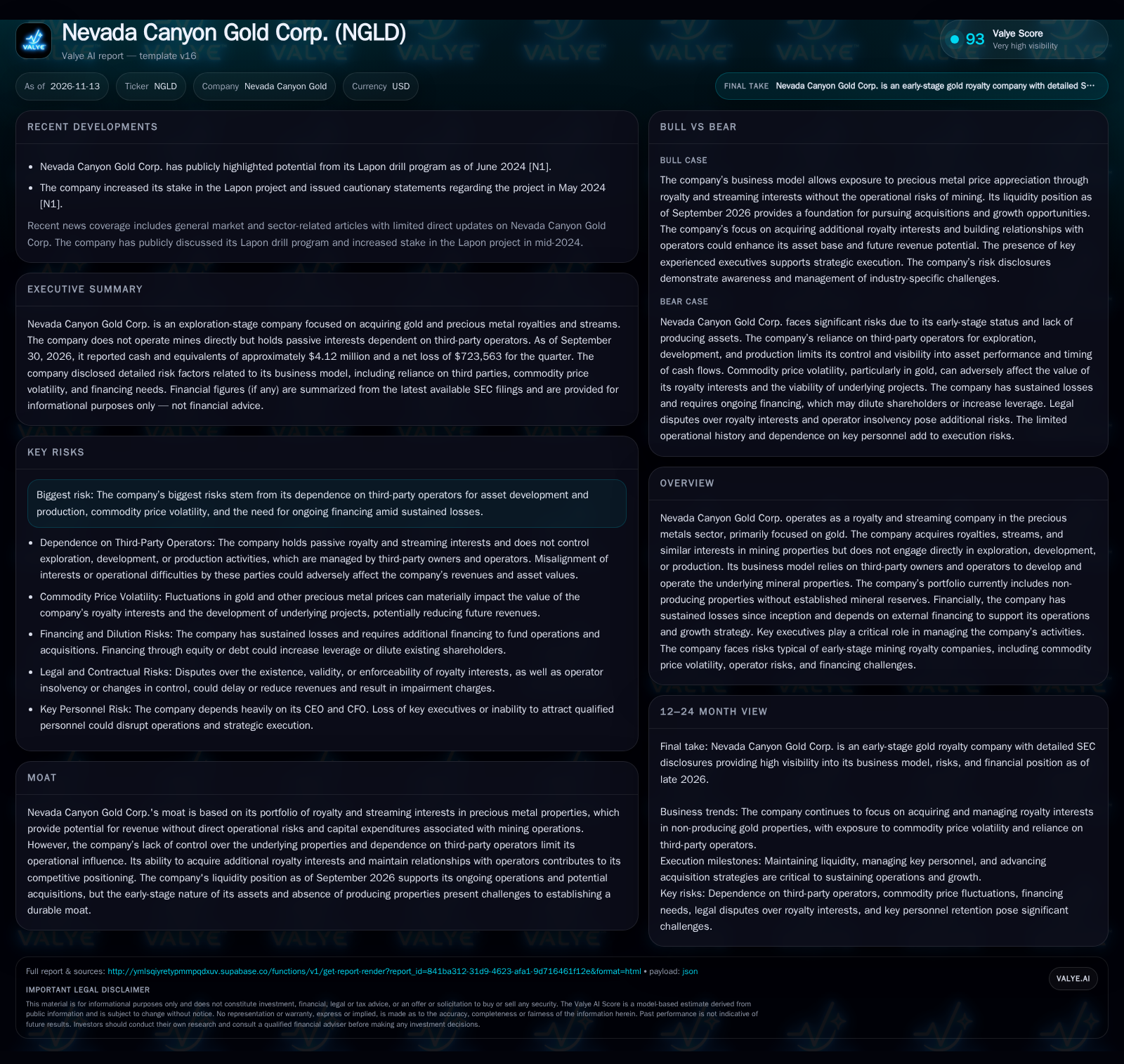
Nevada Canyon Gold Corp. holds only non-producing gold royalty and streaming interests, relies entirely on third-party operators, and has no current revenue. As of September 2026, it reported $4.12M in cash against $1.12M in current liabilities, but continues to post quarterly losses. The company’s success depends on converting its portfolio into producing assets, managing dilution and financing, and navigating gold price volatility. Execution by third-party operators and capital discipline are critical near-term levers. [S2]
Nevada Canyon Gold Corp. positions itself as a pure-play royalty and streaming company focused on gold and other precious metals, seeking to capture upside from commodity cycles without the operational risks of mining. Its future value proposition rests on the successful development of its underlying assets by third parties, prudent capital deployment, and favorable gold price trends—all against the backdrop of early-stage risk and limited operational control. Investors must weigh the appeal of gold-leveraged optionality against the challenges of asset maturation, dilution, and external dependency. [S2]
Portfolio Status: No Producing Assets, Reported Liquidity Position, and Continued Losses
As of September 30, 2026, Nevada Canyon Gold Corp. holds a portfolio of royalty and streaming interests exclusively in non-producing gold and precious metal properties, with none of its assets generating cash flow or possessing established mineral reserves. The company reported cash and liquidity metrics for the period; these figures do not by themselves establish operating runway, investment capacity, financial flexibility, or financing capacity. However, it posted a net loss of $723,563 for the quarter, reflecting ongoing negative operating leverage. The company remains entirely dependent on third-party operators for exploration and potential development, and will require additional capital to fund future activities and acquisitions. [S2]
How the Royalty Model Could Create Value—Or Burn Capital
Nevada Canyon Gold’s business model is designed to capture a percentage of future production or revenues from gold and precious metal properties through royalties and streams, without incurring the direct capital and operational risks of mine development. In theory, this structure offers highly attractive incremental margins once properties reach production, as royalty holders receive a fixed or variable portion of output or revenue with little ongoing cost. However, none of the company’s current interests are in production or contain proven reserves, so there is no near-term revenue or cash flow. As an early-stage royalty company, Nevada Canyon Gold’s economics are dominated by fixed costs—executive compensation, G&A, and acquisition spending—while any upside is deferred and highly uncertain.
The company’s ability to create value depends on acquiring royalty interests at attractive prices, seeing those assets progress toward production under third-party operators, and eventually collecting cash flow if and when production commences. Until then, the company must fund itself through equity or debt, risking shareholder dilution or increased leverage. As the business scales, operating leverage could be significant—royalty revenue typically flows with minimal incremental expense—but only if and when assets mature.
Royalties in a Crowded Field: Advantages, Constraints, and Substitution Threats
The royalty and streaming sector is intensely competitive, with established players and new entrants vying to secure interests in prospective mining projects. Nevada Canyon Gold’s theoretical advantage is exposure to commodity price upside without the operational and capital intensity of mining. However, the company faces several structural constraints. Its lack of producing assets and dependence on third-party operators for asset advancement diminishes its ability to influence timelines or outcomes. Larger royalty companies may have preferential access to high-quality projects, stronger operator relationships, and lower cost of capital.
The threat of substitutes is also material: investors can gain gold exposure through bullion, ETFs, mining equities, or physical funds, each with unique risk/reward and liquidity profiles. For Nevada Canyon Gold to stand out, it must build a portfolio that offers asymmetric upside, demonstrate disciplined capital allocation, and, over time, convert its interests into cash-generating assets. Until then, its competitive position remains largely prospective.
Unlocking Value: If Operators Advance Projects and Gold Prices Rise
The most favorable scenario for Nevada Canyon Gold is a confluence of accelerated development by third-party operators on its royalty properties and a supportive gold price environment. If even one or two of its underlying assets move into production or establish proven reserves, the company could see a step-change in revenue and cash flow, benefiting from the operating leverage inherent in the royalty model. A rising gold price would further magnify royalty revenues and asset values.
Confirmation of this scenario would come from third-party announcements of significant exploration success, resource delineation, or development milestones at properties where Nevada Canyon Gold holds interests. Early evidence might include operator-funded drill programs, positive feasibility studies, or permitting progress. The company’s ability to secure additional royalties in advanced-stage or near-production projects would also support this upside case.
Protracted Asset Maturation, Dilution Risk, and Portfolio Optionality
The most plausible intermediate outcome is a slow and uneven advancement of the company’s royalty portfolio. Given the early-stage nature of its assets and the long cycle times typical in mining, it is likely that Nevada Canyon Gold will continue to incur operating losses and rely on periodic equity or debt financings to fund operations and acquisitions. Shareholder dilution or increased leverage is a persistent risk until producing assets are secured.
Incremental progress could come in the form of asset de-risking—such as operators completing resource estimates or moving projects toward permitting—but meaningful revenue is unlikely in the near term. Evidence for this scenario would include continued losses, new royalty acquisitions in early-stage projects, and few or no producing interests added to the portfolio. [S2]
When Optionality Fails: Financing Strain and Asset Impairment
The adverse scenario emerges if the company’s underlying projects stall or are abandoned by operators, commodity prices weaken, or Nevada Canyon Gold is unable to secure needed financing. In this case, the company could face asset impairments, dwindling liquidity, and forced financing on unfavorable terms. Legal disputes over royalty validity, operator insolvency, or loss of key executives could accelerate downside outcomes.
This scenario would be confirmed by news of operator project suspensions, asset write-downs, unsuccessful capital raises, or rapid cash burn. An extended period without new producing assets or material project advancement would further validate the downside case, as would significant dilution or debt issuance under distressed conditions.
Milestones That Could Shift the Nevada Canyon Gold Thesis
Announcements by third-party operators of resource discoveries, feasibility studies, or construction starts on properties where Nevada Canyon Gold holds royalties would provide leading indicators of asset maturation.
Progress reports or updates on the Lapon project, especially those confirming resource delineation or permitting advances, would help assess the company’s near-term revenue potential, if disclosed.
Disclosure of new royalty or streaming acquisitions—particularly those with near-term production or advanced-stage characteristics—would signal capital allocation discipline and potential for earlier cash flow.
Capital-raising activity, including the terms and structure of equity or debt financings, would test management’s ability to preserve shareholder value and avoid excessive dilution or leverage.
Updates on executive retention, especially regarding CEO Alan Day and CFO Jeffrey Cocks, would help gauge continuity and strategic execution risk.
Regular disclosure of operator activity, expenditures, and project timelines (if provided) would enhance visibility into the company’s portfolio trajectory.
Changes in gold and precious metal prices, and their impact on the economic viability of underlying projects, would directly influence the value of Nevada Canyon Gold’s interests.
Legal or contractual developments related to royalty disputes, operator solvency, or changes in control of underlying properties would affect asset security and revenue timing.
Disclaimer: This is research-only, informational analysis and not investment advice. It may include AI-generated interpretation and general industry context. Always verify important details using primary sources.

Comments