
VS Trust’s SVIX: Navigating Volatility-Linked ETF Demand, Regulatory Friction, and Short-Term Trading Realities
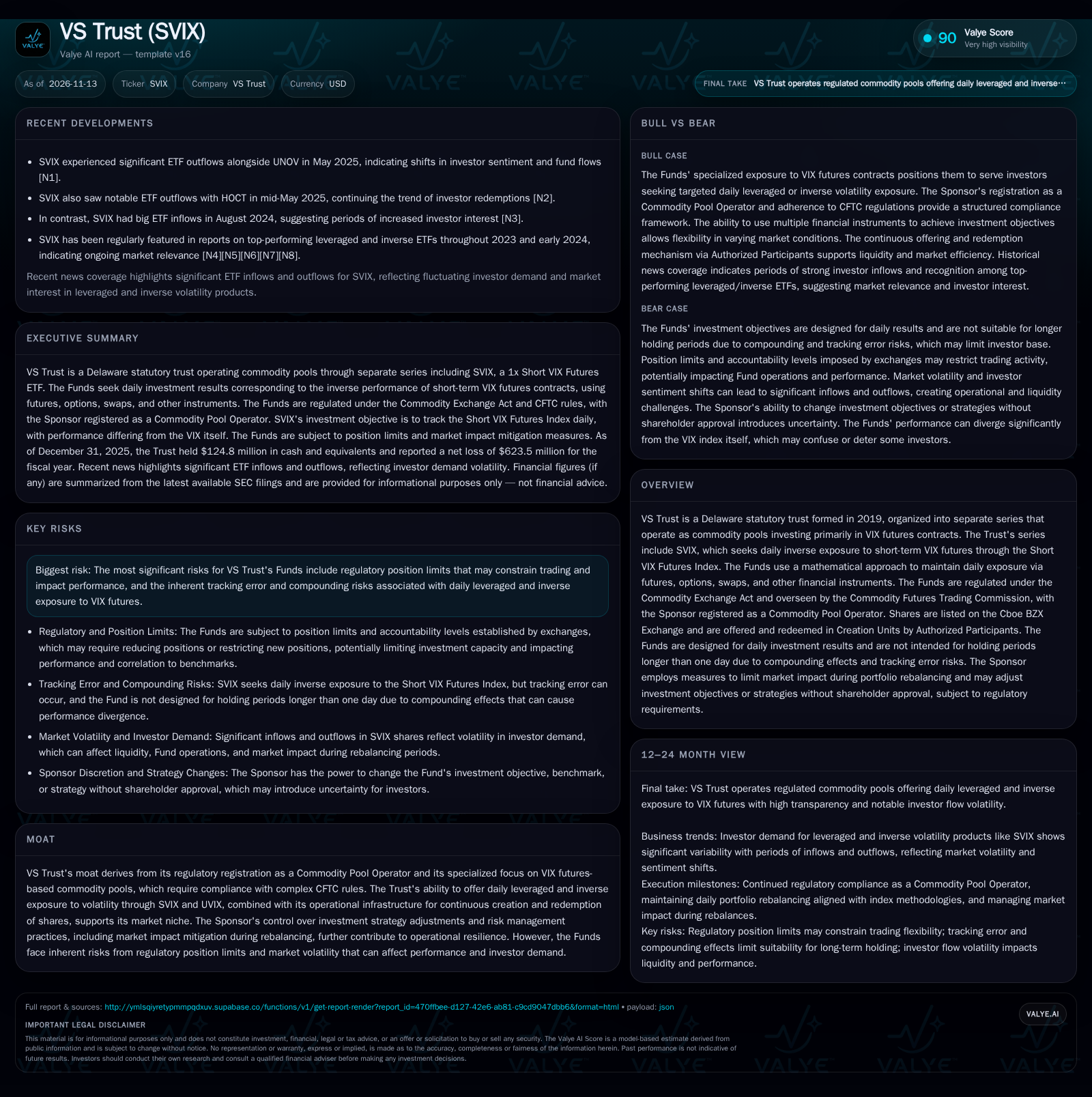
SVIX, the 1x Short VIX Futures ETF from VS Trust, offers daily inverse volatility exposure in a tightly regulated commodity pool structure. While recent fund flows reveal sharp swings in investor sentiment, SVIX’s business model is defined by compounding risks, regulatory position limits, and the operational challenge of tracking VIX futures indices in volatile environments.
SVIX delivers daily inverse exposure to short-term VIX futures, serving traders seeking to capitalize on declining volatility. The ETF’s structure and regulatory oversight provide a compliant, liquid vehicle for this niche, but position limits, tracking error, and volatile investor flows create persistent operational and strategic challenges. Recent periods of heavy inflows and outflows underscore the product’s sensitivity to market sentiment and the complexity of running a short-volatility ETF at scale.
VS Trust’s SVIX stands at the intersection of sophisticated volatility trading and the realities of exchange-traded product (ETP) operations. As a daily-reset inverse VIX futures ETF, SVIX provides a unique but complex tool for traders betting on declining volatility. Recent fund flow swings—large inflows in August 2024 followed by major outflows in May 2025—highlight the product’s sensitivity to market sentiment, as well as the operational burden of managing a short-volatility pool under tight regulatory oversight. While SVIX’s structure offers compliance, liquidity, and niche market relevance, it also faces persistent headwinds from position limits, tracking error, and the compounding drag inherent to daily-reset leveraged and inverse funds.
Recent Inflows, Outflows, and Regulatory Structure: What’s Shaping SVIX Today?
SVIX, a series of VS Trust, is a 1x Short VIX Futures ETF launched in late 2022 and organized as a commodity pool under CFTC oversight. SVIX experienced significant ETF inflows in August 2024, followed by notable outflows in May 2025, signaling sharp shifts in investor sentiment and volatility-linked trading activity [N1] [N2] [N3]. As of December 31, 2025, VS Trust reported $124.8 million in cash and equivalents and a net loss of $623.5 million for the fiscal year, reflecting the inherent volatility and risk profile of short-volatility products [S1]. The fund’s investment mandate is to deliver daily inverse returns of the Short VIX Futures Index, not the VIX itself, which creates material tracking error and compounding risks over periods longer than one day [S1]. The Sponsor is authorized to change the fund’s objective or strategy without shareholder consent, adding an additional layer of uncertainty [S1].
How SVIX Monetizes Short Volatility: Fee Flows, Rebalancing, and Compounding Effects
SVIX generates revenue primarily through management fees and, potentially, securities lending, with its economics tightly linked to assets under management (AUM) and daily trading activity. The ETF is constructed to deliver daily inverse exposure to a portfolio of first- and second-month VIX futures, rebalanced each day to maintain the desired exposure. This daily reset mechanism, while allowing precise short-term bets, introduces compounding effects: over multi-day periods, especially during high volatility, returns can diverge sharply from the simple inverse of the VIX or even the index of VIX futures. The fund’s economics are therefore highly sensitive to volatility regime shifts and investor flows—large inflows increase fee revenue but also raise operational complexity in maintaining exposures within regulatory position limits.
Fixed costs—regulatory compliance, portfolio management, and operational infrastructure—are spread over a fluctuating AUM base, while variable costs scale with trading and rebalancing activity. Notably, SVIX faces capital requirements for margining short VIX futures, and its ability to grow is capped by exchange-imposed position limits. The continuous creation and redemption of shares via Authorized Participants supports liquidity and keeps market prices close to NAV, but this mechanism is only as robust as the fund’s ability to source, roll, and manage futures positions efficiently. In periods of extreme volatility or regulatory constraint, the fund may face slippage, forced rebalancing at adverse prices, or even temporary suspension of creations/redemptions.
Specialized Volatility Exposure Meets Regulatory and Structural Counterforces
SVIX occupies a niche in the ETF landscape: it is designed for traders and institutions seeking daily inverse exposure to VIX futures, a position often used for short-term hedging or tactical bets on declining volatility. Its closest competitors are other volatility-linked ETPs—both leveraged/inverse and standard VIX futures ETFs—as well as more bespoke over-the-counter (OTC) derivatives and swaps offered by investment banks.
The fund’s regulatory status as a commodity pool and its CPO-registered Sponsor provide operational credibility but also impose strict compliance and position limits. These limits, enforced by futures exchanges, can become binding during volatility spikes, curtailing the fund’s ability to expand or even maintain exposures. Unlike synthetic or swap-based products, SVIX’s physical exposure to VIX futures means it must manage rolling costs, slippage, and the risk of crowded trades—particularly when multiple ETPs are vying for the same contracts. Furthermore, the Sponsor’s unilateral discretion to alter strategies or benchmarks introduces uncertainty for sophisticated investors who require predictability in product mechanics.
Substitution risk is real: advanced institutional investors may prefer to construct their own short-volatility positions directly in the futures or options markets, bypassing fund fees and structural drag. For retail or smaller institutional players, SVIX’s exchange-traded format and daily liquidity are competitive strengths, but these same features can amplify volatility in fund flows and tracking error during market stress.
Volatility Normalization and Tactical Demand Drive AUM and Fee Expansion
The most favorable trajectory for SVIX is an environment of gradually declining volatility following a period of elevated VIX levels, coupled with growing trader and institutional interest in tactical volatility strategies. In this scenario, short-volatility products become attractive for those seeking to capitalize on mean reversion in volatility indices. Sustained or repeated inflows, similar to those observed in August 2024, would increase AUM, thereby expanding management fee revenue and enhancing scale efficiency [N3].
A supportive regulatory environment—where position limits are not binding and futures market liquidity remains deep—would allow SVIX to accommodate large inflows without tracking error or operational disruption. Confirming evidence would include persistent net inflows, stable or improving tracking to the Short VIX Futures Index over daily intervals, and growing coverage in reports of top-performing leveraged/inverse ETFs. Falsification would be signaled by persistent tracking error, inability to expand AUM due to regulatory caps, or a sharp reversal in fund flows during volatility shocks.
Trading-Oriented Flows and Episodic Volatility Define the Likeliest Operating Reality
The most plausible future for SVIX is a continued pattern of episodic, sentiment-driven flows—periods of heavy inflows when traders position for volatility mean reversion, followed by rapid outflows during volatility spikes or risk-off events. Over time, this creates a choppy AUM profile, with fee revenue and operational costs fluctuating accordingly. Regulatory position limits periodically constrain the fund’s ability to scale, especially during market stress, and tracking error remains a persistent challenge for investors holding beyond daily intervals.
Operationally, SVIX continues to offer liquidity and daily rebalancing through Authorized Participants, but the fund’s economics are shaped by the push and pull of short-term trading demand, compounding drag, and the risk of forced position reductions. Evidence supporting this scenario includes the documented pattern of inflows and outflows across recent years [N1] [N2] [N3], as well as the fund’s ongoing presence in top-performer reports and volatility ETP coverage. The scenario would be falsified by a sustained collapse in trading interest, regulatory changes that materially restrict ETP participation in VIX futures, or a structural shift in volatility pricing dynamics that erodes the utility of inverse VIX products.
Market Dislocation, Regulatory Tightening, and Structural Drag Accelerate AUM Erosion
The most adverse scenario for SVIX involves a severe volatility spike—such as a sudden market correction—triggering rapid unwinding of short-volatility positions, compounded by regulatory intervention (e.g., tighter position limits or margin requirements). In this environment, SVIX could face outsized redemptions like those seen in May 2025, forced position reductions, and potentially large tracking error or NAV slippage [N1] [N2].
Further downside comes from prolonged periods of high volatility, where the compounding effect of daily resets and negative roll yield in VIX futures can steadily erode the fund’s NAV. If regulatory authorities further tighten commodity pool restrictions or if exchange liquidity deteriorates, SVIX may be forced to limit creations, suspend trading, or operate at a subscale level. Confirmation would be seen in persistent outflows, NAV performance materially lagging the daily inverse benchmark, and regulatory filings detailing position limit breaches or operational disruptions. Falsification would require stabilization of flows and a return to orderly daily tracking and AUM growth.
Testing the SVIX Thesis: Flow Patterns, Tracking Precision, and Regulatory Friction
Monitor monthly and weekly net inflows and outflows to gauge investor sentiment and the stickiness of AUM.
Track daily and multi-day tracking error versus the Short VIX Futures Index as a measure of product integrity.
Watch for regulatory updates on position limits or margin requirements for VIX futures, which could cap scale or disrupt operations.
Observe the frequency and scale of creation/redemption halts or suspensions, as these signal operational stress.
Analyze the realized and implied volatility environment—sustained high volatility increases compounding drag and roll costs.
Review any Sponsor-initiated changes to fund objectives, benchmarks, or strategies, which could alter risk/return characteristics.
A useful metric would be the fund’s share of total VIX futures open interest, testing for concentration and crowding risks.
Disclaimer: This is research-only, informational analysis and not investment advice. It may include AI-generated interpretation and general industry context. Always verify important details using primary sources.

Comments