
Bitwise Avalanche ETF: Unpacking the Economics and Disclosure Gaps of a Blockchain-Themed Fund
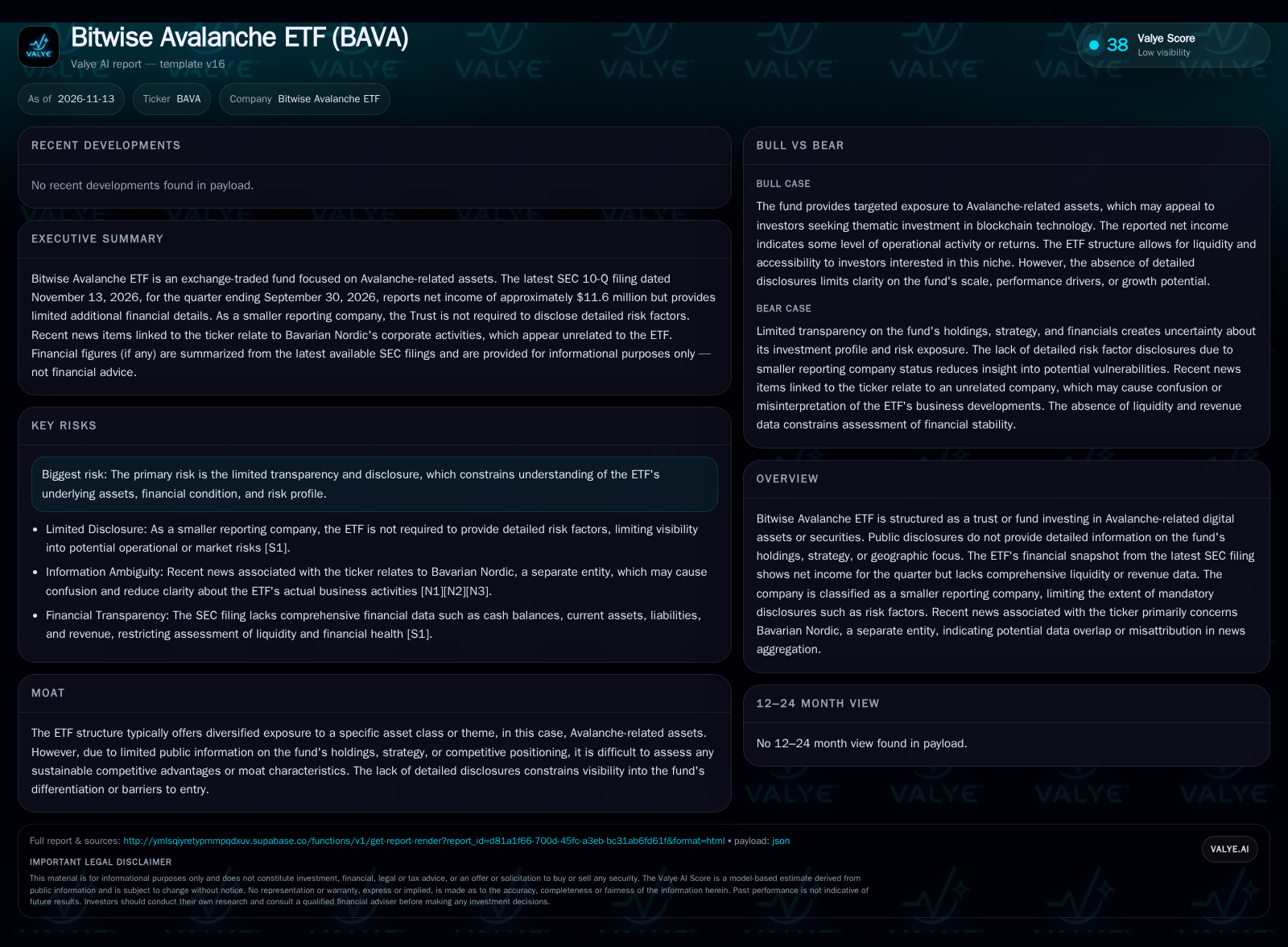
Bitwise Avalanche ETF (BAVA) reported $11.6 million in quarterly net income, but offers little transparency into its holdings, strategy, or financial health. The ETF's focus on Avalanche-related assets creates both thematic appeal and material disclosure risk, leaving investors to weigh potential blockchain-driven returns against significant information gaps.
Bitwise Avalanche ETF posted $11.6M net income for Q3 2026, but lacks detailed disclosure on holdings, liquidity, or strategy. Its appeal as a blockchain-themed ETF is offset by limited transparency, making it challenging to assess true risk and reward.
Bitwise Avalanche ETF (BAVA) provides a rare public window into an ETF focused on Avalanche-related digital assets, reporting $11.6 million net income for Q3 2026. This leaves investors and analysts reliant on fragmentary information to gauge the fund’s underlying economics and competitive positioning. The resulting picture is one of potential blockchain upside—tempered by material opacity and the practical challenges of evaluating a niche digital asset ETF with minimal disclosure.
Sparse Disclosures Frame the Present Investment Landscape
The most recent SEC filing for Bitwise Avalanche ETF (BAVA) covers the quarter ending September 30, 2026, and reports net income of $11,584,438 USD [S1]. This figure signals profitable activity, but the absence of detailed revenue, cash, or asset breakdowns in the filing leaves the source of earnings and the fund’s underlying exposures unclear. The ETF is classified as a smaller reporting company, exempting it from mandatory detailed risk factor disclosure. This regulatory status materially constrains visibility into operational or market risks. Compounding the information gap, recent news items associated with BAVA actually relate to Bavarian Nordic, a separate entity, emphasizing the need for careful data attribution in analysis.
How the ETF Could Generate Profits—and Where the Blind Spots Lie
As an exchange-traded fund focused on Avalanche-related assets, Bitwise Avalanche ETF likely derives its returns from price appreciation, staking yields, and possibly transaction fee income tied to the Avalanche blockchain ecosystem. Typical ETF economics hinge on a combination of management fees, asset appreciation, and—if structured as a grantor trust—potentially income distributions from underlying assets. However, without disclosure of portfolio composition or fee schedules, it is unclear whether BAVA’s net income is driven by realized/unrealized capital gains, staking rewards, or other sources.
The ETF structure generally offers investors liquidity and ease of access to a basket of digital assets, but can also introduce tracking error, slippage, and fee drag depending on the rebalancing mechanism and fund size. Operating leverage in such a fund generally scales with asset base growth, as fixed administrative costs are spread over a larger pool of assets, but the absence of AUM data here prevents assessment of scale efficiency. Without clarity on leverage, derivatives use, or counterparty exposure, it is difficult to gauge how risk is managed or amplified within the fund’s underlying operations.
Assessing Thematic Appeal Amidst a Crowded and Opaque ETF Landscape
Bitwise Avalanche ETF’s competitive positioning is rooted in its thematic focus: exposure to the Avalanche blockchain ecosystem. This appeals to investors seeking targeted access to blockchain and decentralized finance (DeFi) growth narratives. However, the ETF market for digital assets is increasingly crowded, with competitors offering products tracking major blockchains (such as Ethereum or Solana), diversified crypto baskets, or specialized DeFi protocols.
Key sources of potential advantage for BAVA could include unique asset selection, lower fees, or superior tracking of Avalanche ecosystem returns. Yet, the lack of public information on holdings, expense ratios, or rebalancing policies makes it impossible to identify true differentiators or barriers to entry. The ETF’s thematic focus could be undermined if Avalanche underperforms relative to other blockchain networks, or if investor attention shifts toward broader or alternative digital asset exposures. In a segment characterized by rapid innovation and shifting regulatory frameworks, information opacity is itself a competitive handicap.
Blockchain Adoption and Avalanche Ecosystem Growth Drive Outperformance
A favorable scenario for Bitwise Avalanche ETF would be one where the Avalanche blockchain rapidly gains developer adoption, user activity, and total value locked (TVL), driving up the value of assets held by the ETF. In this scenario, BAVA could benefit from both capital appreciation and potential staking or yield-generating mechanisms, magnifying net income and attracting new inflows.
Evidence that would confirm this upside includes: a marked increase in reported AUM (if disclosed), higher net income driven by realized gains or yield, and public announcements of portfolio rebalancing toward outperforming Avalanche-native assets. Additional signals would be a rising share of ETF flows into blockchain-specific products and positive third-party analyses of Avalanche’s ecosystem growth relative to peers. Demonstrable cost efficiency (lower expense ratios) or innovative staking/yield strategies would further validate the fund’s competitive edge.
Information Gaps Limit Investor Confidence Despite Blockchain Tailwinds
The most likely trajectory is that Bitwise Avalanche ETF continues to operate as a niche thematic ETF, capturing periodic inflows from investors seeking blockchain exposure but constrained by persistent information gaps. Net income may remain volatile, tracking the underlying performance of Avalanche-related assets and the broader crypto market cycle.
Confirmation of this scenario would come from continued quarterly profitability without meaningful improvement in disclosure practices, and the absence of material news about changes in fund structure, holdings transparency, or fee schedule. The ETF may retain a small but dedicated investor base, but lack of detailed risk and portfolio data would keep institutional adoption and broad retail confidence muted. If the fund’s net income proves to be driven by short-term price swings rather than sustainable yield or growth, its long-term appeal could be limited.
Opacity Amplifies Risk: Market Volatility and Regulatory Uncertainty Expose Weaknesses
In a negative scenario, the lack of transparency around portfolio holdings, leverage, and risk management leaves Bitwise Avalanche ETF especially vulnerable during periods of digital asset market stress or regulatory intervention. A sharp decline in Avalanche asset prices, technical issues in the underlying blockchain, or adverse regulatory developments could lead to outsized losses or forced asset sales.
Evidence of this downside would include a sudden drop in reported net income or a swing to net losses, negative headlines around ETF structure or risk events, and any regulatory actions targeting Avalanche or ETF-like crypto products. Investor outflows, if disclosed, or significant NAV tracking error could further undermine confidence. In the absence of timely and detailed communication from management, the information vacuum itself could accelerate redemptions and exacerbate volatility.
What Could Shift the Thesis for Bitwise Avalanche ETF
Disclosure of portfolio holdings and asset allocation would be critical to assessing risk, correlation, and potential sources of return.
If available, trends in assets under management (AUM) would signal investor confidence and fund scalability.
Publication of management fee structure and expense ratios would clarify the cost drag and competitive positioning of BAVA.
Quarterly net income composition—distinguishing realized gains, unrealized appreciation, and yield—would help reveal the sustainability of reported profits.
Any updates on leverage, derivatives exposure, or counterparty risk management would improve transparency around downside risks.
Announcements regarding regulatory changes affecting Avalanche or crypto ETFs could materially impact fund operations and appeal.
Redemption and creation activity (if disclosed) would provide insight into liquidity dynamics and investor sentiment.
Third-party ratings or reviews could offer external validation or critique of the ETF’s structure and performance.
Disclaimer: This is research-only, informational analysis and not investment advice. It may include AI-generated interpretation and general industry context. Always verify important details using primary sources.

Comments