
BMP AI Technologies: Compliance-Focused Enterprise AI Ambitions Confront Acute Liquidity and Execution Risks
BMP AI Technologies has repositioned itself as a specialist in document-grounded, compliance-sensitive AI for regulated industries, but as of its latest filing, the company faces a severe cash shortfall, mounting liabilities, and total reliance on a single executive—raising urgent questions about its operational viability and path to market traction.
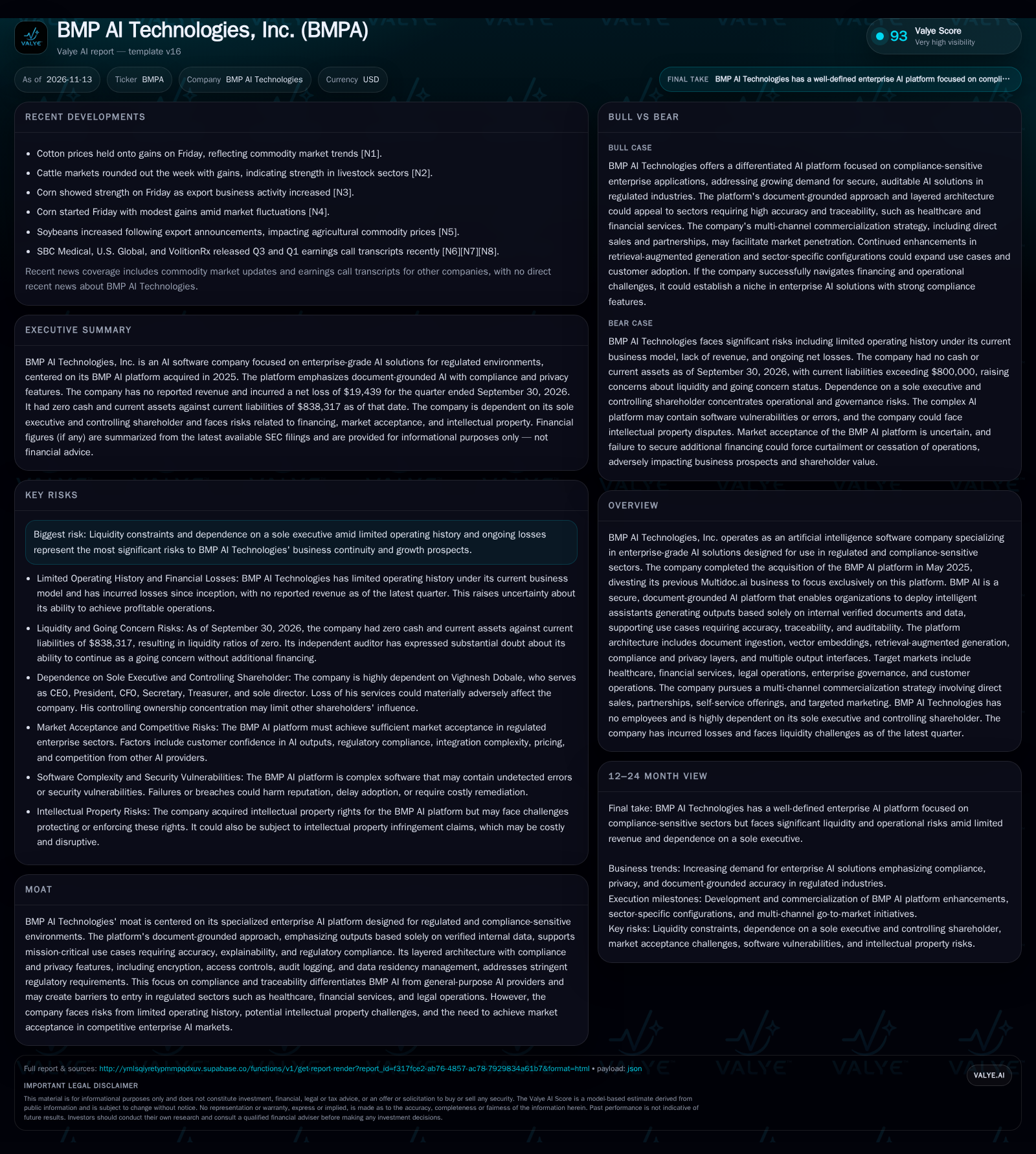
BMP AI Technologies is targeting regulated enterprise markets with a compliance-oriented AI platform, but as of September 2026, it has no cash, no revenue, and over $800,000 in current liabilities. The company’s future depends on securing financing, achieving customer adoption, and mitigating single-executive risk, all while proving its differentiated technology can win in a crowded, capital-intensive AI landscape. [S2]
BMP AI Technologies, Inc. has staked its future on delivering secure, document-grounded AI solutions to highly regulated industries where compliance, auditability, and data privacy are paramount. The company’s recent pivot—disposing of Multidoc.ai and acquiring the BMP AI platform—signals a strategic bet on the growing demand for enterprise AI that meets stringent legal and governance standards. However, this ambition is overshadowed by acute financial distress: as of September 2026, BMP AI reports zero cash, no current assets, and substantial liabilities, with no reported revenue and a sole executive at the helm. The company’s next chapter will be determined by its ability to secure urgent financing, operationalize its go-to-market strategy, and demonstrate that its compliance-first approach is sufficiently differentiated to win enterprise customers in a crowded, resource-intensive sector. [S2]
Liquidity Crisis and Strategic Refocus Define BMP AI’s Immediate Outlook
As of September 30, 2026, BMP AI Technologies reported zero cash or current assets and $838,317 in current liabilities, resulting in a current and cash ratio of zero. The company has incurred ongoing net losses, including a net loss of $19,439 for the latest quarter, and its independent auditor has expressed substantial doubt about its ability to continue as a going concern. In May 2025, BMP AI acquired the document-grounded BMP AI platform and divested its earlier Multidoc.ai business, signaling a strategic shift to focus exclusively on compliance-sensitive, enterprise-grade AI solutions. The company is wholly dependent on its sole officer and controlling shareholder, Vighnesh Dobale, who holds all major executive roles and voting control. These facts paint a picture of a company at a critical inflection point, with a clear product vision but urgent solvency and execution risks. [S2]
How Compliance-Driven AI Could Unlock Value—If Commercialization Barriers Are Overcome
BMP AI’s business model is built around the commercialization of a platform that enables organizations to deploy AI assistants restricted to verified, internal documents and data. Target markets—healthcare, financial services, legal, and governance—are characterized by high willingness to pay for solutions that guarantee compliance, privacy, and explainability. In principle, such a platform could be monetized through enterprise software licensing, usage-based fees, or SaaS subscriptions, with additional revenue from professional services, integrations, or sector-specific modules. However, the company has yet to report any revenue, and its lack of operational staff suggests limited capacity to execute complex enterprise sales or support implementations.
The economics of enterprise AI are typically driven by high initial development and integration costs, but can offer attractive operating leverage if customer acquisition and retention are successful. Fixed costs—such as platform maintenance, security, and ongoing compliance adaptation—can be significant, especially for a company with no reported cash balance. Variable costs may be limited if delivery is primarily software-based, but customer acquisition (especially in regulated sectors) is resource-intensive and often requires a credible support and services layer. BMP AI’s current financial state makes it unclear how the company would fund technical development, sales, and customer support at the scale required for sustainable growth. [S2]
Specialization in Regulated Sectors as a Differentiator—But Facing Deep-Pocketed Rivals and Substitution Risks
BMP AI’s core differentiation lies in its focus on document-grounded AI with compliance, auditability, and privacy features tailored for regulated industries. This positions it against both broad-based AI vendors (who may lack sector-specific compliance controls) and emerging specialist providers targeting legal, healthcare, or financial workflows. The architecture’s emphasis on explainability and regulatory alignment could appeal to enterprise customers wary of black-box models.
However, the market for enterprise AI in regulated sectors is highly competitive, with incumbent software vendors, cloud hyperscalers, and well-funded AI startups all pursuing similar opportunities. Many competitors can bundle AI with established compliance modules and offer deep integration with enterprise systems, often supported by dedicated sales and support teams. Substitution risk is amplified by the rapid pace of AI commoditization and the growing availability of open-source or cloud-native compliance tools. BMP AI’s lack of employees and reliance on a single executive further weakens its ability to form the partnerships, integrations, and support relationships that regulated enterprises typically demand.
If Compliance-First AI Gains Traction: How a Niche Leader Could Emerge
The most favorable scenario for BMP AI hinges on successfully raising emergency funding to stabilize operations and invest in product development, go-to-market, and support capacity. If the company can demonstrate that its compliance, traceability, and privacy features are meaningfully superior to generic AI solutions, it could carve out a defensible niche in sectors where regulatory risk is a gating factor for AI adoption. Early pilot wins or sector-specific partnerships—particularly in healthcare, legal, or financial services—would validate the platform’s value proposition and could lead to reference accounts, recurring revenue, and improved investor confidence.
Confirmation of this scenario would require public disclosure of funding events, customer contracts or pilots, and evidence of revenue growth or committed backlog. Falsification would occur if the company fails to secure financing, is unable to retain or attract customers, or if competitors rapidly close the compliance and explainability gap—making BMP AI’s differentiation insufficient to drive adoption.
Plausible Middle Outcome: Survival Depends on Near-Term Capital and Initial Customer Validation
The most likely path for BMP AI involves a race against time: the company must urgently secure bridge financing while simultaneously seeking validation from a small number of lighthouse customers or partners. In this scenario, BMP AI manages to fund a minimal operating team, focuses on 1-2 verticals (e.g., healthcare or legal), and uses pilot deployments to refine its offering and prove ROI to risk-averse buyers. Growth would be slow and lumpy, with high execution risk and ongoing dependence on the sole executive until additional talent can be recruited.
Evidence confirming this scenario would include announcements of funding, hiring, or customer pilots, even if initial revenue is modest. Falsification would be signaled by a lack of funding, continued absence of commercial traction, or loss of key intellectual property or leadership.
Funding Shortfall and Execution Gaps Could Force Asset Sale or Wind-Down
In the adverse scenario, BMP AI is unable to raise additional capital in time, leading to the inability to service liabilities or fund even minimal operations. Without employees or a functional operating structure, the company may be forced to wind down, sell its intellectual property at a distressed valuation, or enter bankruptcy proceedings. Customers in regulated sectors are especially unlikely to contract with a vendor facing acute going-concern risk, further reducing any near-term path to revenue.
Confirmation of this scenario would be public disclosures of insolvency, asset sales, or cessation of operations. Falsification would require clear evidence of fresh funding or operational continuity beyond the immediate quarter.
Milestones and External Catalysts That Will Determine BMP AI’s Trajectory
Disclosure of new financing events, bridge loans, or equity raises—public evidence of capital infusion is the gating factor for continued operations.
Announcements of customer pilots, contracts, or partnerships in regulated sectors—would demonstrate commercial validation and market acceptance.
Evidence of hiring or onboarding of technical, sales, or support staff—would signal operational ramp and capacity to execute.
Platform enhancements or third-party certifications (e.g., SOC 2, HIPAA, GDPR compliance)—would validate the product’s fit for compliance-sensitive use cases.
Intellectual property litigation or public IP challenges—could threaten the company’s ability to monetize its technology.
Material changes in executive leadership or loss of control by the sole officer—would impact continuity and governance.
If disclosed, metrics on active deployments, retention/churn, or recurring revenue—would provide insight into scalability and customer stickiness.
Disclaimer: This is research-only, informational analysis and not investment advice. It may include AI-generated interpretation and general industry context. Always verify important details using primary sources.

Comments