
Mag Magna Corp: Rare Earth Ambitions Collide With Capital and Execution Realities
After pivoting from poultry consulting to rare earth exploration, Mag Magna Corp holds mineral rights in historically significant mining areas but has yet to begin exploration. With minimal liquidity and substantial work-program obligations looming, the company's future depends on its ability to secure capital, obtain permits, and demonstrate resource potential—each a high bar in today’s critical minerals landscape.
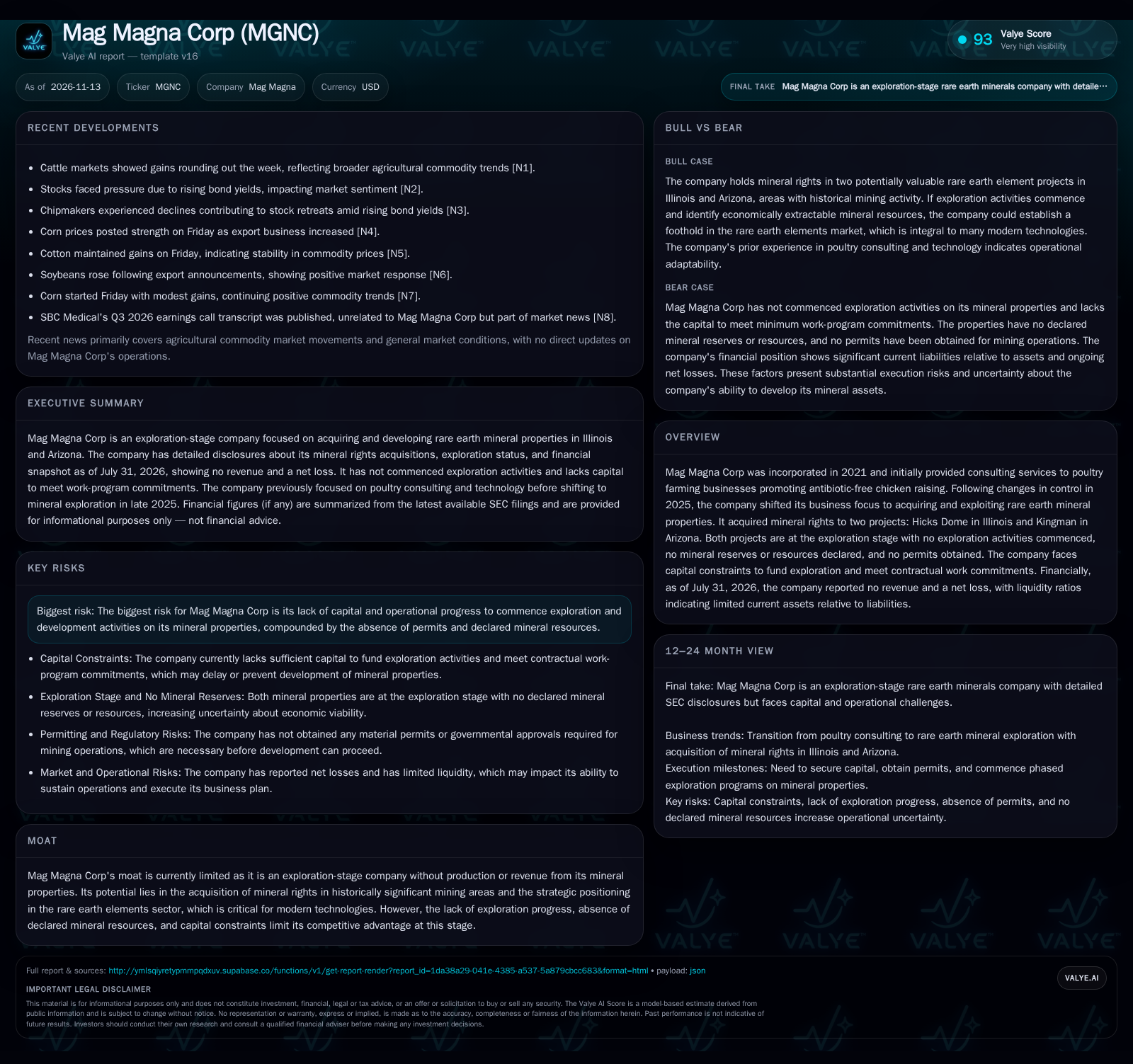
Mag Magna Corp has transitioned from agricultural consulting to rare earth mineral exploration, acquiring mineral rights in Illinois and Arizona. However, as of November 2026, it has not commenced exploration, declared no mineral resources, holds negligible cash, and faces substantial liabilities. The company’s ability to unlock value rests on raising funds, launching exploration, and securing permits—each with considerable uncertainty. [S2]
Mag Magna Corp provides a textbook example of the challenges facing junior exploration companies in the critical minerals sector. After a sharp pivot from poultry consulting to rare earths in late 2025, the company now holds mineral rights in two historically mined regions. However, as of November 2026, it remains pre-exploration: no fieldwork, no resource declaration, and no permits, with only $8,000 in cash against nearly $2 million in liabilities. The company’s strategic opportunity—access to U.S.-based rare earth acreage—remains entirely unrealized, and its future trajectory will hinge on near-term financing, regulatory progress, and technical de-risking.
Rare Earth Assets Acquired, But Progress Halted by Capital Shortfall
Mag Magna Corp underwent a dramatic business model change in late 2025, abandoning its poultry consulting roots to focus on rare earth minerals. In January 2026, it entered into a Properties Agreement to acquire mineral rights for 21 parcels in Hardin County, Illinois (Hicks Dome Project) and three lode mining claims in Mohave County, Arizona (Kingman Project). The total recognized acquisition cost in its financials is $1.9 million, structured as $300,000 in staged cash payments and 2 million shares. Both projects are historically significant mining areas but are at the exploration stage: no fieldwork has begun, no technical report exists, and no resources are declared. Critically, as of July 31, 2026, Mag Magna had only $8,057 in cash and $1.89 million in current liabilities, with no revenue and a net loss of $1.58 million. The company lacks the capital to meet its minimum work commitments ($100,000 in 2026, $200,000 in 2027) or to commence exploration. No material permits or governmental approvals have been obtained, and there is no clear path to operational progress without significant new funding. [S2]
Exploration-Stage Economics: High Fixed Costs, Deferred Revenue, and Capital Dependency
As an exploration-stage company, Mag Magna’s economics are defined by high upfront fixed costs and a prolonged period of negative cash flow. The business model in mineral exploration typically involves acquisition costs (cash and equity), recurring holding costs (royalties, minimum work commitments), and substantial expenditures for exploration, permitting, and technical assessments—all before any revenue is realized. The company faces a 2% net smelter return royalty on future production, but this is only relevant if viable resources are discovered and developed. The minimum work commitments of $100,000 in 2026 and $200,000 in 2027 are contractual obligations that must be met to retain the mineral rights, increasing the urgency of securing outside capital. Mag Magna’s negligible cash, large current liabilities, and lack of ongoing operations mean it is entirely dependent on raising new funds—most likely equity, given its risk profile and lack of collateral—for any progress. If exploration is successful, the economics could shift dramatically, but until then, the company will likely operate at a loss with negative operating leverage and persistent capital needs.
Positioning in the Rare Earth Value Chain: Early Mover or Perpetual Junior?
Mag Magna’s competitive potential rests on two levers: geographic access to U.S.-based rare earth mineral acreage and timing relative to broader market dynamics. The Hicks Dome Project (Illinois) and Kingman Project (Arizona) are situated in regions with documented historical mining activity, which may suggest underlying geological potential. However, the company is one of many junior miners vying for relevance in the rare earth supply chain, competing with better-capitalized peers, established producers, and new entrants leveraging advanced exploration technologies.
At this stage, Mag Magna has no demonstrated technical or cost advantage, no resource declaration, and no permitting head start. Its only differentiator is the option value of its mineral rights in a geopolitically sensitive sector. The lack of exploration progress, combined with capital constraints, means that any competitive edge is purely hypothetical. Should it secure funding and demonstrate resource potential, the company could become an attractive partner or acquisition target for downstream processors or manufacturers seeking U.S.-sourced rare earths. Until then, it risks being bypassed as capital and talent flow to better-positioned projects.
Unlocking Value: What a Breakthrough Would Require
The upside scenario for Mag Magna hinges on a rapid and successful sequence: (1) raising sufficient capital to meet minimum work commitments and launch exploration programs; (2) obtaining necessary permits and assembling a qualified technical team; (3) conducting exploration that identifies economically viable rare earth resources; and (4) progressing toward resource declaration and project de-risking. This would not only enhance the intrinsic value of the company’s assets but could also make it a candidate for strategic partnerships, off-take agreements, or acquisition by larger players seeking U.S.-sourced critical minerals.
Confirmation of this scenario would come from disclosed financing events (e.g., equity raises or strategic investments), announcements of exploration program launches, technical reports by qualified persons, and eventual resource or reserve declarations. Permitting progress and board/management appointments with relevant experience would further validate the de-risking process. The market would likely respond favorably to any credible evidence of resource potential or external validation from industry partners.
Most Probable Trajectory: Delays, Dilution, and Uncertain Progress
Given the current financial position—minimal cash, large liabilities, and no operational momentum—the most plausible scenario is one of delay and incremental progress. Mag Magna may attempt to raise capital through highly dilutive equity offerings or convertible instruments, possibly at distressed valuations given its lack of assets and negative working capital. Even if such financing is secured, the company may face delays in assembling a technical team, obtaining permits, and launching fieldwork, especially if regulatory or environmental hurdles arise.
Progress toward exploration milestones could be slow and subject to interruptions, with ongoing uncertainty about the technical merits of the properties. The company may need to renegotiate payment schedules or work commitments with property vendors if capital remains scarce. Evidence supporting this trajectory would be minor fundraising announcements, piecemeal board or management changes, or limited progress updates without substantive technical results.
Failure to Fund: Forfeiture Risk and Value Erosion
In the adverse scenario, Mag Magna fails to secure sufficient capital to meet its minimum work-program commitments or to retain qualified personnel. This could trigger a default under the Properties Agreement, leading to forfeiture of mineral rights or legal disputes with property vendors. Without progress on exploration or permitting, the company’s assets would remain illiquid and of limited value, while ongoing liabilities and negative cash flow erode shareholder equity.
Confirmation of this scenario would include missed payment deadlines, disclosures regarding default notices or legal proceedings, auditor going-concern warnings, or abrupt board and management resignations. In this environment, the company could become a shell or seek a reverse merger, with little to no value attributable to its rare earth ambitions.
Milestones That Will Define Mag Magna’s Rare Earth Viability
Disclosure of any capital-raising event sufficient to fund at least the next 12 months of work commitments and operational expenses.
Formal announcement of exploration program commencement, including engagement of qualified technical personnel and a published work plan.
Updates on permitting status for both the Hicks Dome and Kingman projects, as regulatory progress is required before any field activities.
Filing of a technical report or disclosure of exploration results prepared by a qualified person, which would support resource potential.
Renegotiation or amendment of acquisition payment schedules or work commitments, which may indicate capital constraints or operational delays.
Board and management changes, particularly the addition of directors or officers with mining and exploration experience.
Any default notices, legal disputes, or forfeiture disclosures relating to the Properties Agreement or mineral rights.
A useful metric would be quarterly cash burn and projected runway, if disclosed, to gauge ongoing capital pressure.
Disclaimer: This is research-only, informational analysis and not investment advice. It may include AI-generated interpretation and general industry context. Always verify important details using primary sources.

Comments