
Greenway Technologies’ Modular GTL Ambitions: Technology Promise Meets Acute Capital Constraints
Greenway Technologies holds proprietary GTL technology designed for modular, distributed deployment—potentially transforming stranded gas into valuable fuels and chemicals domestically.
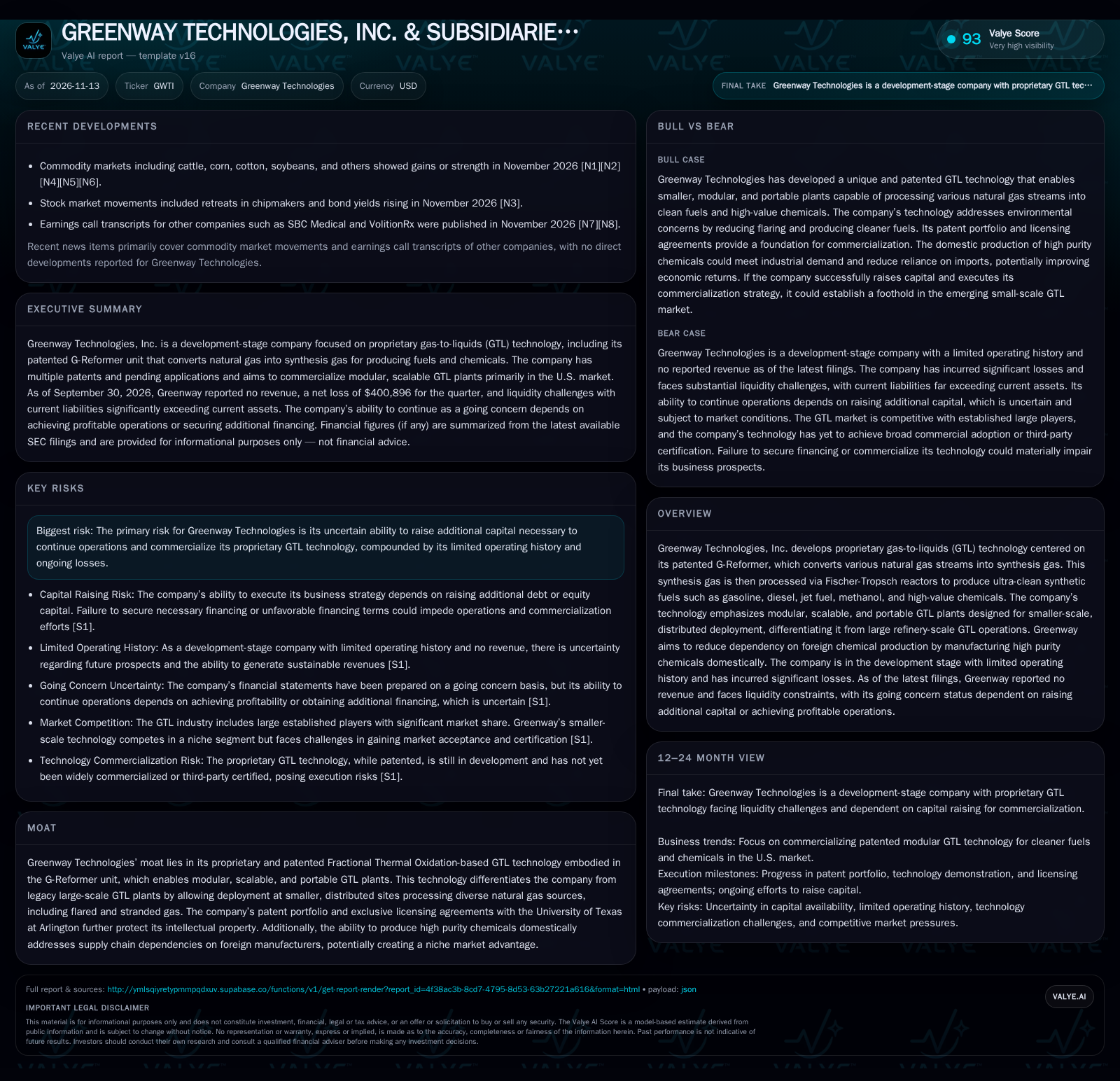
Greenway Technologies holds proprietary GTL technology designed for modular, distributed deployment—potentially transforming stranded gas into valuable fuels and chemicals domestically. However, the company has yet to generate revenue, is deeply loss-making, and faces a severe liquidity crisis, with its ability to survive and scale wholly dependent on securing additional capital and validating its technology in commercial settings. [S1] [S2]
Greenway Technologies is attempting to upend traditional gas-to-liquids economics with its patented G-Reformer technology, which aims to make small-scale, distributed GTL plants viable for monetizing stranded and flared gas. This approach could theoretically open up new value pools and reduce dependence on foreign chemical suppliers. However, Greenway is a development-stage company with no revenue, ongoing losses, and a severe liquidity crisis. Its survival and any path to commercial relevance now rest entirely on its ability to raise capital and prove that its technology can transition from lab to field at a cost and scale that attract customers.
Acute Liquidity Crisis and Lack of Revenue Define Immediate Reality
As of September 30, 2026, Greenway Technologies reported zero revenue and a net loss of $400,896 for the quarter, with an accumulated deficit exceeding $41 million. The company’s cash position is critically low at $1,132, while current liabilities stand at $15.6 million—resulting in a current ratio and cash ratio of just 0.01. These figures put the company’s ability to continue as a going concern in serious doubt, with management explicitly stating dependence on new financing or achieving profitable operations to survive. No substantive operational developments or commercial milestones were reported in recent periods. [S1] [S2]
Modular GTL: Theoretical Profit Pools and Real-World Capital Hurdles
Greenway’s business model centers on deploying proprietary, modular gas-to-liquids (GTL) plants using its patented G-Reformer unit. The theoretical economics are compelling: by enabling smaller-scale, distributed GTL deployment, Greenway could unlock value from gas streams that are otherwise flared, stranded, or uneconomic to exploit using conventional large-scale plants. The potential revenue streams include selling GTL fuels (diesel, gasoline, jet fuel), high-purity chemicals, and possibly licensing the technology or selling turnkey micro-plants.
However, the capital intensity of building even small GTL plants is considerable, and the company’s current financial position precludes any meaningful self-funded deployment. Without revenue, Greenway’s cost structure is dominated by R&D, IP maintenance, and minimal staffing, with some employees on deferred or no compensation. If commercial traction is achieved, the business could benefit from operating leverage as fixed R&D and SG&A costs are spread over increasing deployments, but this remains purely hypothetical until commercialization is proven. [S1] [S2]
In the absence of commercial contracts or disclosed pricing, the unit economics—capital cost per plant, gross margins on GTL output, payback periods, and customer willingness to pay—are all untested. The business is currently locked in a pre-revenue, pre-scale phase, and its economics will only be validated if it can secure funding and execute pilot deployments.
Niche Differentiation Versus Incumbent GTL Giants and Technology Skepticism
Greenway aims to differentiate itself from legacy GTL players by focusing on modular, portable plants that can be deployed at distributed gas sources—such as oilfield flares, coal-bed methane, or biomass gasification—rather than relying on massive, centralized capital projects. Its patent portfolio, including the proprietary Fractional Thermal Oxidation process and exclusive licensing from the University of Texas at Arlington, provides some IP protection and a potential moat in the small-scale GTL space. [S1]
However, the company competes indirectly with large, resource-rich GTL incumbents who benefit from economies of scale, established supply chains, and deeply entrenched customer relationships. The key challenge for Greenway is to prove that its modular solution is cost-effective, reliable, and scalable—especially given the lack of third-party certification or commercial deployments to date.
Potential substitutes include alternative gas monetization technologies (such as small-scale LNG, CNG, or direct chemical synthesis), as well as renewable energy solutions for off-grid energy needs. Customer skepticism regarding unproven, capital-intensive technologies is a significant barrier, and regulatory or environmental acceptance of new GTL processes may also be a gating factor.
How Successful Capital Raise and Field Validation Could Unlock a GTL Niche
The most favorable scenario for Greenway is one where it secures sufficient capital—either through equity, strategic partnership, or non-dilutive funding—to build and deploy its first commercial-scale modular GTL plant. If this pilot plant demonstrates reliable, cost-competitive conversion of stranded or flared gas into fuels or high-purity chemicals, the company could attract further customer interest and potentially initiate a licensing or plant-sales business model.
A successful field demonstration would also enable Greenway to pursue third-party certification, build credibility with regulators, and attract additional strategic or financial investors. If the economics of the plant prove attractive—meaningfully lower capex per barrel than large-scale GTL, or the ability to monetize previously wasted gas streams—the company could carve out a profitable niche, especially in regions with abundant stranded gas and limited infrastructure.
Evidence that would confirm this scenario includes announcements of new funding, contract awards for pilot deployments, successful commissioning of a GTL plant, and initial revenue recognition from technology sales or licensing.
Stalled Progress Amid Financing Delays and Market Skepticism
The most plausible near-term scenario is one in which Greenway continues to struggle to raise capital amid a challenging funding environment for pre-revenue cleantech ventures. Without new financing, the company may be forced to further reduce operations, defer compensation, or seek strategic alternatives such as asset sales or technology licensing under distressed terms.
Even if modest funding is secured, the path to commercial deployment is likely to be slow, with lengthy customer validation cycles, regulatory hurdles, and ongoing skepticism from potential partners about the technology’s unproven economics and scalability. The company may continue to report operating losses and minimal operational progress, with its long-term viability remaining in question unless a breakthrough in funding or commercial acceptance occurs.
Confirmation of this scenario would come from continued absence of revenue, limited operational updates, ongoing net losses, and further warnings regarding going concern risk. Falsification would require visible progress toward securing funding, partnerships, or a commercial pilot.
Acute Funding Shortfall Forces Shutdown or Distressed Sale
In the most adverse scenario, Greenway is unable to secure any new financing and exhausts its limited cash resources. This would likely force the company to cease operations, lay off remaining staff, and seek to liquidate assets or sell its IP portfolio—possibly at distressed valuations. The lack of revenue, ongoing operating losses, and high current liabilities make this scenario plausible in the near term absent a significant infusion of capital.
Potential buyers for the company’s technology could include larger energy or chemical players interested in the patent portfolio, but without demonstrated commercial performance, the value of these assets may be limited. Creditors could force asset sales or even precipitate bankruptcy proceedings, erasing equity value for current shareholders.
Evidence supporting this scenario would include bankruptcy filings, asset/liquidation announcements, mass layoffs, or urgent communications regarding inability to meet obligations.
Milestones and External Triggers That Could Alter Greenway’s Commercialization Trajectory
Any announcement of a successful capital raise—whether equity, debt, or strategic investment—would be critical to testing Greenway’s ability to continue as a going concern. [S1] [S2]
Updates on pilot plant construction, commissioning, or commercial demonstration would provide tangible evidence of technology progress and market validation—if disclosed.
Securing third-party certification or regulatory approval for the G-Reformer process would help address customer and partner skepticism and could open new markets.
First revenue recognition—either from technology licensing, plant sales, or direct fuel/chemical sales—would be a clear milestone toward commercial viability.
Material changes in customer or partner relationships, such as announced contracts, JV agreements, or strategic alliances, would signal traction toward commercialization.
Cost and performance data from any deployed GTL units—such as capex per plant, conversion efficiency, and product purity—would help test the company’s claimed advantages, if disclosed.
Progress in reducing liabilities or restructuring debt would impact the company’s potential financial flexibility and ability to weather ongoing losses.
Disclaimer: This is research-only, informational analysis and not investment advice. It may include AI-generated interpretation and general industry context. Always verify important details using primary sources.

Comments