
Tri-County Financial Group: Local Banking Scale, Deposit Dynamics, and the Limits of Community Moats
Tri-County Financial Group’s focus on diversified lending and relationship-driven banking in north central Illinois supports modest loan growth and stable earnings, but rising competition and geographic concentration test the durability of its franchise. The interplay between deposit retention, loan mix, and regional economic cycles will dictate the company’s ability to sustain profitability in a shifting financial landscape.
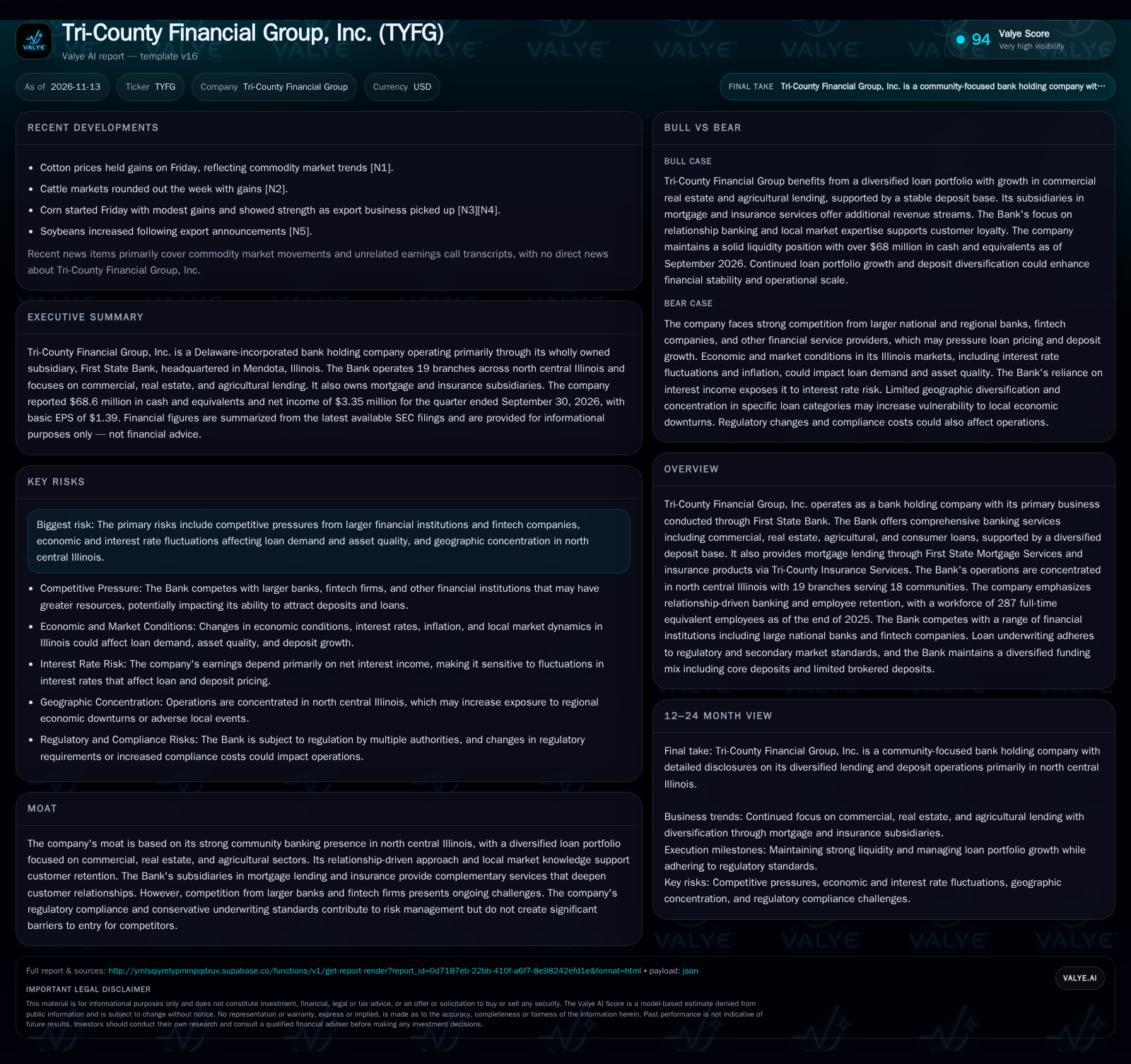
Tri-County Financial Group, Inc. reported $1.6 billion in assets and a 3% loan portfolio increase in 2025, with recent quarterly net income at $3.35 million. Its growth is rooted in commercial and real estate lending, but the company’s regional focus and exposure to competitive and interest rate pressures could constrain future performance. Monitoring deposit trends, loan quality, and market share shifts will be crucial to gauge the resilience of its community banking strategy. [S2]
Tri-County Financial Group, Inc. exemplifies the strengths and vulnerabilities of community banking in the Midwest. With a $1.6 billion asset base and a footprint spanning 19 branches in north central Illinois, the company’s recent loan growth and stable deposit base are testaments to its relationship-driven approach. However, in an environment marked by intensifying competition, fluctuating interest rates, and regional economic dependencies, the durability of Tri-County’s business model will hinge on its ability to defend margins, manage credit quality, and deepen customer relationships while navigating the limits of its geographic and product reach. [S1] [S2]
Recent Loan Growth, Deposit Structure, and Earnings Snapshot
As of December 31, 2025, Tri-County Financial Group reported $1.6 billion in consolidated assets and a 3% year-over-year increase in its loan portfolio, with growth concentrated in commercial real estate, consumer real estate, and construction and land loans. Non-core or brokered deposits represented just 3% of total deposits, highlighting a funding structure anchored in local retail and commercial relationships. For the quarter ended September 30, 2026, the company posted net income of $3.35 million and basic earnings per share of $1.39. These figures underscore a period of modest, stable expansion, supported by relationship banking but also revealing the company’s exposure to regional economic cycles and the competitive dynamics of its Illinois markets. [S1] [S2]
How Tri-County Earns: Lending Mix, Deposit Costs, and Operating Leverage
Tri-County’s revenue model is anchored in net interest income generated by lending activities—primarily commercial, agricultural, and real estate loans—funded by a diversified base of core deposits. The company’s relatively low reliance on brokered deposits suggests that it may enjoy lower funding costs than peers more dependent on wholesale markets, though this advantage is balanced by the need to maintain competitive deposit rates in a rising-rate environment. Fee income is supplemented by its mortgage and insurance subsidiaries, but these remain ancillary to core lending. Operating leverage is potentially limited by the fixed cost base associated with maintaining 19 branches and a workforce of 287 full-time equivalents. While loan growth can drive incremental profitability, operating efficiency gains may be modest unless the company can increase business volumes or rationalize its physical footprint. Capital requirements are shaped by regulatory standards and the need to buffer against credit losses, particularly given the concentration in commercial and agricultural lending.
Community Bank Advantages Meet Fintech and Mega-Bank Competition
Tri-County’s competitive moat is primarily rooted in local market knowledge, long-term customer relationships, and a broad suite of lending and deposit products tailored to its regional clientele. Its presence as a relationship-driven lender in north central Illinois fosters loyalty, but barriers to entry remain relatively low, and switching costs for customers are limited. The company faces direct competition from national and regional banks with more resources and technology, as well as fintech entrants that can offer convenience and competitive rates. While Tri-County’s insurance and mortgage subsidiaries provide cross-selling opportunities, these are unlikely to offset the structural advantages enjoyed by larger or more digitally advanced peers. Regulatory compliance and conservative underwriting help manage risk but do not constitute a true moat in an industry where product and price transparency are high.
If Deposit Franchise and Loan Growth Accelerate, Scale Benefits Could Emerge
A favorable scenario would see Tri-County leveraging its community relationships to capture a larger share of commercial and agricultural lending as regional economic activity improves. Sustained growth in core deposits—without resorting to expensive brokered funding—would allow the bank to maintain a low cost of funds, supporting net interest margins even in a competitive environment. If the mortgage and insurance subsidiaries gain traction, fee income diversification could become more material, enhancing overall returns. Operating leverage could improve if business volumes rise faster than branch-level expenses, or if digital channel adoption reduces servicing costs. Evidence supporting this scenario would include above-peer loan growth, stable or expanding net interest margins, and a meaningful uptick in non-interest income from ancillary businesses.
Regional Lending Growth Balances Out Margin and Credit Pressures
The most likely path is continued modest loan growth in line with local economic trends, with net interest margins pressured by competition and a flattening yield curve. Deposit gathering remains stable but not a major source of incremental cost advantage as larger banks and fintechs compete aggressively on rates and convenience. Credit quality stays within historical norms, supported by conservative underwriting, but with some vulnerability to sector-specific shocks in commercial real estate or agriculture. Fee income from mortgage and insurance subsidiaries provides incremental diversification, but core profitability remains tied to traditional lending. Confirmation of this scenario would include steady, single-digit loan growth, broadly stable return on assets and equity, and no material deterioration in asset quality or deposit retention.
Margin Compression and Local Economic Stress Could Erode Profitability
An adverse scenario could be triggered by a combination of heightened deposit competition, local economic downturns, and rising credit losses. If loan demand weakens—particularly in commercial real estate or agriculture—while funding costs rise due to aggressive rate competition from larger players, net interest margins could compress sharply. An uptick in non-performing loans, especially in concentrated sectors, would pressure earnings and potentially require higher provisions. Regulatory or compliance costs could further strain overhead, especially if operational efficiencies are not realized. Evidence supporting this scenario would include flat or declining loan balances, a marked increase in non-performing assets, shrinking net interest margins, and erosion of the core deposit base.
Tracking the Resilience of Tri-County’s Community Banking Model
Quarterly trends in core deposit growth and the proportion of non-core or brokered deposits, if disclosed, to gauge funding stability and cost pressures.
Changes in net interest margin, as reported, to assess the interplay between loan yields and deposit costs in a competitive, rate-sensitive environment.
Loan portfolio composition and growth rates by segment (e.g., commercial real estate, agriculture, residential), as a signal of risk concentration and diversification.
Non-performing loan ratios and credit loss provisions, to monitor asset quality and emerging credit risks in the loan book.
Non-interest income from mortgage and insurance operations, if disclosed, to evaluate the effectiveness of diversification initiatives.
Expense ratios and branch-level productivity metrics, if available, to test for operating leverage and efficiency gains.
Local economic indicators relevant to north central Illinois—such as commercial construction activity, farmland values, and employment trends—as lead indicators of future loan demand and credit quality.
Regulatory developments or changes in compliance costs that could impact profitability or capital requirements.
Disclaimer: This is research-only, informational analysis and not investment advice. It may include AI-generated interpretation and general industry context. Always verify important details using primary sources.

Comments