
Chaince Digital Holdings: Liquidity Strength Versus Strategic Uncertainty in a Thinly Disclosed Business
Chaince Digital Holdings Inc. presents an unusual financial profile: reported liquidity position and clean governance optics contrast with minimal revenue scale, opaque business mechanics, and historical related-party complexities. The company’s future depends on whether it can convert its balance sheet strength into meaningful, recurring business activity amid limited public disclosure.
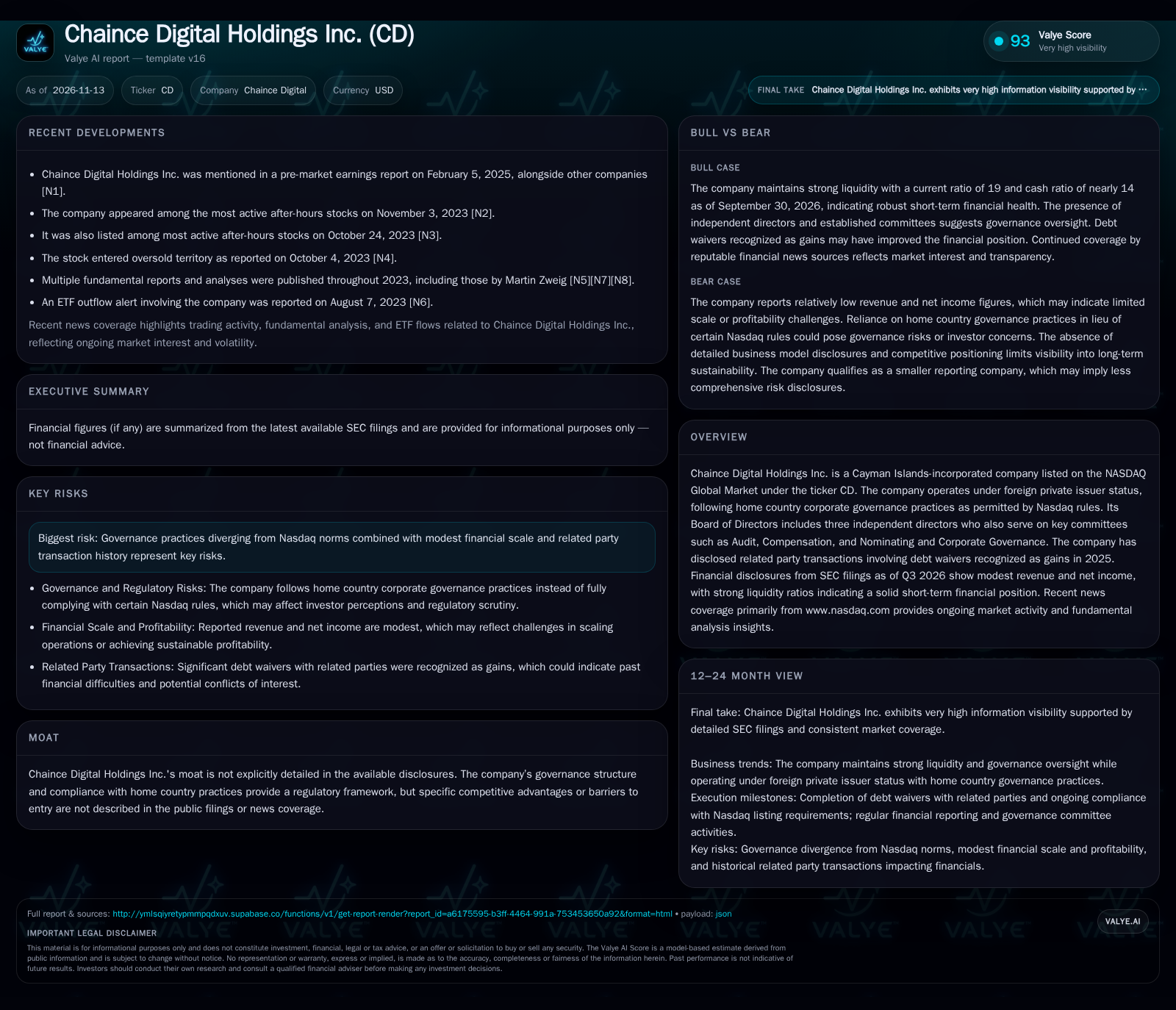
Chaince Digital’s current ratio of 19 and cash ratio of nearly 14 as of Q3 2026 signal reported liquidity position, but its modest net income and revenue highlight a lack of operational scale. With related-party debt waivers recognized as gains and governance practices diverging from Nasdaq norms, the company’s ability to translate its financial cushion into sustainable business remains uncertain. The key issue: can Chaince Digital leverage its balance sheet to achieve material, recurring revenue growth in the face of limited transparency and potential governance risks? [S2]
Chaince Digital Holdings Inc. (NASDAQ: CD) stands out for its balance sheet strength, reporting a cash-rich position and exceptionally high liquidity ratios as of Q3 2026. Yet, this financial buffer is paired with strikingly modest revenue and profit figures, and the company’s public disclosures provide little insight into its operating model or sources of sustainable growth. With a history of related-party debt waivers and governance practices that differ from U.S. standards, Chaince Digital’s future will hinge on whether it can build a scalable, credible business atop its current financial foundation—or whether its liquidity will be gradually eroded in the absence of clear revenue drivers.
Liquidity Outpaces Operations: Chaince Digital’s Current Financial Profile
As of September 30, 2026, Chaince Digital reported $33.67 million in cash and equivalents and $13.56 million in short-term investments, supporting a current ratio of 19 and a cash ratio of 13.93. These figures point to an extremely reported liquidity position relative to its current liabilities of just $3.39 million. However, operational performance remains limited: Q3 2026 net income was just $229,490, and basic/diluted EPS stood at $0.002 per share. Revenue for the most recently disclosed full year (2022) was only $863,438. The company’s capital structure was also affected by related-party debt waivers in 2025, which were recognized as gains and could mask underlying profitability trends. Governance is handled under Cayman Islands rules, with three independent directors on all major committees, but the company does not adhere to all Nasdaq governance standards. [S2] [S1]
Unpacking Earnings Capacity: Where Could Profits Come From?
The company’s core economics are difficult to assess directly due to a lack of disclosed detail on its commercial activities, pricing, or cost structure. With sub-$1 million annual revenue and minimal net income, Chaince Digital may be in a pre-scale, asset-light phase, or could be operating in a niche with modest throughput and limited fixed costs. The company reported cash and liquidity metrics for the period; these figures do not by themselves establish operating runway, investment capacity, financial flexibility, or financing capacity. If the company were to pursue a digital asset, fintech, or platform business model (as the name might suggest), typical economics would depend on transaction volumes, fee rates, and the ability to leverage technology for operating scale. However, without evidence of recurring contracts, customer cohorts, or stable gross margins, it is plausible that much of the company’s cost base is variable or that it has not yet engaged in significant operating activities. Should Chaince Digital deploy its liquidity into higher-yielding or scalable operations, operating leverage could become significant—but this is not currently visible in disclosures.
A further dimension to consider is the company’s capital allocation strategy amid its liquidity abundance. If Chaince Digital opts to maintain a conservative investment posture, prioritizing capital preservation over aggressive growth, this could constrain operational expansion but reduce downside risk. Conversely, a pivot toward deploying cash into innovative product development, strategic partnerships, or market expansion initiatives could increase both risk and potential reward. The balance between these approaches will likely hinge on management’s risk tolerance and market opportunity assessment, which remain opaque. Evaluating how the company manages this trade-off would provide insight into its potential to convert liquidity into sustainable profitability.
Assessing Moat and Market Power in the Absence of Transparency
Chaince Digital’s competitive positioning is opaque. The lack of detailed business model or product information prevents direct comparison to peer groups or identification of a clear moat. In digital finance or asset management, scale, proprietary technology, regulatory compliance, and network effects often confer advantage. However, Chaince Digital’s low revenue base suggests it has not established market share, sticky customer relationships, or significant switching frictions. The company’s adherence to home country governance practices could be a differentiator in certain international markets, but conversely, may deter institutional or U.S.-centric investors seeking transparency and regulatory alignment. In effect, the company’s current competitive posture is defined more by its balance sheet than by any observable operational edge.
In addition, the company’s positioning relative to regulatory environments could materially affect its competitive prospects. Operating under Cayman Islands governance may afford certain tax or operational advantages, yet it may also limit access to markets or institutional investors who require stringent regulatory compliance and transparency. This regulatory positioning could either serve as a strategic moat in niche jurisdictions or become a barrier to scaling in more regulated, larger markets. Understanding how Chaince Digital navigates these trade-offs in regulatory alignment versus operational flexibility would help clarify its potential to build durable competitive advantages.
Capital Deployment as a Catalyst: How Balance Sheet Strength Could Drive a Step-Change
If the company can leverage its capital to acquire users, build technology infrastructure, or secure strategic partnerships, a rapid escalation in revenue and operating leverage could follow. Confirmation of this thesis would require new disclosures detailing business development, customer contracts, product launches, or acquisition activity. Material increases in recurring or transaction-based revenue, sustained gross margin improvement, and tighter linkage between operating expenses and revenue growth would support the upside case. Conversely, continued stasis in revenue or cash deployment would falsify the scenario.
Moreover, the scalability of Chaince Digital’s business model, if it exists, would depend heavily on the company’s ability to harness network effects or proprietary technology. In digital asset or fintech sectors, success often requires not just capital but also the capacity to attract and retain a critical mass of users or clients, creating self-reinforcing growth dynamics. Without evidence of such network development or technology differentiation, the company’s capital deployment might yield only incremental gains rather than transformative growth. Thus, the presence or absence of these scalable elements is a key conditional factor in assessing the upside potential.
Stability Without Scale: The Most Likely Trajectory Absent Business Model Change
Given the current facts, the most plausible near-term scenario is that Chaince Digital continues to operate with high liquidity but low operational throughput. The company may remain in a holding pattern, using its balance sheet to cover limited expenses while seeking opportunities or awaiting regulatory clarity. Modest net income could persist, driven by investment returns or sporadic business activity rather than true operating scale. Confirmation would come from continued flat or declining revenue, low expense growth, and little change in core business disclosures. Falsification would require a clear shift in business activity, capital deployment, or a step-change in revenue.
Erosion Risk: When Liquidity Becomes a Sinking Asset
The bear case is that Chaince Digital’s liquidity is gradually depleted by ongoing costs, unproductive investments, or adverse related-party actions, without any successful conversion into sustainable revenue. In this scenario, the absence of recurring business activity and transparency could lead to investor flight, higher governance risk premiums, or regulatory intervention. Confirmation would include persistent low or negative operating cash flow, declining cash balances, new related-party transactions that favor insiders, or adverse audit findings. A lack of progress on business disclosures or a spike in governance concerns would further validate the downside scenario.
What Will Reveal Whether Chaince Digital Can Build a Durable Business?
Disclosure of revenue mix—recurring versus nonrecurring—if provided, would clarify the quality and sustainability of earnings.
Any announcement of a new business line, proprietary platform, or acquisition would indicate a shift from capital preservation to growth.
Quarterly trends in cash and short-term investments: sustained or increasing balances would imply ongoing capital discipline; declines could signal investment or operational strain.
Related-party transaction frequency and terms, if disclosed, would help assess governance risk and the integrity of financial results.
Board or management changes, especially among independent directors or committee chairs, could foreshadow shifts in governance standards or strategic direction.
Updates on compliance with Nasdaq governance requirements, or changes to home country practices, would affect regulatory risk perception.
A detailed cost breakdown—fixed versus variable—if disclosed, would illuminate operating leverage and scalability potential.
Disclaimer: This is research-only, informational analysis and not investment advice. It may include AI-generated interpretation and general industry context. Always verify important details using primary sources.

Comments