
Autonomix Medical Boosts Clinical Trials and Patent Portfolio While Addressing Nasdaq Price Compliance
Autonomix Medical expands R&D and regulatory progress on its nerve-sensing ablation platform, balancing increased funding needs with Nasdaq bid price challenges through mid-2026.
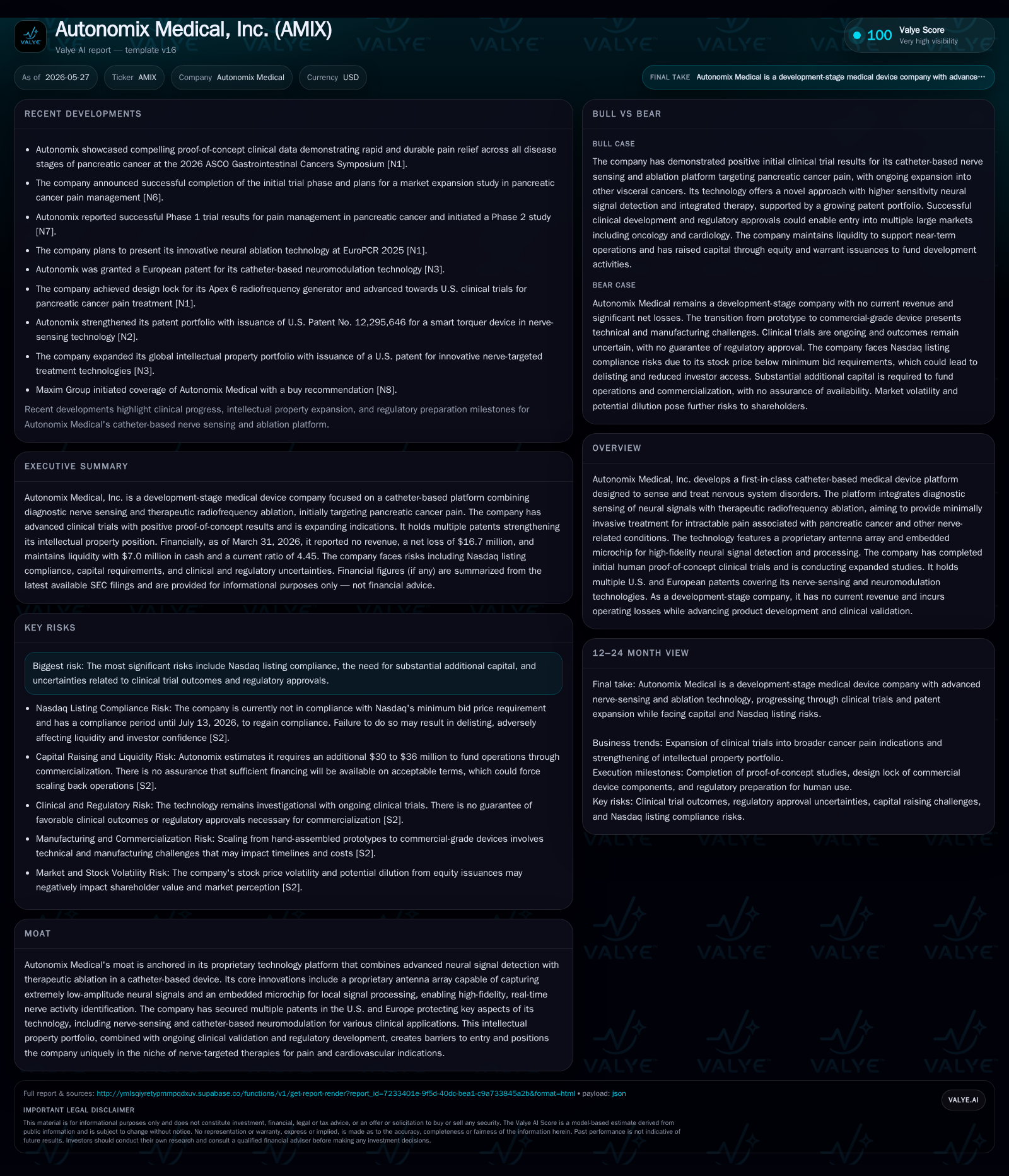
In its latest quarterly filing, Autonomix Medical disclosed cash sufficient to fund operations only through the third quarter of 2026, with research and development expenses rising due to intensified clinical trials. The company’s catheter-based platform integrates high-fidelity neural sensing with therapeutic radiofrequency ablation, targeting pancreatic cancer-related pain and expanding into cardiology indications supported by recent patents. Key risks include Nasdaq listing compliance by July 2026, substantial capital needs estimated between $30 million and $36 million, manufacturing scale-up challenges, and inherent clinical trial uncertainties. Progress on regulatory pathways, clinical milestones, and financing will be critical for advancing toward commercialization.
Latest Operating Update Highlights Financial Constraints Amid Clinical Advancement
Autonomix Medical's most recent quarterly filing dated February 11, 2026 reports year-end cash of $9.9 million and working capital of $8.5 million as of December 31, 2025 [S2]. The company projects that these resources will finance operations only through the third calendar quarter of 2026, underscoring pressing capital requirements. Research and development expenses rose by 65% year-over-year in Q4 2025 to $1.7 million due to intensified clinical trial activity and product development efforts [S2]. Management anticipates continued increases in R&D spending aligned with ongoing trials.
Simultaneously, Autonomix faces Nasdaq listing challenges after receiving notification on January 14, 2026 that its common stock failed to maintain the minimum $1.00 per share bid price over thirty consecutive business days [S3]. The company has until July 13, 2026 to regain compliance or risk delisting unless corrective actions such as a reverse stock split—already authorized by shareholders—are implemented.
This environment frames a near-term imperative balancing operational execution against financial constraints.
Business Model Focused on Integrated Neural Sensing and Therapeutic Ablation
Autonomix Medical develops a first-in-class catheter-based platform combining high-fidelity neural signal sensing with therapeutic radiofrequency (RF) ablation designed for minimally invasive treatment of nervous system disorders [S1]. The lead application targets pancreatic cancer-related pain but aims for broader utility across chronic pain syndromes and cardiovascular conditions.
Currently pre-commercial with no product revenue or regulatory approvals, future income is expected from healthcare providers purchasing the system for outpatient or inpatient use. Pricing dynamics will depend on reimbursement frameworks applicable to nerve-targeted therapies in oncology and cardiology.
Core differentiation lies in its proprietary antenna array engineered to detect extremely low-amplitude neural signals undetectable by conventional devices paired with embedded microchip technology enabling real-time local signal processing during procedures. This integrated diagnostic-therapeutic approach may enhance procedural efficacy compared to standalone ablation devices lacking sensing capabilities.
Intellectual Property Creates Strategic Barriers Within Neuromodulation Niche
Autonomix holds multiple patents protecting key innovations including the nerve-sensing antenna design and localized signal processing via embedded microchips in both the U.S. and Europe [S7,S16]. Recent patent grants extend coverage into cardiology indications such as renal denervation for hypertension and arrhythmia management.
These protections support a narrow moat in precise intravascular nerve targeting technology where engineering complexity limits direct competition. Manufacturing challenges related to miniaturized biosensor integration further reinforce barriers.
Industry Context: Positioned in Emerging Neuromodulation Segment with Distinct Technology
The neuromodulation sector is growing driven by demand for non-opioid chronic pain solutions and treatments for refractory cardiovascular diseases. Autonomix occupies a specialized niche integrating intravascular nerve mapping with targeted ablative therapy.
Unlike competitors focusing solely on either diagnostic nerve mapping or ablation without integrated sensing, Autonomix offers a combined platform that could improve treatment precision.
Challenges typical to medtech innovators include regulatory approval uncertainties requiring multi-phase trials; scaling production from prototype models dependent on manual assembly; obtaining reimbursement codes for novel neurotherapy devices; clinician adoption necessitating robust clinical evidence; and building distribution infrastructure absent existing commercial footprint [S1,S7]
These factors temper short-term growth prospects but delineate necessary steps toward commercialization.
Growth Drivers: Clinical Progression and Commercialization Pathway
Key growth catalysts encompass:
- Expanded Clinical Trials: Enrollment continues in second proof-of-concept studies targeting earlier-stage pancreatic cancer patients and other visceral cancers with encouraging preliminary human data demonstrating safety and feasibility presented at major scientific forums [S7,S16,S17].
- Regulatory Milestones: Successful pivotal trials will underpin FDA submissions potentially facilitated by breakthrough device programs given unmet medical needs.
- IP Expansion: Newly issued U.S. and European patents augment platform versatility enabling entry into broader cardiology markets [S7,S16].
- Manufacturing Scale-Up: Transitioning from hand-assembled prototypes toward scalable commercial-grade systems remains critical for launch readiness
Achievement of these milestones is vital before revenue generation can commence.
Risks: Nasdaq Compliance Pressure, Capital Intensity, Clinical Uncertainty
Principal risks include:
- Nasdaq Listing Compliance: Failure to meet minimum bid price requirements risks delisting after July 13, 2026 unless remedial action such as reverse stock split (authorized at ratios between 1-for-2 to 1-for-25) restores compliance [S3].
- Substantial Capital Needs: Additional funding estimated at $30–36 million is required for ongoing operations through commercialization phases without assurance of securing favorable terms risking dilution or operational retrenchment [S10,S21].
- Clinical Trial Uncertainties: As typical in development-stage medtech firms, trial outcomes remain uncertain; failure or adverse events would significantly impede regulatory progress.
- Manufacturing Scale-Up Challenges: Moving from prototype to automated production lines entails engineering hurdles that could delay market introduction or increase costs.
- Regulatory Risks Beyond FDA: International market entry depends on CE mark acquisition aligned with European patent coverage timelines.
Each risk factor individually or collectively could materially impact business continuity or valuation.
Milestones to Monitor for Validation of Investment Thesis
Watchpoints include:
- Nasdaq compliance status updates as July 13 deadline approaches including any reverse stock split execution plans [S2,S3]
- Interim results from ongoing proof-of-concept clinical trials providing insight into safety and efficacy across expanded patient cohorts [S7,S16]
- Finalization of commercial-grade device design enabling scalable manufacturing transitions [S1]
- Further patent issuances enhancing indication breadth or device performance [S7]
- Successful capital raises sufficient to extend runway into commercialization phase mitigating liquidity risks [S10]
Tracking these metrics will be essential for assessing transformation from investigational device status toward active market participation.
Financial Overview: Liquidity Position Amid Operating Losses
As of March 31, 2026 (latest available snapshot), Autonomix reported approximately $7.0 million in cash equivalents with current assets near $7.6 million against current liabilities of about $1.7 million resulting in a strong current ratio around 4.45 indicating solid short-term liquidity management despite ongoing operating losses [F1]
Operating income remains negative at roughly -$17 million annualized consistent with development-stage investment profiles lacking product revenues [F1]. Quarterly filings indicate rising net cash usage aligned with increased R&D spend reflecting accelerating clinical development activity requiring imminent financing events beyond mid-2026 for operational continuity absent retrenchment risks[S2,S10].
The company employs equity sales alongside warrant issuances strategically but acknowledges dependence on continued capital market access which may be pressured by Nasdaq non-compliance status [S10,S18,S21]
Overall financials support near-term developmental efforts but highlight an impending liquidity cliff if planned financings are not secured timely.
This analysis is based exclusively on public SEC filings through May 27, 2026. It does not constitute investment advice.
Disclaimer: This is research-only, informational analysis and not investment advice. It may include AI-generated interpretation and general industry context. Always verify important details using primary sources.

Comments