
Autonomix Medical Q2 2026: Clinical Trial Pause and Liquidity Constraints Highlight Development Risks
Autonomix Medical paused clinical trial enrollment due to outcome variability and faces a cash runway limited to early 2027, highlighting development and financing challenges.
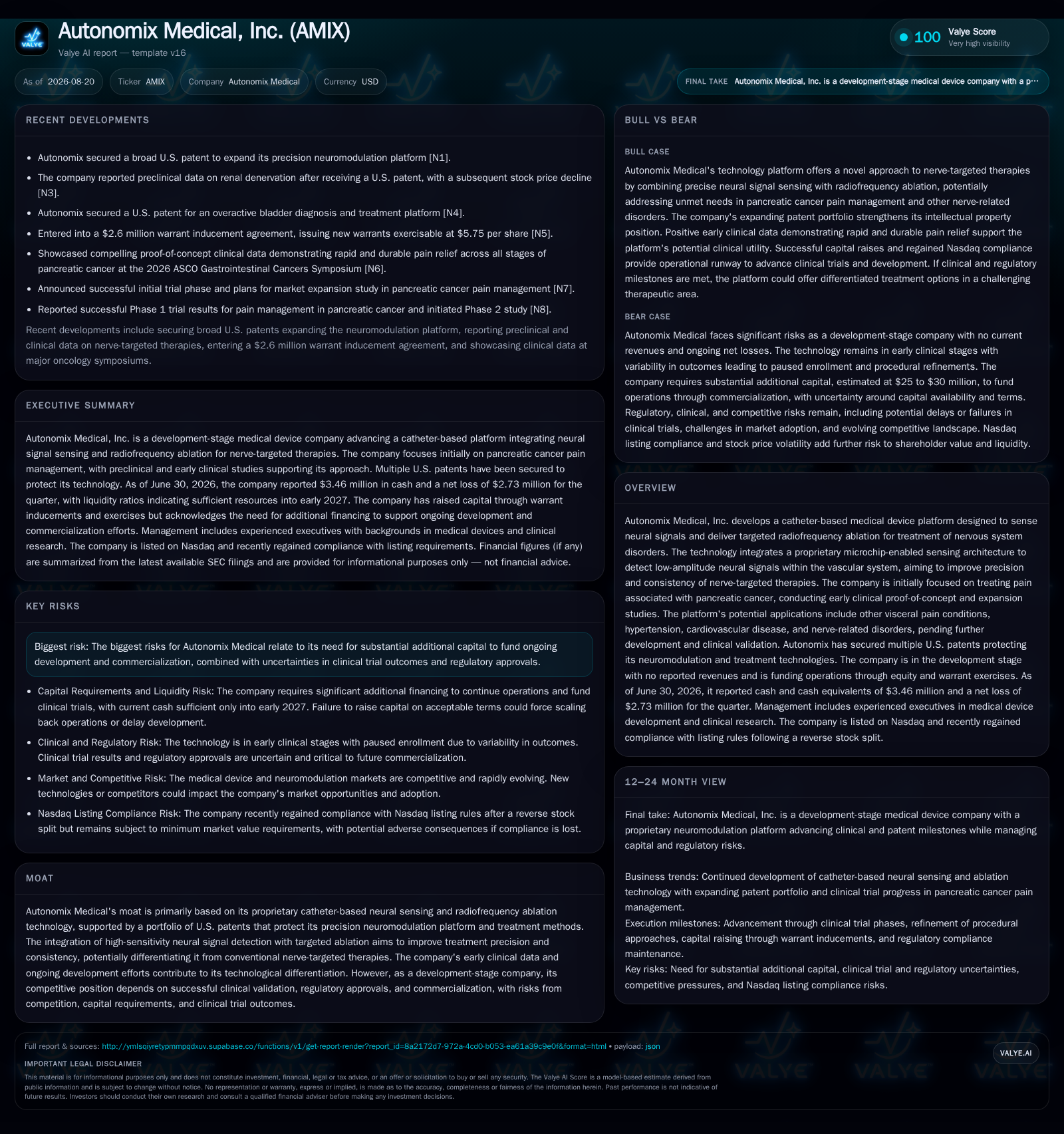
In Q2 2026, Autonomix Medical halted enrollment in its clinical expansion study after observing variability in early outcomes linked to vascular access and anatomical targeting. The company held $3.5 million in cash and $3.1 million in working capital as of June 30, 2026, with liquidity sufficient only into early 2027. Operating expenses declined 19% year-over-year, reflecting cost management amid ongoing development. These factors underscore structural uncertainties in clinical validation and significant near-term capital risk as Autonomix advances its catheter-based neuromodulation platform.
Q2 2026 Operating Update and Clinical Trial Status
Autonomix Medical, Inc. reported a significant operational development in Q2 2026 with the pause of enrollment in its clinical expansion study. This decision followed observations of variability in early clinical outcomes, which the company attributes to differences in vascular access and anatomical targeting during procedures [S2]. The clinical study is designed to assess the safety and feasibility of the company’s catheter-based neuromodulation platform that integrates neural signal sensing with radiofrequency ablation technology for transvascular nerve ablation treatments.
This enrollment pause underscores structural challenges inherent in refining the procedural approach for a novel medical device platform at an early clinical stage [S2]. Variability in patient anatomy and vascular access routes complicates consistent targeting, which is critical for demonstrating efficacy and safety in clinical trials. As a result, this pause may delay regulatory milestones and extend development timelines, potentially increasing costs associated with further procedural optimization and clinical validation.
Liquidity Position and Capital Requirements
As of June 30, 2026, Autonomix Medical reported cash and cash equivalents of $3.5 million and working capital of $3.1 million, with a current ratio of 4.85, indicating short-term liquidity sufficient to meet obligations but a limited runway for ongoing operations [S2][F1]. The company estimates that its current cash resources will fund operations only into the first calendar quarter of 2027 [S2][S5].
Recent equity capital was bolstered by a warrant inducement and exercise in July 2026, which increased shares outstanding to approximately 971,043 [S3]. The cash inflow from this exercise is reflected in the July 28, 2026, filing but does not affect the June 30, 2026, liquidity position [S2], [F1].
The company anticipates requiring an additional $25 to $30 million in financing to support clinical development and commercialization efforts for its initial indication [S5]. This sizable funding gap highlights significant near-term capital risk, as insufficient financing could constrain the company’s ability to resume clinical enrollment and advance toward regulatory approval.
Business Model and Competitive Positioning
Autonomix Medical’s business model focuses on developing and commercializing a proprietary catheter-based medical device platform designed for transvascular nerve ablation therapies. The device integrates microchip-enabled neural signal sensing with targeted radiofrequency ablation technology, aiming to provide a minimally invasive treatment option for nerve-related conditions [S1][S2].
Future revenue is expected to derive from sales of the medical device to healthcare providers and institutions, contingent on successful regulatory clearance and clinical adoption. Margins and cash conversion will depend on manufacturing efficiency, pricing strategies, and the rate of procedural adoption by clinicians. Currently, the company operates at a net cash outflow due to ongoing research, development, and clinical trial expenses.
The company holds U.S. patents covering its technology, providing a degree of technological differentiation. Nevertheless, clinical validation and regulatory approval remain significant hurdles before the platform can achieve commercial viability [S2]
Risks and Scenario Analysis
The clinical enrollment pause reflects structural risks associated with procedural variability and anatomical challenges in early clinical development [S2][S3]. If Autonomix successfully refines its clinical and procedural approach, it could resume enrollment and progress toward regulatory milestones within the next 12 to 18 months, supported by additional capital raises. Confirmation of this scenario would include resumption of enrollment, positive interim clinical data, and announcements of financing or partnerships.
Conversely, persistent clinical variability and limited cash runway could delay trial progress and increase costs, while financing challenges may force operational cutbacks [S2][F1][S5]. This bear case would be confirmed by prolonged enrollment pauses, announcements of scaling back activities, or deteriorating liquidity metrics.
Financial and Operational Outlook
Operating expenses in Q2 2026 decreased by 19% year-over-year, primarily due to a 31% reduction in general and administrative expenses, driven by lower stock-based compensation, legal fees, and employee compensation [S5]. Research and development expenses remained relatively stable, reflecting continued investment in clinical and product development.
The company’s cash burn of approximately $3.5 million during Q2 2026 aligns with ongoing clinical and R&D activities, underscoring the importance of securing additional financing to sustain operations beyond early 2027 [S2][S5]
Watchpoints
Key indicators to monitor include the resumption and pace of clinical trial enrollment, interim clinical data releases that address procedural variability, announcements of additional financing or capital raises, and progress toward regulatory submissions or approvals. These developments will be critical in assessing the company’s ability to overcome current operational challenges and advance its catheter-based neuromodulation platform toward commercialization.
The enrollment pause due to outcome variability and a cash runway limited to early 2027 highlight the operational and financial challenges the company faces as it continues efforts to develop and potentially commercialize its nerve ablation technology [S2]
Disclaimer: This is research-only, informational analysis and not investment advice. It may include AI-generated interpretation and general industry context. Always verify important details using primary sources.

Comments