
Amylyx Pharmaceuticals’ Transition to Late-Stage Rare Disease Pipeline Amid Financial Challenges
Amylyx is advancing multiple clinical-stage assets targeting rare diseases while facing ongoing operating losses and capital needs amid discontinued prior commercial operations.
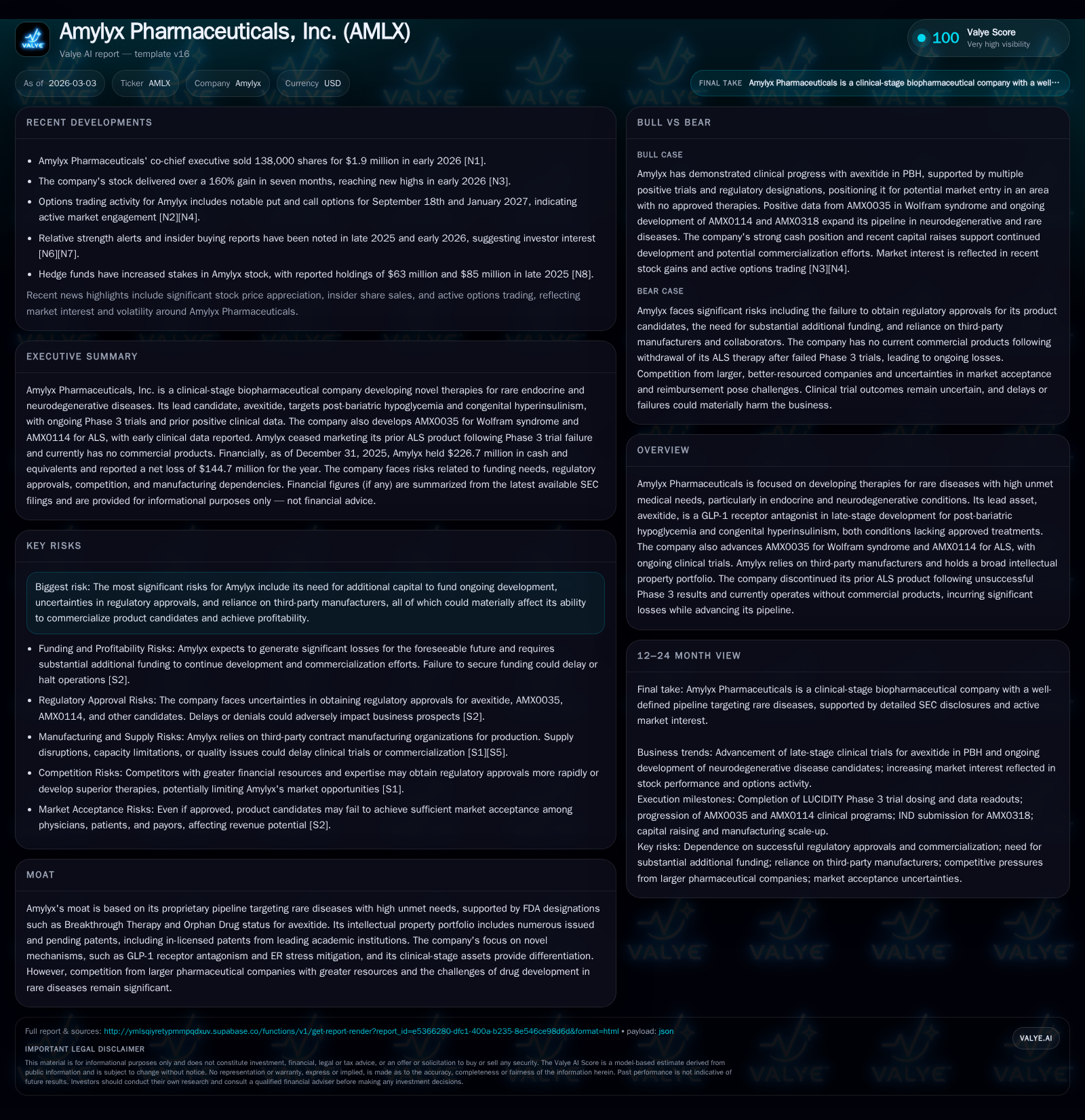
Amylyx Pharmaceuticals has pivoted from its prior ALS commercial product following unsuccessful trials to focus on a pipeline addressing rare endocrine and neurodegenerative diseases. Its lead candidate, avexitide, is in a Phase 3 trial for post-bariatric hypoglycemia and congenital hyperinsulinism, with topline data anticipated in Q3 2026. The company continues clinical development of AMX0035 and AMX0114. Despite a revenue increase in 2023 tied to legacy product sales, Amylyx remains unprofitable with significant operating losses and negative cash flows, supported by substantial cash reserves but reliant on continued capital for development and commercialization.
Company Background and Historical Performance
Amylyx Pharmaceuticals focuses on developing novel therapies for rare endocrine and neurodegenerative diseases [S1]. The company historically generated revenues primarily from RELYVRIO, an ALS treatment which was discontinued after unsuccessful Phase 3 trials [N1][S2].
Financial results show notable growth in revenue from approximately $22.2 million in FY2022 to $380.8 million in FY2023, driven by legacy ALS product sales [F1]. However, operating income reversed sharply from a positive $38.8 million in 2023 to losses of -$314.7 million in 2024 and -$153.3 million in 2025 as commercialization ceased and R&D expenses increased [F1]. Net income mirrored this trend.
Operating cash flow also deteriorated from a positive $11.9 million in 2023 to negative $167.6 million in 2024 before improving slightly to negative $123.3 million by year-end 2025 [F1]. Capital expenditures remained minimal during this period.
Historical performance (annual)
| FY | Rev ($mm) | Net ($mm) | CFO ($mm) | OpInc ($mm) | Rev YoY | Net YoY |
|---|---|---|---|---|---|---|
| 2025 | -145 | -123 | -153 | +52.0% | ||
| 2024 | -302 | -168 | -315 | -712.4% | ||
| 2023 | 381 | 49 | 12 | 39 | +1612.9% | +124.8% |
| 2022 | 22 | -198 | -180 | -201 |
Source: SEC companyfacts cache [F1].
Capital returns and efficiency (annual)
| FY | FCF ($mm) | ROE% |
|---|---|---|
| 2025 | -123 | -47.4 |
| 2024 | -168 | -183.1 |
| 2023 | 11 | 11.4 |
| 2022 | -182 | -58.2 |
Source: SEC companyfacts cache [F1].
All figures are rounded; amounts in USD millions except capex which is thousands [F1]
Pipeline Overview and Growth Outlook
Amylyx’s lead investigational asset is avexitide, a first-in-class GLP-1 receptor antagonist targeting post-bariatric hypoglycemia (PBH) and congenital hyperinsulinism (HI), both characterized by hyperinsulinemic hypoglycemia [S1]. PBH affects an estimated ~160,000 U.S. patients post-bariatric surgery with no currently approved therapies [S1].
The LUCIDITY Phase 3 trial for avexitide enrolled approximately 75 participants evaluating reduction of hypoglycemic events; topline data are expected by Q3 2026 [S1]. Avexitide holds multiple FDA designations including Breakthrough Therapy and Orphan Drug status, supporting expedited regulatory pathways [N3][S1].
Additional clinical-stage programs include AMX0035 for Wolfram syndrome and AMX0114 targeting ALS indications; these remain under active investigation without defined commercial timelines [S1][N4].
The company’s intellectual property portfolio includes issued patents and licensed technologies enhancing differentiation within competitive pharmaceutical landscapes dominated by larger players [S9].
Regulatory Milestones and Corporate Developments
Key near-term catalysts center on the avexitide Phase 3 trial readout expected Q3 2026, which will inform potential regulatory submissions [S1][N3]. Progress updates on other pipeline candidates will provide supplemental insights but lack explicit public timelines.
Amylyx faces ongoing securities litigation related to disclosures about its prior ALS product’s commercial results; confidential mediation is scheduled for March 12, 2026 [S15][S4]. Outcomes may impact financial contingencies or management priorities.
Financial Returns and Capital Allocation
Despite significant revenue growth linked to legacy products, Amylyx remains unprofitable with net losses of approximately $144.7 million in FY2025 against equity of about $305 million at year-end, implying an approximate return on equity near -47% [F1].
Operating cash flow remains negative at roughly -$123.3 million for FY2025 while capex levels are minimal relative to overall expenses, consistent with intensive clinical development spending rather than fixed asset investments [F1].
Liquidity is strong with current assets around $324 million versus current liabilities near $23 million yielding a current ratio exceeding fourteen times as of December 31, 2025 [F1].
Capital allocation has focused exclusively on advancing the clinical pipeline; the company has neither paid dividends nor conducted share buybacks given ongoing investment needs and loss-making operations [F1][S2]. Future capital requirements may necessitate equity raises or strategic partnerships.
Operational Considerations: Manufacturing and Legal Risks
Production relies extensively on third-party contract manufacturing organizations complying with cGMP standards for pipeline assets like avexitide, AMX0035, and AMX0114 [S9]. This external dependency introduces risks related to supply chain disruptions or scale-up challenges ahead of potential commercialization.
Legal exposure includes ongoing securities class action and derivative lawsuits concerning alleged misleading statements about past product performance; mediation efforts aim at resolution but uncertainties persist [S15][S4]. Regulatory compliance burdens remain significant across multiple jurisdictions.
Cybersecurity governance is robust with oversight from senior IT leadership reporting up through executive management and the board, reflecting industry best practices amid evolving digital threats [S1].
Industry Context Analysis
Rare disease drug development faces inherent challenges including small patient populations limiting scale but offset by regulatory incentives such as Orphan Drug exclusivity [S9]. Novel mechanisms like GLP-1 antagonism offer differentiation yet require successful clinical validation amidst competition from well-resourced pharmaceutical companies.
Market access depends on not only clinical efficacy but also reimbursement acceptance given premium pricing models required by limited patient populations.
Conclusion
Amylyx Pharmaceuticals is at a critical inflection point transitioning from discontinued ALS commercial activities toward a rare disease-focused pipeline led by pivotal data anticipated from avexitide’s Phase 3 trial later this year. While promising clinical opportunities exist within PBH and congenital HI indications lacking approved therapies, the company operates under sustained financial pressure marked by substantial losses and negative cash flows requiring prudent capital management.
Execution risks remain elevated due to clinical trial uncertainties inherent in rare disease drug development alongside operational dependencies on external manufacturers plus ongoing legal proceedings stemming from previous disclosures. Investors should closely monitor upcoming clinical readouts and regulatory milestones that will be pivotal for Amylyx’s prospects of returning to commercial revenue growth and achieving longer-term financial sustainability.
This analysis synthesizes publicly disclosed filings and credible news sources without constituting investment advice or recommendations.
Disclaimer: This is research-only, informational analysis and not investment advice. It may include AI-generated interpretation and general industry context. Always verify important details using primary sources.

Comments