
Alpha Metallurgical Resources Faces Revenue and Earnings Pressure Amid Metallurgical Coal Market Weakness
Alpha Metallurgical Resources experienced significant declines in revenue and profitability in 2025 as metallurgical coal market softness and operational adjustments weighed on financial results.
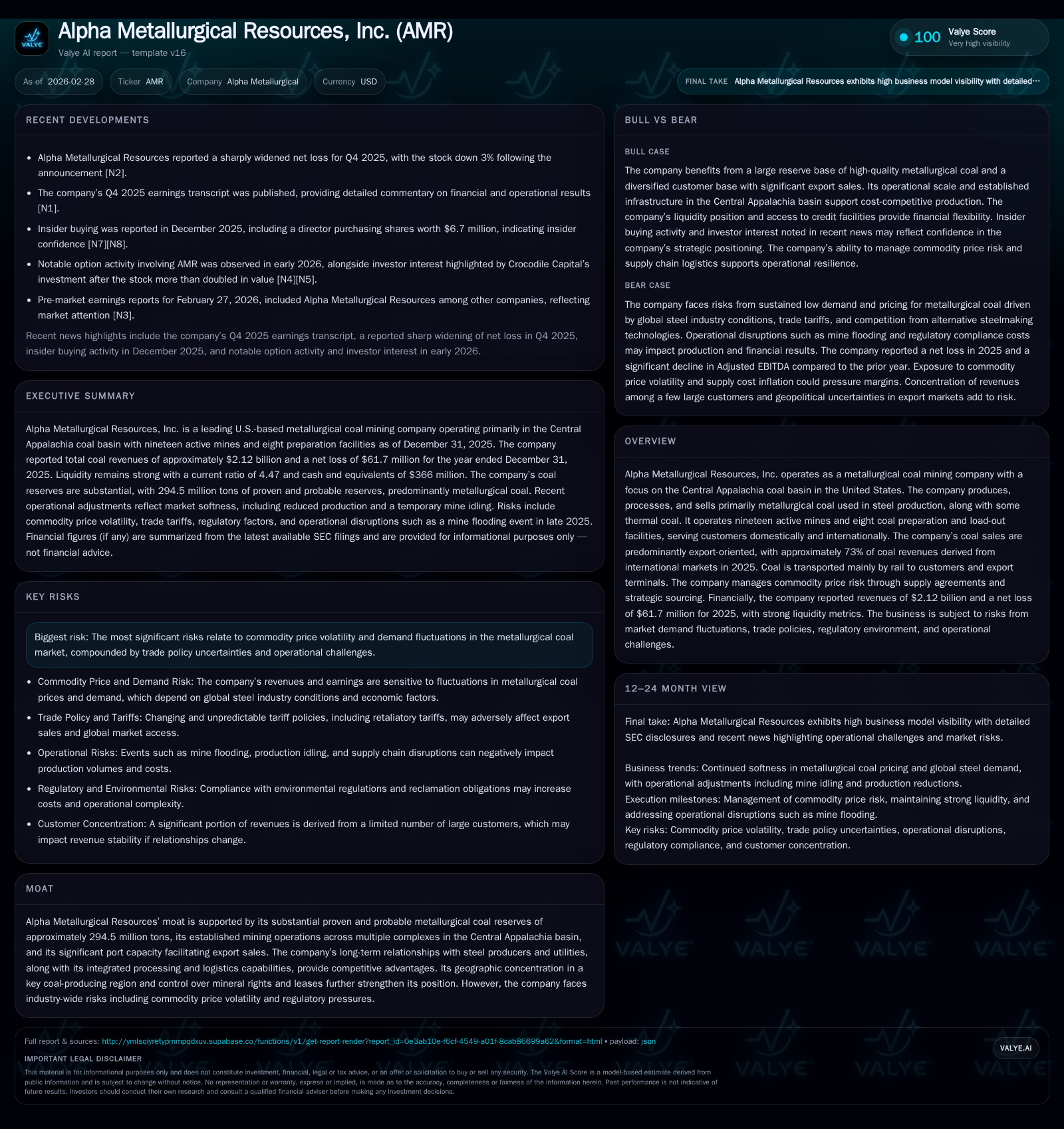
Alpha Metallurgical Resources, Inc. produced $2.13 billion in revenues for 2025, down nearly 28% from 2024, reflecting weak global demand for metallurgical coal and export market challenges. The company reported a net loss of $61.7 million in 2025, reversing profitability from prior years amid lower coal prices and reduced production volumes. Operational shifts included the temporary idling of higher-cost assets and development of a new underground mine slated to start production in 2026. Liquidity remains robust with over $365 million cash on hand and $524 million in total liquidity. Capital allocation prioritized substantial share repurchases exceeding $1.1 billion despite earnings pressure, while dividend payments were minimal following suspension of the fixed dividend program.
Historical Performance Overview
Alpha Metallurgical Resources (AMR) operates principally within the Central Appalachia (CAPP) basin focusing on metallurgical coal production used primarily for steelmaking. The company's operations are largely export-driven with a significant portion of revenues generated internationally.
Financially, AMR posted revenues of approximately $2.13 billion for fiscal year 2025, marking a 28% decrease compared to roughly $2.96 billion in 2024 [F1]. Operating income swung negative to a loss of $61 million after generating operating profits exceeding $227 million the previous year [F1]. Net income followed this trend with a net loss of $61.7 million recorded in 2025 compared to positive net income of around $187.6 million in 2024 [F1]. This deterioration reflects weakened demand dynamics for metallurgical coal globally alongside pricing pressures.
Adjusted EBITDA declined sharply by over 70% year-over-year, falling from approximately $408 million in 2024 to roughly $122 million in 2025 [S18]. The compound effect stems from both volume reductions and lower realized price per ton caused by ongoing softness in global steel production coupled with increased supply dynamics.
Historical Financial Summary (USD thousands)
Historical performance (annual)
| FY | Rev ($bn) | Net ($mm) | CFO ($mm) | OpInc ($mm) | Rev YoY | Net YoY |
|---|---|---|---|---|---|---|
| 2025 | 2.1 | -62 | 145 | -61 | -28.0% | -132.9% |
| 2024 | 3.0 | 188 | 580 | 228 | -14.8% | -74.0% |
| 2023 | 3.5 | 722 | 851 | 863 | -15.4% | -50.2% |
| 2022 | 4.1 | 1449 | 1484 | 1581 |
Source: SEC companyfacts cache [F1].
Capital returns and efficiency (annual)
| FY | Div ($mm) | Buybacks ($mm) | FCF ($mm) |
|---|---|---|---|
| 2025 | 0 | 1139 | 18 |
| 2024 | 3 | 1099 | 381 |
| 2023 | 113 | 1040 | 606 |
| 2022 | 13 | 517 | 1320 |
Source: SEC companyfacts cache [F1].
Note: Operating income and net income show material reversal from profitable prior years to losses in latest period.
Drivers of Past Growth
Historically growth was underpinned by robust global demand for met coal—particularly from Asian steel producers—as well as steady extraction volumes across AMR's portfolio of nineteen active mines spanning key seams such as Pocahontas No.3 (Kepler), Upper Chilton (Aracoma), Douglas seam (Kingston/Mammoth), among others [S1]. Significant capital investments supported mine development including recently completed Rolling Thunder and Checkmate Powellton mines providing access to higher-quality metallurgical grades [S1]. Export terminal capacity through DTA facilitated reliable access to international buyers.
Current Industry Context & Operational Adjustments
The current market environment has been challenged by slowing steel production globally amid inflationary headwinds and geopolitical uncertainties that impact trade flows especially due to tariffs imposed by U.S. administrations since early 2025 [S2]. These tariffs on imported steel affect foreign steel producers—customers of AMR's exports—leading to reduced demand or pricing concessions.
In response to softening conditions and price environment drops during late-2024 and into 2025 AMR took operational actions:
- Temporarily idled the Elk Run mining complex due to relatively high costs at the Checkmate Powellton mine that had not achieved planned production levels yet [S1].
- Reduced output at Jerry Fork and Black Eagle mines within Power Mountain and Marfork complexes [S22].
- Temporarily idled Long Branch surface mine within McClure/Toms Creek complex [S22].
- Continued advancement on the Kingston Wildcat underground mine project expected to bring low-volatility ASTM-grade met coal starting Q1-2026 supporting medium-term supply resilience [S1].
These moves aim at aligning cost structure with softer market demand while positioning the portfolio towards quality reserves.
Reserves Base & Production Footprint
The company's competitive advantage is anchored on proven and probable reserves nearing 295 million tons predominantly bituminous met coal with additional resources exceeding 522 million tons [S1]. Key mining complexes include:
- Aracoma: Three active underground mines producing High-Vol B quality met coal with mine lives ranging up to 13 years.
- Kepler: A single underground mine producing Low-Vol met coal with approx. a dozen years life.
- Kingston/Mammoth: Underground plus surface mines producing Mid/High Vol met coal; plus some thermal co-products.
- Marfork: Three active underground mines covering multiple counties delivering mostly high-quality met products.
Transportation logistics leverage CSX Transportation and Norfolk Southern Railway connections facilitating smooth delivery to domestic utilities or export terminals including capacity via DTA ownership stake [S1][S16].
Future Growth Prospects & Risks
Growth will likely hinge on recovery or stabilization in global steel demand which could improve realized met coal pricing; however lingering uncertainties around trade policies remain risks impacting exports notably [S2]. Additionally:
- The ramp-up of production at the Kingston Wildcat mine presents incremental tonnage of low-volatility met coal starting early next year providing volume growth potential [S1].
- Continued exposure to commodity price volatility with margins sensitive to input cost inflation notably diesel fuel where AMR expects ~22 million gallons purchases annually subject to market rates [S1].
- Regulatory developments involving black lung obligations may heighten collateral requirements forcing reallocation of liquidity [S17][S19].
AMR manages commodity price risk through supply agreements but competition intensified by currency fluctuations affecting foreign competitors’ pricing competitiveness introduces additional complexity [S1].
Forecasts / Milestones To Watch
While explicit guidance is not provided publicly for near-term year-on-year performance post-2025 close [N1], attention should focus on:
- Production start and ramp-up curves for Kingston Wildcat mine during Q1/Q2 of 2026.
- Met coal price trends influenced by global steel industry health including emerging tariff regulations.
- Operational decisions regarding reactivation timing for Elk Run complex if market conditions warrant.
- Capital expenditures related primarily to infrastructure upgrades at DTA targeting ~$21 million average annual investment next five years supporting shipping reliability [S16].
Returns & Capital Allocation Strategy
Despite earnings challenges in FY25 AMR maintained a proactive capital return posture:
- The company repurchased approximately $1.14 billion worth of common stock under an authorized program capped at $1.5 billion as of end-2025 leaving $361 million capacity available for further buybacks [F1][S10].
- Dividend payments ceased fixed quarterly dividends late in Q3 2023; only nominal dividends paid ($415k) versus over $110 million distributed three years earlier reflective of preservation approach given financial results [F1][S8].
Operating cash flow generation significantly declined by approximately 75% YoY from nearly $580 million down to about $145 million mainly due to margin contraction combined with working capital impacts tied to weaker sales volume; nevertheless free cash flow remains mildly positive around $18 million after capex which itself was reduced notably during the downturn representing a 36% decrease YoY ($127m vs $199m) [F1][S18][S25].
Leverage metrics remain manageable with long-term indebtedness low relative to equity value nearing $1.55 billion providing balance sheet flexibility; liquidity totals approximately $524 million including cash + short-term investments + revolving credit availability [F1][S11].[F1]
Return Metrics Approximation:
ROE approximates negative 4% based on FY25 net loss relative to shareholders' equity base [F1] reflecting near-term return headwinds typical for commodity-centric cyclicality.
Industry Structural Moat Considerations
AMR’s moat rests on several pillars:
- Large metro-coal proven reserves secured predominantly within Central Appalachia - a key global supplier region.
- Established vertically integrated mining complexes spanning underground and surface operations allowing product mix flexibility.
- Ownership interests (~65%) in DTA terminal providing critical export capacity enhancing logistical reliability amidst port capacity constraints faced by peers worldwide.[S16]
- Long-term customer relationships spanning domestic utilities and international steel producers enabling sustained contracted sales volume albeit subject to price renegotiation periodically.
- Rail transportation agreements leveraging mainline Class I railroads enabling broad geographic reach including multiple loading points.[S14]
These advantages help buffer competitive pressures though industry risks such as policy shifts on environmental regulation or trade tariffs remain inherent concerns.[N2][N3]
Conclusion & Strategic Outlook Analysis
Alpha Metallurgical Resources experienced severe earnings pressure during calendar year 2025 with sharp declines in revenue driven largely by external downstream macroeconomic weakness depressing steel demand globally coupled with cyclical oversupply concerns that pressured met coal pricing internationally. The company’s management responded decisively via tactical operational curtailments alongside disciplined capital management balancing investment into new mine development aimed for medium-term supply growth.
Liquidity remains healthy affording AMR optionality but ongoing volatility tied closely to external macro factors warrants vigilance particularly concerning tariff developments impacting customer purchasing patterns as well as cost inflation risks stemming from fuel prices and labor shortages that have affected Appalachian miners broadly.
Monitoring key developments such as volume ramp ups at Kingston Wildcat mine beginning early next year along with rolling performance updates against export contract benchmark prices will be critical milestones indicating potential stability or improvement trajectory versus the recent challenging operating environment.
This analysis is compiled purely for informational purposes drawing exclusively on publicly available data without recommendation or investment advice. Readers should consider their own context when evaluating company prospects within this volatile raw materials sector.
Disclaimer: This is research-only, informational analysis and not investment advice. It may include AI-generated interpretation and general industry context. Always verify important details using primary sources.

Comments