
AngioDynamics Strengthens Med Tech Growth Amid Margin Pressure and Market Dynamics
Latest quarterly results highlight robust Med Tech revenue gains but reveal margin compression and ongoing operational challenges.
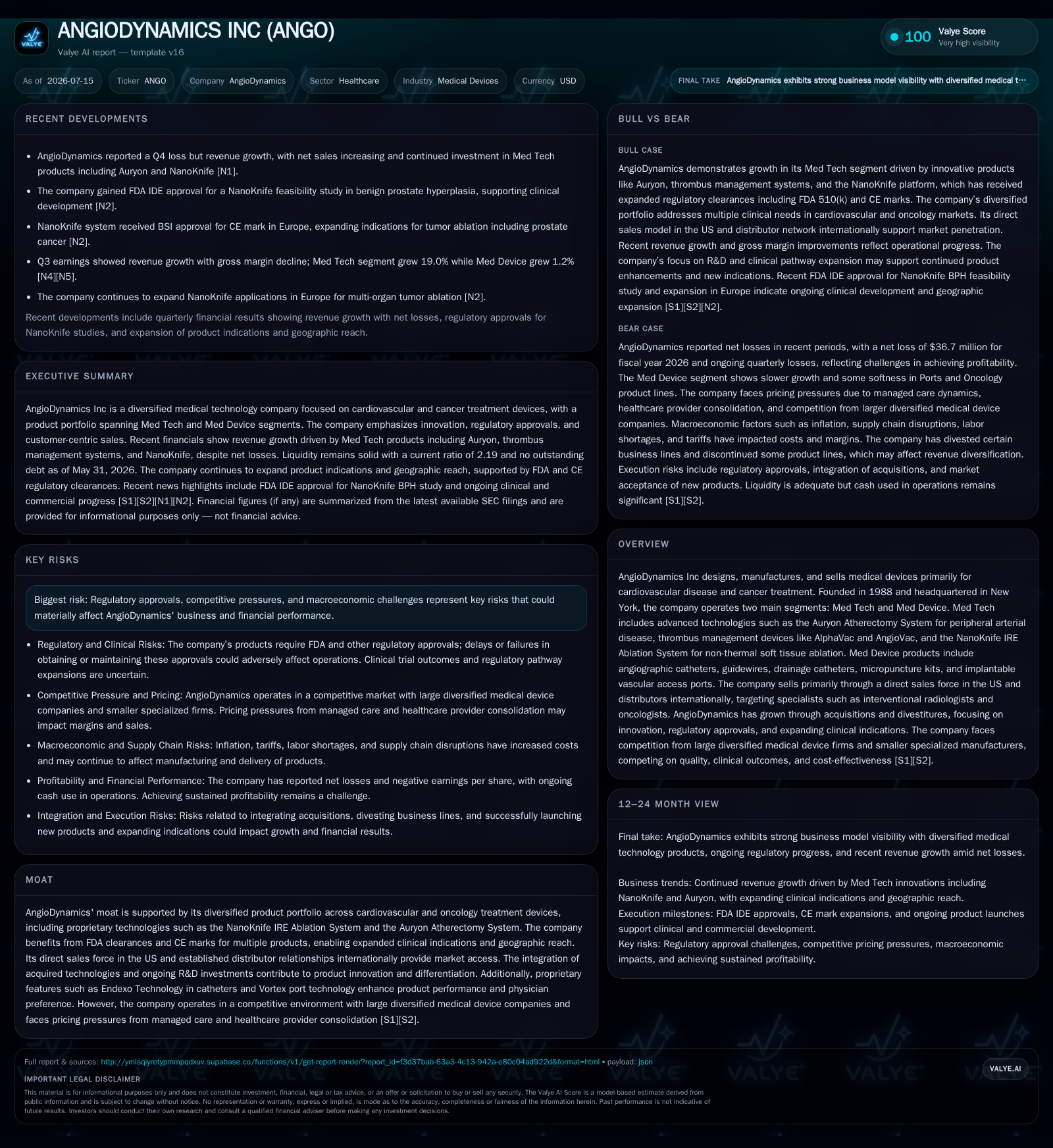
AngioDynamics delivered solid top-line growth in the fiscal third quarter of 2026, led by its Med Tech segment with 19% growth, outpacing the modest 1.2% increase in Med Device revenues. However, gross margins declined due to inflationary pressures, tariffs, and product mix shifts. The company’s focus on innovation through products like Auryon and NanoKnife supports clinical adoption and expansion into cardiovascular and oncology markets. Challenges include pricing pressure from managed care, supply chain risks, and a net loss that widened in the latest quarter. Liquidity remains sufficient for operational needs with a current ratio over 2. AngioDynamics’ competitive position rests on FDA-cleared specialty devices marketed primarily via a U.S. direct sales force and international distributors targeting specialist physicians.
Recent Operating Update
AngioDynamics reported fiscal third quarter results for 2026 with total revenue increasing 8.9% to $78.4 million, driven primarily by a 19.0% surge in its Med Tech segment, which includes proprietary technologies such as the Auryon atherectomy system and NanoKnife irreversible electroporation (IRE) ablation devices [S13][S15]. In contrast, the Med Device segment, comprising more commoditized products like angiographic catheters and vascular access devices, grew modestly by 1.2% [S13]. Despite top-line growth, gross margin contracted by approximately 110 basis points to 52.9%, reflecting inflationary pressures, tariffs on raw materials, and an unfavorable product mix [S13][S15]. Specifically, Med Tech gross margin held steady at 62.5%, while Med Device margins compressed by 320 basis points to 44.2%, highlighting the margin sensitivity of the lower-priced product lines [S13][S15]. Operating expenses increased notably, with research and development (R&D) and selling, general and administrative (SG&A) costs rising to support ongoing innovation and market expansion, contributing to a widened net loss of $8.1 million for the quarter, compared to prior year losses [S2][S12][S15].
Business Model Analysis
AngioDynamics operates through two core segments: Med Tech and Med Device. The Med Tech segment focuses on high-growth, FDA-cleared proprietary devices such as the Auryon laser atherectomy system, which offers a differentiated approach to treating peripheral arterial disease by utilizing laser technology rather than traditional mechanical debulking, and the NanoKnife system, which employs non-thermal IRE ablation technology for oncology and emerging urology indications [S1][N3][N4]. The Med Device segment includes a broad portfolio of consumable products such as angiographic catheters, vascular access ports, drainage catheters, and micropuncture kits, which are generally lower margin but provide recurring revenue streams tied to procedural volumes [S1].
Revenue generation primarily occurs through a U.S.-based direct sales force targeting specialist physicians—interventional radiologists, cardiologists, vascular surgeons, oncologists, urologists, and critical care nurses—who perform minimally invasive, image-guided procedures in hospitals and outpatient settings [S1][S4]. Internationally, the company leverages distributor networks to extend its reach, though with less direct control over customer engagement and sales force productivity [S1][S4]. The consumable nature of many products supports recurring demand, closely linked to procedure volumes and clinical adoption rates.
Key operating metrics include procedural adoption rates of innovative devices, sales force productivity, and reimbursement environment impacts. For example, the clinical adoption of NanoKnife is supported by recent FDA investigational device exemption (IDE) approvals for new indications such as benign prostate hyperplasia, which may expand the addressable market beyond oncology [N3][N4]. Sustained R&D investment, representing approximately 9–10% of sales, underpins the innovation pipeline and regulatory submissions necessary to maintain competitive positioning and expand clinical indications [S12][S15].
Margins fluctuate based on product mix between higher-margin proprietary technologies and lower-margin commoditized products, manufacturing cost inflation driven by tariffs and labor costs, production scale efficiencies, and pricing pressures from managed care contracts and group purchasing organizations prevalent in the healthcare sector [S13][S15]
Industry Structure and Competitive Position
The cardiovascular and oncology medical device sector is characterized by stringent regulatory oversight, requiring FDA clearances supported by clinical evidence, which creates high barriers to entry and protects established players with cleared platforms [S1]. AngioDynamics occupies a mid-tier position, focusing on niche specialty devices with proprietary technologies such as Endexo surface modification integrated into vascular access products to enhance device performance and reduce complications [S1].
The competitive landscape includes large diversified medical device manufacturers like Stryker Corporation and Abbott Laboratories, which offer broader portfolios and greater R&D resources but may lack the specialized technological differentiation AngioDynamics pursues in select niches [S1].
AngioDynamics’ competitive advantages stem from continuous product innovation—such as the laser-based Auryon atherectomy system versus mechanical competitors—regulatory clearances enabling expanded clinical indications, a focused U.S. direct sales force cultivating physician familiarity, and established international distributor relationships facilitating geographic reach [S1]. Strategic acquisitions have augmented the product portfolio, enabling cross-selling synergies and broader market penetration [S1].
However, consolidation among healthcare providers intensifies pricing pressures as larger hospital systems leverage scale for discounts, and value-based purchasing models emphasize cost containment, limiting pricing power even for clinically differentiated products [S1]. Additionally, supply chain disruptions exacerbated by labor shortages and inflationary input costs challenge operational flexibility and margin stability.
Growth Drivers
AngioDynamics’ growth prospects are supported by several structural factors:
- Innovation-led product launches: The recent FDA IDE approval for NanoKnife’s application in benign prostate hyperplasia expands the clinical pipeline beyond oncology into urology, opening new patient populations and procedural volumes [N3][N4]. Ongoing clinical trials and label expansions remain critical milestones.
- Demographic tailwinds: An aging population drives increased incidence of peripheral arterial disease and cancer diagnoses, fueling demand for minimally invasive interventional treatments where AngioDynamics’ devices offer clinical advantages.
- Geographic expansion: While the U.S. remains the primary market served via direct sales, efforts to grow international presence through distributor networks aim to capture incremental revenue, albeit with challenges in sales force control and market penetration.
- Sales force effectiveness: Targeted coverage of specialist physicians performing high-volume procedures supports adoption rates, though competitive pressures require continued investment in sales and marketing.
- Strategic acquisitions: Historical acquisitions have broadened the product portfolio, enhancing cross-selling opportunities and technological capabilities; management remains open to selective future deals subject to liquidity and financing considerations [S2].
- Value-based purchasing adaptation: Demonstrating superior clinical outcomes and cost-effectiveness supports premium pricing under evolving reimbursement models emphasizing long-term value over upfront costs.
Risks and Watchpoints
Key risks facing AngioDynamics include:
- Regulatory hurdles: Delays or difficulties in obtaining FDA approvals or clearances can impede time-to-market and restrict clinical indications, slowing growth.
- Pricing pressure: Consolidation among healthcare providers and managed care negotiations exert downward pressure on pricing and margins, especially for commoditized products.
- Supply chain and inflation: Volatility in raw material costs due to tariffs and labor shortages increases manufacturing expenses, negatively impacting gross margins.
- Competitive intensity: Larger diversified firms with greater R&D budgets and distribution reach pose ongoing competitive challenges.
- Integration risks: Past and future acquisitions require effective integration to avoid operational disruptions.
- Macroeconomic factors: Economic downturns may reduce elective procedure volumes, which constitute a significant portion of device utilization.
- Cybersecurity threats: The company acknowledges cybersecurity risks that could disrupt operations or compromise sensitive data, necessitating robust governance and controls [S1]
Monitoring operational KPIs such as segmented sales growth, regulatory approval milestones, gross margin trends, and customer adoption rates—particularly for new products like NanoKnife—is essential to assess execution against strategic objectives.
What To Watch Next
Upcoming catalysts include clinical trial progress and regulatory updates for pipeline products, such as NanoKnife feasibility studies in new indications, which could drive revenue growth beyond legacy offerings [N3][N4]. Given the widening operating losses despite revenue gains, controlling operating expenses and improving R&D efficiency will be critical to enhance profitability [S2][S12][S15].
Gross margin trends should be closely observed for impacts from tariffs and raw material cost fluctuations, providing early signals on supply chain risk management [S13][S15]. Management commentary on potential acquisition activity or capital expenditure plans during earnings calls will offer insights into strategic capital allocation and growth priorities [S2]. Additionally, shifts in reimbursement policies or provider purchasing strategies under value-based care models may materially affect unit economics and device utilization rates.
Financial Profile Discussion
As of the fiscal third quarter ended February 28, 2026, AngioDynamics held approximately $53.9 million in cash and equivalents, with current assets totaling $163.4 million against current liabilities of $74.7 million, yielding a current ratio of 2.19, indicating sufficient liquidity to meet operational needs over the next 12 months without near-term refinancing concerns [F1][S2]. Total debt remains near $132.5 million based on best-effort estimates, resulting in a net debt position of approximately $78.6 million after accounting for cash holdings [F1].
Operating losses widened to $8.1 million in Q3 FY26, driven by margin pressures and increased investments in sales force productivity and R&D, with selling and marketing expenses representing roughly 35% of sales and R&D maintaining a stable ratio near 9–10% of revenue [S2][S12][S15]. These expenditures align with strategic priorities to expand addressable markets through clinical and regulatory advancements.
Cash flow from operations remains a critical funding source, supplemented by available revolving credit facilities that provide flexibility for external shocks or opportunistic acquisitions requiring cash consideration, as management has indicated potential external financing needs if acquisition activity intensifies [S2]. Working capital management is active, with increases in accounts receivable partially offset by inventory reductions, reflecting resource allocation efforts amid challenging economic conditions.
This analysis integrates the latest reported financial data and regulatory disclosures with sector-specific context relevant to cardiovascular and oncology medical devices. It emphasizes key operational metrics, competitive positioning, and strategic growth drivers without extrapolating beyond documented evidence.
Disclaimer: This is research-only, informational analysis and not investment advice. It may include AI-generated interpretation and general industry context. Always verify important details using primary sources.

Comments