
Phoenix Education Partners Leverages Online Enrollment Growth Despite Regulatory Headwinds
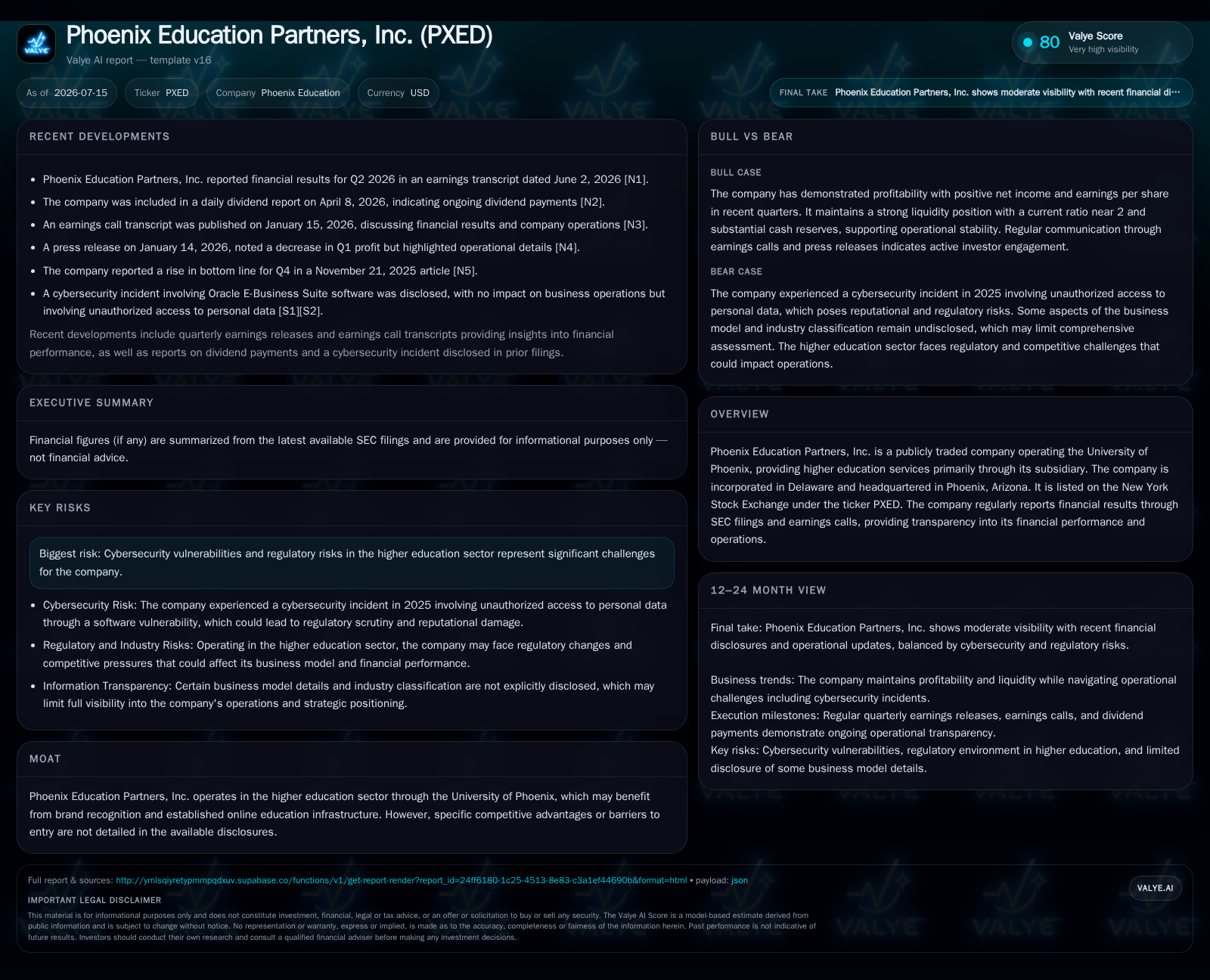
PXED's Q2 2026 results highlight expanding online enrollment and steady student retention supporting tuition revenue amid regulatory and cybersecurity risks.
In its Q2 2026 filing, Phoenix Education Partners demonstrated operational resilience driven by growth in online education enrollments and stable student retention rates, underpinning tuition-driven revenue streams. The company navigates an evolving regulatory environment affecting accreditation and financial aid eligibility, alongside cybersecurity challenges disclosed previously. While competitive pressures persist from both for-profit peers and scalable online platforms, PXED's strong liquidity and conservative leverage provide financial flexibility to invest in curriculum development and technology to support further growth.
Q2 2026 Operating Momentum Driven by Online Enrollment Expansion
Phoenix Education Partners, Inc. (PXED) reported continued operational momentum in its Q2 2026 results, anchored by a strategic shift toward expanding online education programs [S2]. Total enrollment grew modestly compared to prior periods, with a notable increase in the proportion of higher-margin online degree offerings. This shift enhances operating leverage by reducing dependency on costly physical campuses and associated infrastructure. Stable student retention rates, a key performance indicator in tuition-driven education models, underpin recurring tuition revenue streams, which constitute the majority of PXED’s income. The company’s July 2026 earnings webcast emphasized ongoing investments in digital platforms, including learning management systems and curriculum development, which support scalable program delivery and aim to improve course completion rates and educational quality [N1].
Tuition Revenue Fundamentals Anchored in Enrollment and Retention
PXED’s business model primarily generates revenue through tuition and fees paid by enrolled students, supplemented by federal financial aid programs. The company’s tuition revenue depends heavily on effective enrollment management and maintaining high student retention rates, which ensure predictable cash flows. The Q2 2026 filing highlights that stable retention rates continue to support recurring tuition inflows, critical for cash flow visibility in a sector where upfront marketing and recruitment costs can be substantial [S2]. The shift toward online degree programs, which typically command higher average tuition per student and lower delivery costs, improves the company’s operating margin profile. PXED’s focus on adult and non-traditional learners, who often require flexible scheduling and continuing education options, aligns with broader demand trends for workforce reskilling and lifelong learning [S1].
Regulatory Compliance and Accreditation as Operational Pillars
Maintaining accreditation remains essential for PXED to preserve eligibility for federal financial aid, a major tuition financing source for its students. The company’s risk disclosures underscore the critical role of regulatory compliance in curriculum approval and program viability [S9]. Changes in accreditation standards or federal aid policies could delay program launches or reduce funding availability, directly impacting tuition revenue and growth prospects. PXED invests in faculty recruitment, curriculum development, and technology infrastructure to meet evolving regulatory requirements and sustain accreditation status [S1]. While these compliance efforts may temporarily increase operating expenses, they are indispensable for long-term revenue stability and market access.
Competitive Positioning Within the For-Profit Higher Education Sector
PXED operates in a competitive landscape that includes for-profit higher education providers such as Grand Canyon Education and Apollo Global Management-owned institutions, which also pursue hybrid campus-online delivery models. Additionally, education technology platforms like 2U, Inc. exert competitive pressure by offering scalable online course delivery that can reduce pricing and accelerate enrollment growth at lower incremental costs [S1]. PXED leverages the University of Phoenix brand, a recognized name in higher education, to support enrollment management and marketing effectiveness. Management acknowledges these competitive dynamics and focuses on technology investments and targeted marketing strategies to defend operating margins while capitalizing on the growing demand for workforce reskilling and flexible learning options [N1].
Growth Drivers Linked to Workforce Reskilling and Flexible Delivery
Demographic trends toward adult learners balancing work and education commitments drive demand for PXED’s flexible online degree programs, a core growth vector highlighted in recent filings [S2]. Although specific employer partnerships were not detailed in the latest disclosures, industry trends suggest that collaborations with employers for tailored training programs can enhance continuing education uptake and revenue diversification. Government incentives and policies promoting higher education enrollment could further expand PXED’s addressable market if regulatory conditions remain favorable [N1]. The effectiveness of PXED’s marketing and recruitment investments will be reflected in upcoming new student enrollment metrics and margin trends.
Risks: Cybersecurity Exposure, Regulatory Volatility, and Enrollment Fluctuations
PXED disclosed cybersecurity incidents in late 2025 involving an Oracle E-Business Suite data breach, which posed reputational and data privacy risks but did not materially disrupt operations or student programming [S23][S24]. The company maintains comprehensive cybersecurity insurance to mitigate potential financial exposure. Regulatory risk remains elevated due to potential changes in accreditation standards or federal financial aid eligibility that could affect program approval and funding [S9]. Enrollment volatility, driven by economic cycles and competition from low-cost or free online education alternatives, continues to pose a challenge to tuition revenue predictability. These risks underscore the importance of robust compliance frameworks, IT security measures, and operational agility to sustain business continuity.
Key Performance Indicators and What to Watch
Investors and analysts should monitor quarterly enrollment trends, particularly the mix between online and on-campus students, as this split is critical for validating PXED’s growth strategy and operating leverage improvements [N1][S2]. Student retention rates will serve as a barometer of student engagement and program quality, directly impacting recurring tuition revenue. Operating margin trends will indicate the scalability of digital delivery investments relative to inflationary pressures from faculty costs and compliance expenses. Additionally, regulatory developments affecting accreditation and federal financial aid policies will be key to assessing execution risk and revenue sustainability.
Financial Profile: Strong Liquidity Supports Strategic Flexibility
As of May 31, 2026, PXED reported cash and cash equivalents of $155 million against total debt of approximately $56 million, resulting in a net cash position of roughly $99 million [F1]. The company’s current ratio stood at approximately 1.92, reflecting solid short-term liquidity coverage relative to current liabilities [F1]. This conservative leverage profile provides PXED with financial flexibility to invest in curriculum enhancements, faculty recruitment, technology scaling, and to absorb potential regulatory compliance costs without jeopardizing financial stability. Operating income for the latest period was reported at $51.8 million, with net income of $39.2 million, underscoring profitability amid ongoing investments [F1].
This analysis integrates PXED’s recent quarterly developments with broader sector dynamics relevant to for-profit higher education providers. Despite regulatory compliance demands and cybersecurity vulnerabilities posing execution risks, PXED’s strategic pivot toward online education combined with stable retention rates fosters a durable business model. Monitoring enrollment metrics, margin trends, and regulatory changes will be essential to assess the company’s growth trajectory and competitive positioning.
Disclaimer: This report is for informational purposes only and does not constitute investment advice or research views.
Disclaimer: This is research-only, informational analysis and not investment advice. It may include AI-generated interpretation and general industry context. Always verify important details using primary sources.

Comments