
Zoomcar’s Transition to Peer-to-Peer Car Sharing Faces Financial and Adoption Challenges
Zoomcar Holdings, Inc. is reshaping urban mobility in emerging markets with its peer-to-peer car sharing platform but contends with severe liquidity constraints and nascent market adoption.
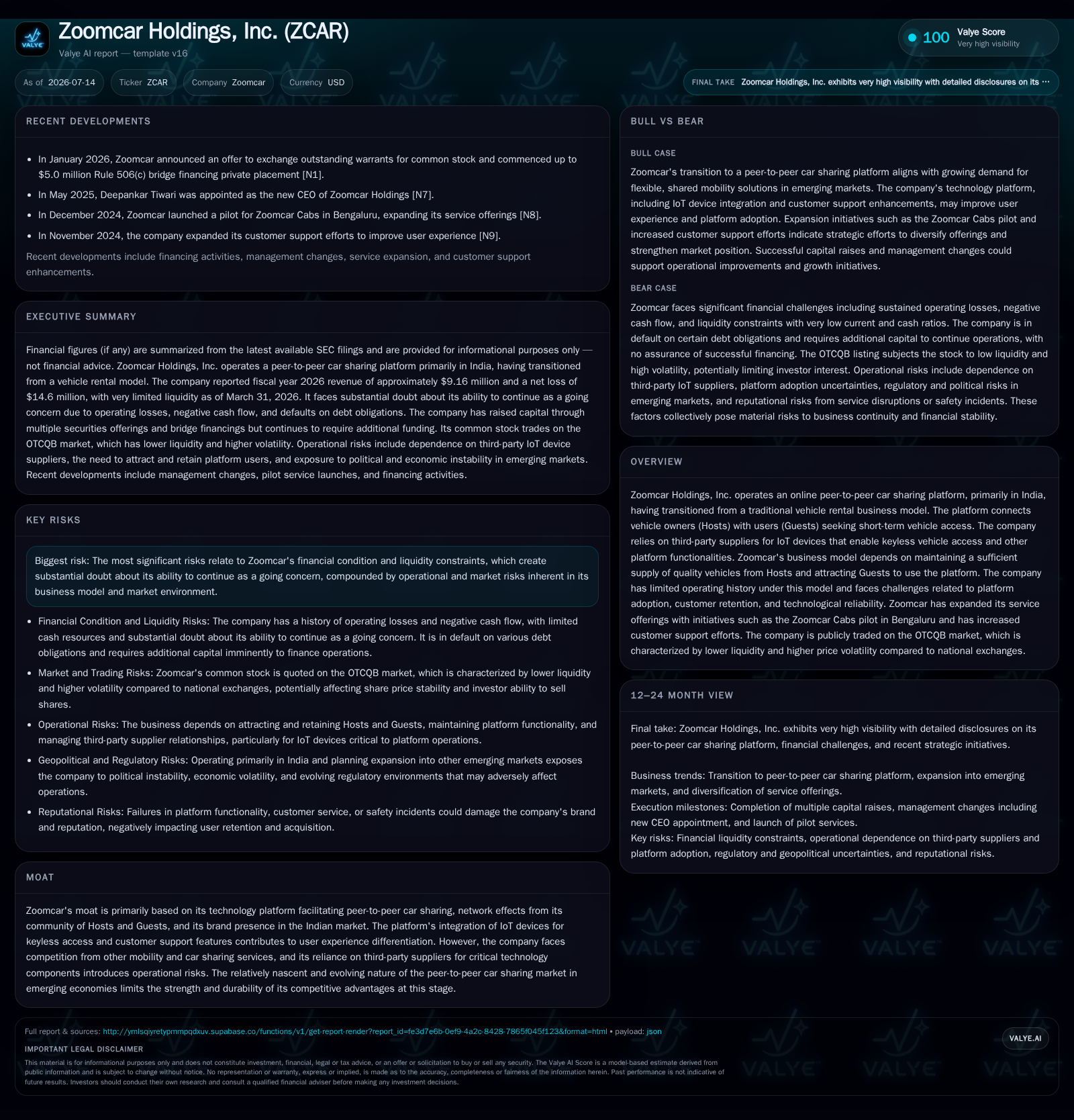
Zoomcar has pivoted from traditional car rental to an online peer-to-peer car sharing marketplace, connecting vehicle owners (Hosts) with users (Guests) primarily in India. The company’s platform relies heavily on technology integration—including IoT-enabled keyless access—to differentiate itself, aiming to leverage network effects and expand service offerings. Despite these strategic moves, Zoomcar’s limited operating history under this model and ongoing liquidity crises raise significant execution risks, compounded by competition from both traditional rental firms and ride-hailing services. Near-term growth hinges on increasing platform adoption, improving customer retention, and securing fresh capital to sustain operations.
Latest Operating Update: Acute Liquidity Pressure Amid Strategic Platform Pivot
Zoomcar Holdings, Inc. reported in its latest quarterly filing for the period ended December 31, 2025, that it continues to navigate significant financial distress while advancing its transition to a peer-to-peer car sharing marketplace [S2]. As of March 31, 2026, the company held approximately $329,000 in cash and equivalents against current liabilities exceeding $37 million, resulting in a critically low current ratio of 0.03 [F1]. This imbalance underscores an urgent liquidity crisis that threatens Zoomcar’s ability to sustain operations without immediate capital infusion.
The company’s total debt stood near $2.5 million as of March 2025, with net debt (debt minus cash) around $2.18 million [F1]. Several debt instruments are in default, carrying punitive interest rates up to 22% per annum, further exacerbating financial strain [S5][S7]. Delays in servicing debt obligations have constrained operational flexibility, while ongoing securities purchase agreements reflect efforts to bridge funding gaps [S3]. However, given the scale of liabilities relative to resources, Zoomcar’s survival hinges on successful refinancing or equity raises, which remain uncertain.
Business Model: Digital Marketplace Connecting Hosts and Guests
Zoomcar operates a technology-driven peer-to-peer car sharing platform primarily focused on India’s emerging urban mobility market [S1]. The platform connects private vehicle owners (“Hosts”) who list their cars for short- to medium-term rentals with users (“Guests”) seeking flexible, self-driven mobility solutions without the burdens of ownership. Revenue is generated mainly through transaction fees and commissions on bookings, supplemented by ancillary services such as insurance facilitation.
A key differentiator is the integration of third-party IoT-enabled keyless access devices, allowing Guests seamless vehicle entry without physical key exchanges—a critical feature for scalability across dispersed urban geographies [S1]. While this enhances user convenience and operational efficiency, it introduces dependency risks on suppliers’ technological reliability and maintenance.
The platform’s value proposition depends on expanding the active Host base to ensure a diverse fleet across vehicle models and price points, while simultaneously growing the Guest user pool to drive booking frequency and vehicle utilization rates [S1]. Historically, growth has relied heavily on organic word-of-mouth and brand reputation, with management signaling intentions to increase sales and marketing investments to accelerate platform adoption and retention
Industry Context and Competitive Landscape
Peer-to-peer car sharing is an emergent segment within the broader mobility-as-a-service ecosystem, distinct from traditional rental companies like Hertz or Avis that own and operate fleets, and ride-hailing services such as Uber or Ola that focus on chauffeur-driven rides. Platforms like Turo and Getaround represent closer U.S.-based peers emphasizing technology-enabled peer-to-peer vehicle rentals.
Zoomcar’s competitive positioning leverages early mover advantage in India’s urban centers, where rising smartphone penetration and shifting consumer preferences favor flexible, cost-effective mobility alternatives [S1]. However, structural challenges persist:
- Regulatory frameworks for vehicle sharing vary across Indian states, creating compliance complexity.
- Infrastructure limitations complicate vehicle handoff logistics and maintenance scheduling.
- Established rental operators with fleet ownership can leverage scale economies to undercut pricing.
- Ride-hailing platforms increasingly bundle multiple mobility services, potentially encroaching on self-drive rental demand.
Network effects remain nascent; achieving critical mass among Hosts is essential to provide sufficient geographic coverage and vehicle variety, which in turn attracts and retains Guests. Without scale, pricing power and gross margins remain constrained.
Growth Drivers: Enhancing Engagement and Service Diversification
Urbanization and cost-conscious consumer trends underpin demand for peer-to-peer car sharing in emerging markets [S1]. Zoomcar aims to deepen Guest engagement beyond discrete trip bookings by promoting broader use cases and intra-city travel options. Initiatives such as the Zoomcar Cabs pilot in Bengaluru seek to diversify offerings by integrating ride options beyond traditional rentals [S1].
Increasing post-booking engagement is a strategic priority, as current usage patterns show Guests primarily booking for planned trips. Enhancing platform features—such as loyalty programs for Guests and streamlined listing management tools for Hosts—could improve repeat booking rates and customer lifetime value [S1].
Geographic expansion into tier-1 and select tier-2 Indian cities, where digital adoption is robust, represents another growth vector. Partnerships with insurance providers mitigate risk exposure inherent in peer-to-peer rentals and create ancillary revenue streams [S1]. Management acknowledges that scaling marketing spend beyond organic growth is necessary to accelerate platform adoption and brand awareness
Risks and Watchpoints: Financial Viability and Market Adoption Challenges
Zoomcar faces multiple risks that threaten its strategic execution and financial sustainability:
- Going Concern Uncertainty: The company explicitly discloses substantial doubt about its ability to continue as a going concern absent immediate capital raises, given its history of operating losses and defaulted debt obligations [S2][S5][S11]. Cash runway projections extend only through early 2026 without new funding [S17].
- Platform Adoption Risk: Peer-to-peer car sharing is nascent in India, requiring overcoming trust barriers among Hosts and Guests to achieve sufficient scale and vehicle utilization [S1].
- Technology Dependency: Reliance on third-party IoT devices for keyless access introduces operational risks; device failures or supplier disruptions could degrade user experience and retention.
- Regulatory and Legal Exposure: Variability in local transport and commercial vehicle laws, coupled with ongoing legal proceedings related to labor and contractual disputes, add compliance costs and management distraction [S1][S7].
- Competitive Pressure: Traditional rental firms with fleet ownership and ride-hailing platforms bundling mobility services exert pricing and market share pressure.
- Market Liquidity and Trading Constraints: Following delisting from Nasdaq Global Market in May 2025 due to failure to meet listing standards, Zoomcar’s common stock trades on the OTCQB platform, limiting institutional investor participation and increasing share price volatility [S1][S2].
Key Metrics and Indicators to Monitor
Zoomcar’s trajectory will be shaped by several operational and financial indicators:
- Successful execution of announced funding rounds in mid-2026 filings, which are critical to extending liquidity beyond Q1 2026 [S3].
- Growth in the number of active Hosts and Guests, along with booking frequency and vehicle utilization rates, signaling platform adoption and network effect development.
- Customer retention metrics and repeat booking rates reflecting engagement depth.
- Progress and user feedback from pilot projects like Zoomcar Cabs, indicating diversification effectiveness.
- Platform uptime and IoT device reliability reports, which directly impact user satisfaction and operational continuity.
- Regulatory developments clarifying vehicle sharing compliance requirements or imposing new costs.
- Management’s marketing spend and strategic initiatives to broaden customer acquisition beyond organic growth [S1].
Financial Profile: Acute Liquidity Constraints and Debt Burden
As of March 31, 2026, Zoomcar’s cash and cash equivalents totaled approximately $328,586, while current liabilities stood at $37,535,986, yielding a critically low current ratio of 0.03 [F1]. This liquidity profile highlights an urgent need for capital infusion to meet short-term obligations and sustain operations.
Total debt was approximately $2.5 million as of March 2025, with net debt (debt minus cash) near $2.18 million [F1]. Several debt instruments are in default, carrying default interest rates up to 22% per annum, which significantly increase the effective debt servicing burden [S7][S12]. The company has a history of operating losses and negative cash flow, with operating income of negative $6.77 million and net losses exceeding $14.6 million for the latest period [F1].
Recent capital raises through convertible notes and securities purchase agreements indicate some investor willingness to provide interim financing [S3]. However, the company remains dependent on further equity or debt raises to avoid insolvency, with refinancing terms and timing uncertain given market conditions and operational risks.
Disclaimer: This analysis is based solely on public filings and industry data available as of July 2026. It does not constitute investment advice or research views.
Financial snapshot as of 2026-03-31
- Cash & equivalents: $328,586
- Current assets: $1,260,089
- Current liabilities: $37,535,986
- Current ratio: 0.03
- Total debt: $2,511,444 (as of 2025-03-31)
- Net debt: $2,182,858
- Operating income: -$6,767,583
- Net income: -$14,621,113
Disclaimer: This is research-only, informational analysis and not investment advice. It may include AI-generated interpretation and general industry context. Always verify important details using primary sources.

Comments