
Waste Energy Corp. Advances Modular Waste-to-Energy Facility Amid Commercial and Financial Hurdles
The company's Midland, Texas site aims to prove its thermal waste conversion technology, but delays and capital constraints temper near-term outlook.
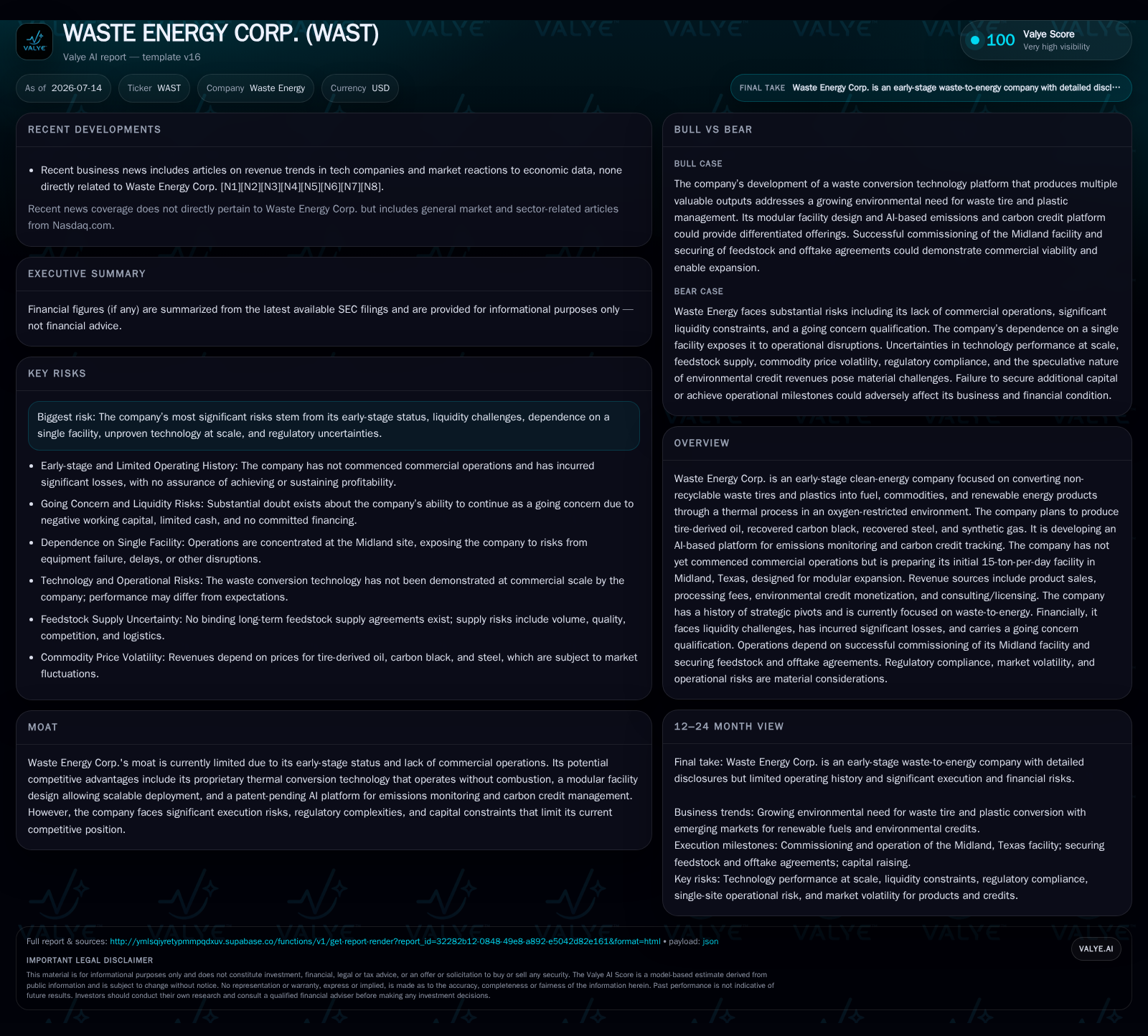
Waste Energy Corp. is poised to begin commercial operations with its initial 15-tons-per-day modular waste conversion facility in Midland, Texas, representing a critical step in validating its thermal conversion technology for non-recyclable tires and plastics. Despite progress in equipment delivery and site preparation, the firm faces meaningful execution risks, including unproven commercial-scale operation, lack of finalized feedstock and offtake agreements, and extensive regulatory compliance requirements. Financially, substantial operating losses persist alongside liquidity challenges that heighten dependency on external financing to sustain business continuity. The company’s longer-term growth hinges on successful facility commissioning, securing sustainable feedstock sources and product markets, expanding facilities modularly, and monetizing environmental credits through its AI-driven platform.
Recent Operating Update: Commissioning Ready but Commercial Operations Pending
Waste Energy Corp. reported that its initial 15-tons-per-day (TPD) modular waste conversion system, designed to thermally process non-recyclable tires and plastics, arrived at the Midland, Texas site by the end of 2025 but had not cleared customs or commenced installation as of the first quarter of 2026. Payments totaling approximately $653,000 were made for this equipment but recorded as a capital advance pending transfer of control [S1][S6]. The company anticipates beginning commissioning in Q3 2026; however, commercial operations have not yet started [S7]. This commissioning phase is a critical near-term milestone to validate the proprietary thermal conversion technology operating in an oxygen-restricted environment and to demonstrate consistent feedstock throughput, product yield rates, and operational uptime converting waste into tire-derived oil (TDO), recovered carbon black (rCB), recovered steel, and synthetic gas (syngas) [S6][S16]. Any delays or performance shortfalls during commissioning could postpone revenue generation and increase capital expenditures.
Management continues to rely on this single facility for initial revenue generation, exposing the company to concentrated operational risk if technical or regulatory challenges arise during start-up [S7][S16]. Achieving stable throughput volumes and desired product yields will be vital operating KPIs that remain unproven at commercial scale within Waste Energy's deployment
Business Model: Diverse Revenue Streams Dependent on Execution
Waste Energy’s business model centers on multiple revenue streams derived from its thermal waste-to-energy process [S6][S10]. The company plans to generate revenue from (i) sales of tire-derived oil (TDO) to industrial users, refiners, and brokers; (ii) sales of recovered carbon black and steel commodities to industrial and recycling markets; (iii) feedstock processing fees charged to municipalities, tire haulers, transfer stations, and industrial waste generators; (iv) monetization of environmental credits including carbon and plastic credits; and (v) consulting and licensing services related to its developing AI-based emissions monitoring platform
The thermal conversion process breaks down waste tires and plastics at elevated temperatures without combustion, producing liquid fuels suitable for industrial use or further refining, alongside solid recovered materials. This positions Waste Energy within the waste-to-energy value chain as a converter selling multiple product types to distinct downstream end-users, including fuel brokers, refiners, and material recyclers. The feedstock processing fees, analogous to tipping fees, provide a volume-linked revenue component contingent on steady feedstock intake.
Additionally, Waste Energy is developing a patent-pending AI platform for real-time emissions monitoring, PFAS detection in feedstock streams, and automated carbon credit creation and tracking. This platform is intended to be integrated into its facilities and potentially licensed externally, representing a potential technology moat and a diversification into software-enabled environmental compliance solutions—an emerging differentiator in the sector [S6]. However, these digital revenues remain speculative until commercial deployment and validation.
Industry Structure and Competitive Position
The waste-to-energy industry includes a spectrum of operators, from large-scale municipal solid waste incinerators such as Covanta and Wheelabrator to advanced chemical recycling firms like Agilyx and Brightmark specializing in plastics-to-fuel conversions. Waste Energy’s niche focuses on non-recyclable tires and mixed plastics processed through an oxygen-restricted thermal conversion route that produces fuel oils and commodity materials without the combustion-related emissions typical of incineration.
Waste Energy’s modular facility design enables scalable deployment, starting with a 15 TPD footprint expandable to 30 TPD through a second processing line and ultimately up to 60 TPD within the Midland site. This modularity offers potential advantages in capital efficiency and faster market entry compared to larger bespoke plants requiring heavier upfront investment, which could shorten time-to-revenue cycles if execution proceeds smoothly [S7]
The proprietary thermal process’s emissions profile may align well with tightening environmental regulations under the Clean Air Act and Texas Commission on Environmental Quality (TCEQ) oversight, but this also increases permitting complexity. The evolving regulatory landscape imposes stringent air quality monitoring requirements, where Waste Energy’s AI-based emissions monitoring platform could provide a competitive edge if operationally validated [S8][S19].
Growth Drivers: Policy Tailwinds and Technological Promise
Structural growth drivers include increasing regulatory pressure to reduce landfill disposals, particularly for environmentally challenging waste streams like tires and plastics. This creates demand for scalable circular economy solutions such as Waste Energy’s thermal conversion technology. Market projections indicate rising plastic waste generation, reinforcing the need for advanced waste-to-energy alternatives [S12].
Demand for renewable and alternative fuels supports market acceptance of tire-derived oil as a substitute industrial fuel. Concurrently, the expansion of voluntary and regulated carbon credit markets offers incremental upside through environmental credit monetization. Waste Energy’s AI-based emissions monitoring platform aligns with increasing regulatory scrutiny over environmental compliance reporting, potentially generating licensing revenues beyond core processing operations.
Early municipal partnerships, including vendor registration with Midland County, provide initial feedstock supply routes essential for throughput targets. The company’s modular expansion plans reflect management’s intent to replicate proof-of-concept success regionally near major waste sources, landfills, transfer stations, and industrial hubs to minimize transportation costs and optimize operational efficiency [S7][S12].
Risks and Watchpoints: Execution Uncertainty and Financial Fragility
Waste Energy faces significant execution and financial risks common to early-stage waste-to-energy firms. Key risks include:
These risks underscore the fragile near-term viability of Waste Energy, requiring flawless project execution and timely capital raises amid challenging market conditions, further complicated by OTCQB penny stock trading restrictions that limit financing options.
What to Watch Next
Key upcoming milestones that will shape Waste Energy’s trajectory include:
- Completion of equipment customs clearance and installation progress updates.
- Confirmation of commissioning start date and early operational throughput metrics validating technology performance.
- Finalization of binding multi-year feedstock supply agreements to ensure steady volume intake.
- Execution of materially binding product offtake contracts to secure revenue visibility.
- Acquisition of all required regulatory permits, particularly air emissions permits necessary for full commercial operation.
- Progress on commercialization and licensing of the AI-based emissions monitoring platform.
- Announcements of financial liquidity events such as equity raises or credit facilities to address immediate funding needs and support ongoing operations, including an estimated $900,000 in general and administrative expenses over the next twelve months [S11]
Monitoring these developments will provide insight into whether Waste Energy can transition from pilot and development stages into a sustainable commercial operator capable of scaling modular waste-to-energy facilities across multiple regions.
Financial Profile Discussion
Capital raising efforts will likely involve dilutive equity issuances or debt instruments with potentially onerous terms, including convertible notes with default penalties, which could further constrain financial flexibility if commissioning and commercialization are delayed [S26]. Governance improvements, including remediation of internal control material weaknesses, remain a priority to enhance public issuer credibility and facilitate future fundraising [S20][S27].
This analysis synthesizes public filings through July 14, 2026, without offering investment advice or valuation opinions. Waste Energy Corp.'s potential hinges critically on successfully translating near-complete development work into stable commercial throughput while navigating substantial financial constraints endemic to early-stage waste-to-energy startups.
Disclaimer: This is research-only, informational analysis and not investment advice. It may include AI-generated interpretation and general industry context. Always verify important details using primary sources.

Comments