
King Resources’ Blockchain-Enabled Collectibles Strategy Faces Capital and Customer Concentration Risks
King Resources operates a hybrid physical-digital collectibles trading model leveraging blockchain-based digital ownership tokens but remains challenged by liquidity and customer concentration risks.
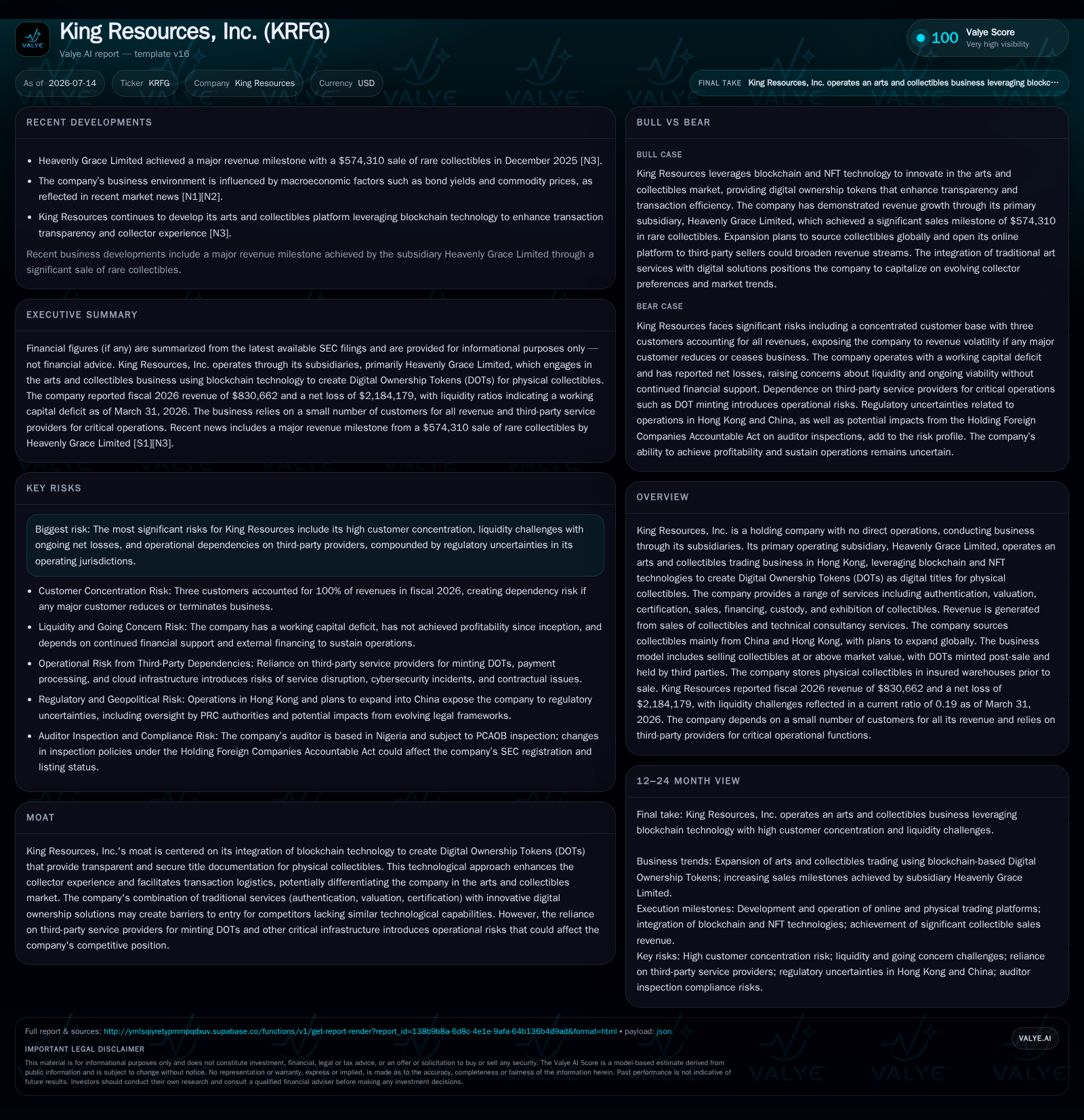
King Resources, Inc. has refocused from technology hardware towards a niche arts and collectibles trading business through its subsidiary Heavenly Grace Limited, which integrates blockchain and NFTs to enhance provenance and transaction transparency. Despite meaningful revenue growth to $830,662 as of March 2026, the company is unprofitable with a net loss exceeding $2 million and a precarious liquidity position evidenced by a current ratio below 0.2. Its business model combines traditional art market services with innovative digital ownership tokens (DOTs) for physical collectibles but faces operational dependencies on third-party providers for token minting and custody. Additionally, King Resources relies heavily on a handful of customers—three accounted for all revenues in fiscal 2026—exposing it to significant concentration risk. Expansion efforts include plans to globalize sourcing and open their online platform to broader marketplace participation, yet execution risks persist amid uncertain regulatory environments and funding needs.
Recent Operating Update
King Resources, Inc. reported continued operational challenges in its fiscal year ended March 31, 2026, as it transitions fully into the arts and collectibles trading sector through its subsidiary Heavenly Grace Limited. The company recorded revenue growth to $830,662, a substantial increase from $76,921 in the prior year, reflecting initial traction in its niche market [F1]. However, the company remains unprofitable with a net loss of $2,184,179 for the year, driven by significant increases in sales, marketing, and technology development expenses as it invests in platform enhancement and customer acquisition [S1][F1]. Liquidity remains a critical concern, with cash and equivalents of only $8,789 against current liabilities exceeding $1.46 million, resulting in a current ratio of 0.19, underscoring a precarious working capital position [F1][S3][S4]. The company’s survival depends heavily on continued shareholder financing, including a planned investment of up to $20 million from Williamsburg Venture Holdings, LLC over the next two to three years [S3][S4].
Business Model Specifics
King Resources’ pivot from technology hardware to arts and collectibles trading was formalized in late 2024 through the divestiture of its former power technology subsidiaries and acquisition of Heavenly Grace Limited, which now operates as its primary business unit in Hong Kong [S1]. Heavenly Grace operates a hybrid physical-digital collectibles trading model, sourcing physical collectibles primarily from Mainland China and Hong Kong at discounts to market valuations determined by recognized appraisal experts. These collectibles are authenticated, valued, and certified (AVC) before sale, leveraging both traditional channels and blockchain-enabled innovations [S1].
The company integrates blockchain technology by minting Digital Ownership Tokens (DOTs), a form of non-fungible token (NFT), which serve as tamper-proof digital certificates of title and provenance linked to physical collectibles. This approach aims to enhance transparency and trust in provenance, addressing a key pain point in the collectibles market where authenticity and ownership history are often opaque [S1]. DOT minting and custody services are outsourced to third-party providers, introducing operational dependencies and risks related to service continuity and regulatory compliance [S1].
Revenue is generated primarily through the resale of collectibles at or above market value via Heavenly Grace’s online platform and third-party auction houses [S1]. The company plans to evolve its platform into a marketplace model, enabling direct peer-to-peer transactions between sellers and collectors. This would shift revenue generation toward scalable transaction and platform fees, reducing reliance on inventory turnover margins and expanding monetization avenues
Additional services include hire purchase and financing options to broaden collector accessibility, custody and security services for physical assets, and exhibition opportunities to enhance collector engagement. These value-added services align with industry practices aimed at increasing customer lifetime value and platform stickiness.
Industry Structure & Competitive Position
The arts and collectibles trading industry is traditionally dominated by intermediaries providing sourcing, authentication, valuation, certification, and sales facilitation services. King Resources’ hybrid model situates it at the intersection of physical asset management and emerging blockchain-based provenance solutions, a niche that combines elements of established auction houses like Sotheby’s and Christie’s with digital registry platforms such as Artory and Codex Protocol.
This integration of blockchain technology for digital ownership tokens differentiates King Resources by offering enhanced provenance transparency and transaction security, potentially increasing buyer confidence and secondary market liquidity. However, this also introduces complexity and operational risk not typically encountered by pure-play auction houses or NFT marketplaces like OpenSea.
Customer concentration is a significant risk factor; three customers accounted for 100% of revenues in fiscal 2026, highlighting vulnerability to demand shocks and underscoring the need for broader customer diversification [S1]. Scaling sourcing beyond China and Hong Kong to global markets is a critical growth step to mitigate geographic concentration and expand collectible variety, a common trajectory for maturing players in this sector.
Growth Drivers
Key growth drivers include the increasing adoption of blockchain and NFT technologies for provenance and ownership verification, which appeals to tech-savvy collectors seeking transparent and immutable ownership records. The planned development of the online marketplace platform aims to unlock recurring revenue streams through transaction fees, reducing dependency on direct collectible sales and improving gross margin potential [S1]
Expanding sourcing channels internationally will diversify inventory and reduce reliance on regional markets, addressing supply-side constraints. Financing and hire purchase offerings enable collectors with limited upfront capital to participate, broadening the addressable market.
Investments in sales and marketing reflect management’s focus on customer acquisition and community building, essential for network effects that drive platform liquidity and repeat transactions. Enhanced authentication and certification turnaround times will be important to maintain buyer confidence and support premium pricing relative to market valuations.
Risks and Watchpoints
Customer Concentration: The company’s revenue dependence on three customers in FY2026 exposes it to significant top-line volatility if any major customer reduces or ceases business, given the absence of long-term volume commitments [S1]
Operational Dependencies: Reliance on third-party providers for DOT minting, cloud infrastructure, payment processing, and custody services introduces risks of service disruption, contract non-renewal, or regulatory challenges, particularly given the geopolitical complexities of operating in Hong Kong and China [S1].
Liquidity and Capital Structure: King Resources faces acute liquidity constraints with a working capital deficit exceeding $1.19 million and net debt of approximately $13.2 million as of late 2025, necessitating substantial shareholder financing to sustain operations and fund growth initiatives [F1][S3][S4]. Failure to secure adequate capital could result in cessation of operations.
Regulatory Uncertainty: The evolving regulatory landscape for digital asset securities in Hong Kong and China presents compliance challenges and potential transactional restrictions, which could impede scaling of the hybrid physical-digital collectibles model.
Margin Pressure: Elevated costs associated with technology development, sales and marketing expansion, and compliance efforts weigh on near-term profitability, especially given the modest revenue base [S16]
Market Volatility: The collectibles market’s inherent valuation subjectivity and sensitivity to collector sentiment may lead to inventory markdowns or liquidity delays, impacting cash flow and gross margins.
What To Watch Next
Key milestones include the launch and adoption of the open-access marketplace platform enabling peer-to-peer collectible sales with transaction fee monetization, which would mark a strategic shift toward scalable, recurring revenue. Metrics such as the number of collectibles sourced internationally and volume of DOTs minted will provide insight into platform traction and blockchain adoption.
Efforts to diversify the customer base beyond the current concentrated pool will be critical to reduce revenue volatility. Monitoring sales and marketing expense trends relative to customer acquisition outcomes will indicate execution effectiveness.
Liquidity developments, particularly the timing and scale of funding from Williamsburg Venture Holdings LLC and other shareholders, will be pivotal in assessing the company’s ability to sustain operations and invest in growth [S3][S4]
Financial Profile Discussion
As of March 31, 2026, King Resources held $8,789 in cash and equivalents against current liabilities of approximately $1.47 million, resulting in a current ratio of 0.19, reflecting significant liquidity constraints [F1]. Current assets totaled $271,830, while net debt stood near $13.2 million as of September 30, 2025, highlighting substantial leverage and working capital deficits that limit operational flexibility [F1]. The company’s continuation as a going concern depends on securing additional capital resources, with management anticipating significantly higher cash expenditures in 2027 driven by platform development and marketing investments [S1][S3][S4].
In conclusion, King Resources operates an innovative hybrid arts and collectibles trading business that leverages blockchain-enabled digital ownership tokens to enhance provenance and transaction transparency. While this positions the company to differentiate itself within a traditional market, significant risks remain from liquidity pressures, customer concentration, operational dependencies on third-party service providers, and regulatory uncertainties. Successful execution of its marketplace platform and diversification strategies, alongside securing critical funding, will be essential for sustainable growth.
The analysis presented here incorporates publicly filed disclosures as well as industry context; it does not constitute investment advice nor research view.
Disclaimer: This is research-only, informational analysis and not investment advice. It may include AI-generated interpretation and general industry context. Always verify important details using primary sources.

Comments