
OFA Group Advances AI-Powered Architectural Services and Real Estate Tokenization Despite Liquidity Constraints
OFA Group integrates AI-driven design automation and blockchain asset tokenization into traditional architectural workflows while navigating Nasdaq listing challenges and expanding into Japan.
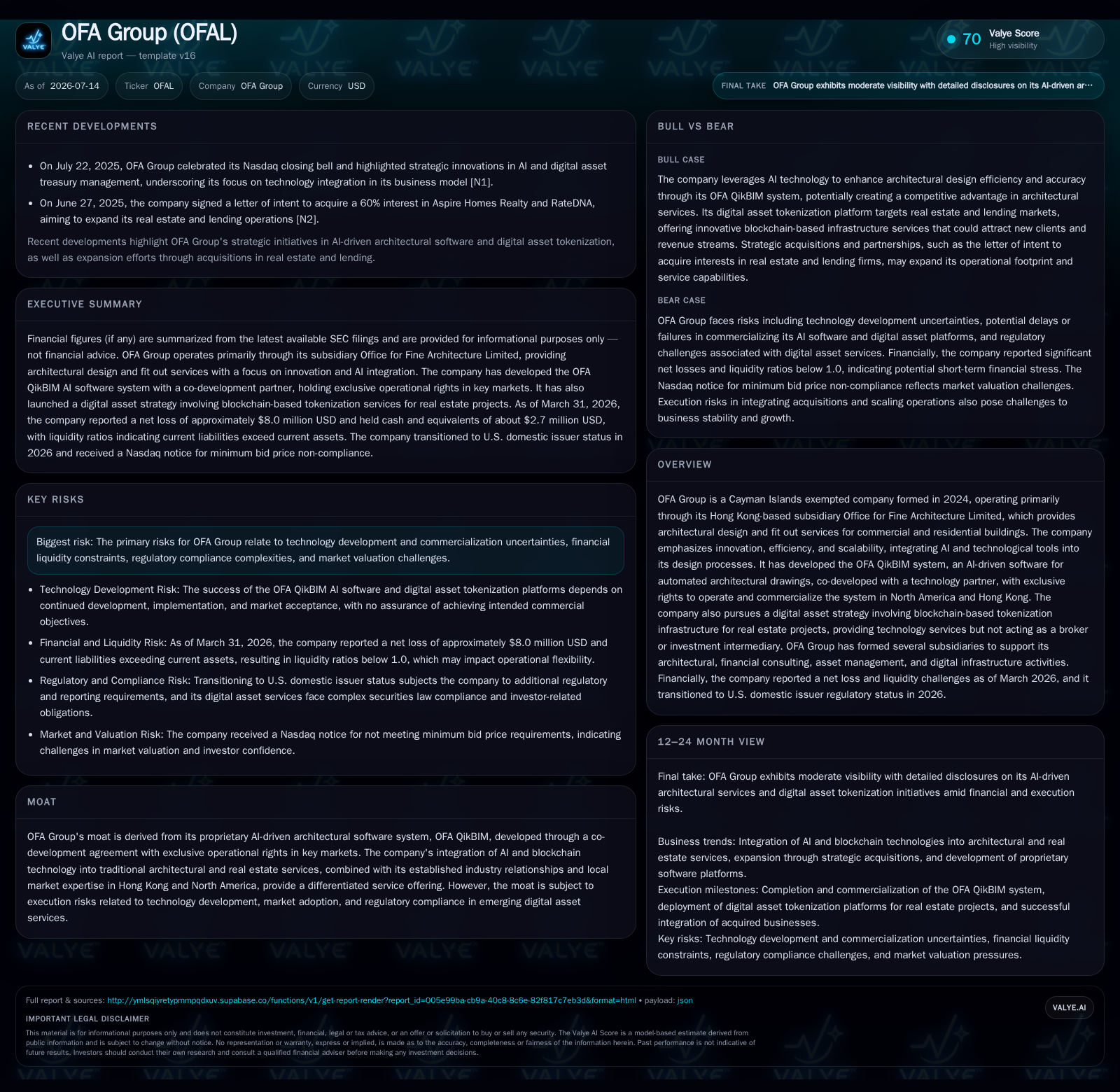
OFA Group operates through its Hong Kong-based subsidiary offering architectural design and fit out services, augmented by proprietary AI software such as OFA QikBIM and plans for an AI building code compliance tool. The company is advancing a digital asset strategy focused on blockchain-based tokenization of real estate projects via its Hearth Labs subsidiary. Recent filings reveal ongoing equity financing activities, a strategic geographic expansion into Japan with new subsidiaries, and a Nasdaq minimum bid price deficiency with potential reverse split remedies. Despite negative operating income and a current liquidity deficit, OFA is investing in technology development to position itself at the intersection of architecture and digital innovation.
Recent Operating Update
OFA Group’s latest SEC filings culminate most recently in the June 23, 2026 Form 8-K [S3], which primarily formalizes their equity issuance framework under exemptions from registration. More materially, the July 14, 2026 Form 10-K filing provides comprehensive insight into OFA’s evolving business model, technological advances, geographical expansion initiatives, financial condition, and capital markets standing [S1][S4][S5]. The company has not issued Class A ordinary shares or converted preferred shares during recent closings but relies on private placements involving accredited sophisticated investors to fund growth [S3].
A critical near-term development is OFA’s Nasdaq minimum bid price deficiency letter received in late 2025; the stock has traded below $1 for over 30 consecutive business days triggering Nasdaq’s remedial process. The company has entered an extended compliance period lasting until December 7, 2026 and considers executing a reverse stock split to restore listing compliance while maintaining uninterrupted trading under "OFAL" [S5][S6]. This liquidity event backdrop factors into capital allocation decisions throughout fiscal 2026.
Simultaneously, OFA is pushing forward strategic expansions beyond Hong Kong with the establishment of Japanese subsidiaries - OFA Japan Inc. and OFA Japan Asset Management Inc. - initiated in May 2026 to develop projects including regional revitalization efforts around Choshi City [S4][S8]. These moves reflect diversification across geography and sector (including real estate entertainment) to broaden revenue bases.
Business Model
OFA Group generates revenue predominantly from architectural design consultation and fit out contracting services delivered mainly via its Hong Kong subsidiary Office for Fine Architecture Limited. This operational arm handles project phases from conceptual layouts and detailed drawings to construction support like installing partitions, plumbing, electrical wiring, furniture fixtures, emphasizing comprehensive client service from plan to execution [S22]. The company’s clientele spans commercial entities and residential property owners reflecting standard market sectors.
Distinctively, OFA has embedded proprietary technology into its service offering. The cornerstone is the OFA QikBIM™ AI-driven Building Information Modeling platform developed jointly with a tech partner holding exclusive operational rights in North America and Hong Kong. This platform automates aspects of architectural drawing production—such as coordinated architectural plans and structural BIM models—potentially reducing cycle times while enhancing design accuracy [S23][N# unavailable].
In parallel it is advancing PlanAID™, an automated building code compliance verifier leveraging AI to analyze designs against municipal regulations — anticipated for commercial release in Q3 2026. Such technology tools open avenues beyond one-off project fees toward recurring licensing or subscription revenue streams if broadly adopted by architecture firms or regulatory agencies.
Further monetization efforts include acceptance of cryptocurrency payments (BTC & SOL) since mid-2025 for its services with custodial solutions secured by Kraken exchange [S26][S23]. Separately it manages a dedicated digital asset treasury aiming for long-term capital appreciation balanced against liquidity needs under governance frameworks set for asset allocation bands (70%-90% BTC / 10%-30% SOL) overseen by external advisors like Bitwise Asset Management without discretionary investment control
Additionally, OFA has constructed a blockchain infrastructure subsidiary Hearth Labs responsible for tokenizing real estate-related assets via smart contracts enabling fractional ownership models aligned with its real-world-asset distribution strategy — entailing complex regulatory navigation but potentially scalable financing mechanisms layered atop physical property developments [S26]
This hybrid offering positions OFA at the intersection where traditional architecture meets emergent tech-enabled real estate finance. While the core remains project-driven design-plus-fit-out contracting — inherently discrete transactions dependent on client acquisition — growing software platforms & digital assets can shift revenue mechanics towards technology licensing recurring revenues with higher gross margins if adoption succeeds.
Industry Structure and Competitive Position
The architecture and architectural technology services sector remains highly fragmented globally with players ranging from legacy design firms (e.g., Gensler) to specialized BIM software providers (e.g., Autodesk) alongside emergent startups integrating AI automation or digital twin technologies. Competition pivots on design innovation quality, regulatory navigability especially regarding building codes, client relationships often tied to reputation or locality expertise, pricing competitiveness given project bidding norms, plus increasingly technology enablement.
OFA benefits from strong local industry integration through its eleven-year HK Institute of Architects membership base supporting over 100 client accounts locally—a nontrivial moat based on network effects within Hong Kong’s dense market [S22]. Exclusive rights to co-developed AI tools like QikBIM™ further provide potential defensibility absent widespread comparable products combining BIM automation with integrated compliance verification.
However, barriers remain low enough that other medium-sized boutique firms or large regional competitors could copy some tech functionality or undercut contract bids without comparable technological investment upfront. Moreover, broad market adoption of AI-enabled tools remains nascent; sustained investments are required to validate commercial viability versus incumbent manual workflows still preferred by many architects.
OFA’s added focus on blockchain tokenization slots them partly alongside blockchain infrastructure providers targeting real estate digitization rather than pure architecture peers alone—an emerging niche impacted by regulatory uncertainties involving securities laws concerning tokenized assets.
Growth Drivers
Multiple drivers underpin OFA’s growth ambitions:
- Technology Adoption: Increasing demand from clients for efficiency gains via AI-driven design automation supports planned commercial launch of PlanAID™ as well as incremental uptake of QikBIM™.
- Urban Expansion: Rapid urbanization across Asia-Pacific including Japan where OFA recently expanded creates fresh demand for new commercial/residential developments requiring architectural input.
- Blockchain Tokenization Trend: Growing interest globally in fractionalized real estate investments via digital tokens aligns with Hearth Labs’ platform capabilities potentially unlocking new financing routes.
- Geographic Diversification: Entry into the Japanese market and entertainment-related projects broadens end-market exposure reducing concentration risks compared to prior dependence mainly on Hong Kong properties.
- Client Sector Broadening: Targeting healthcare and hospitality sectors expands portfolio breadth beyond traditional office/residential buildings addressing more resilient or specialized segments.
- Digital Asset Treasury: Strategic cryptocurrency holdings provide potential treasury value appreciation contributing flexibly towards operational funding or investment capacity.
These drivers also hinge critically on successful execution milestones such as launching PlanAID™, achieving user adoption benchmarks for QikBIM™, completing joint ventures in Japan timely, and navigating regulatory hurdles associated with real estate tokens issuance.
Risks and Challenges
What to Watch Next
Key near-term indicators include:
- Commercial launch status and adoption metrics of PlanAID™ building code tool anticipated by Q3 2026 [S23]
- Progress updates regarding Japanese subsidiary operations including joint venture Miyabi Spectrum Inc.’s role on Choshi City revitalization projects [S4]
- Nasdaq bid-price compliance trajectory through December 2026 deadline including any reverse stock split resolutions announced [S5]
- Financial performance trends assessing operating loss trajectory reduction or improvements in liquidity ratios beyond March quarter snapshot [F1]
- Regulatory developments impacting blockchain token issuance platforms under Hearth Labs auspices clarifying potential go-to-market pathways [S26]
- Client diversification efforts capturing healthcare/hospitality sector contracts evidencing portfolio resilience shifts [S8]
Financial Profile Discussion
At the latest reporting date (March 31, 2026), OFA held approximately $2.7 million in cash versus total debt approximating $470 thousand resulting in negative net debt positioning; however, the company faced significant short-term liquidity stress reflected by current liabilities exceeding $7.9 million against current assets at $3.9 million yielding an acute current ratio deficiency at roughly 0.49 suggesting working capital deficits likely requiring external funding or operational cash flow improvements soon [F1]
Operating income was substantially negative at about $8 million indicating early-stage investment intensity particularly into technology development initiatives including the proprietary QikBIM™ platform rollout and ongoing software commercialization efforts alongside geographical expansion costs [F1][S23][S4]. The company also maintains an equity facility agreement enabling up to $100 million of share issuances subject to shareholder approvals providing available capital raising optionality albeit dilutive [S24].
It does not constitute investment advice or research views. Readers should conduct their own due diligence before making any financial decisions involving this company.**
Disclaimer: This is research-only, informational analysis and not investment advice. It may include AI-generated interpretation and general industry context. Always verify important details using primary sources.

Comments