
Solitron Devices Faces Customer Concentration and Manufacturing Complexity Amid Modest Product Mix Shifts
Latest quarterly filings highlight ongoing revenue concentration risks and operational challenges in military-grade semiconductor manufacturing.
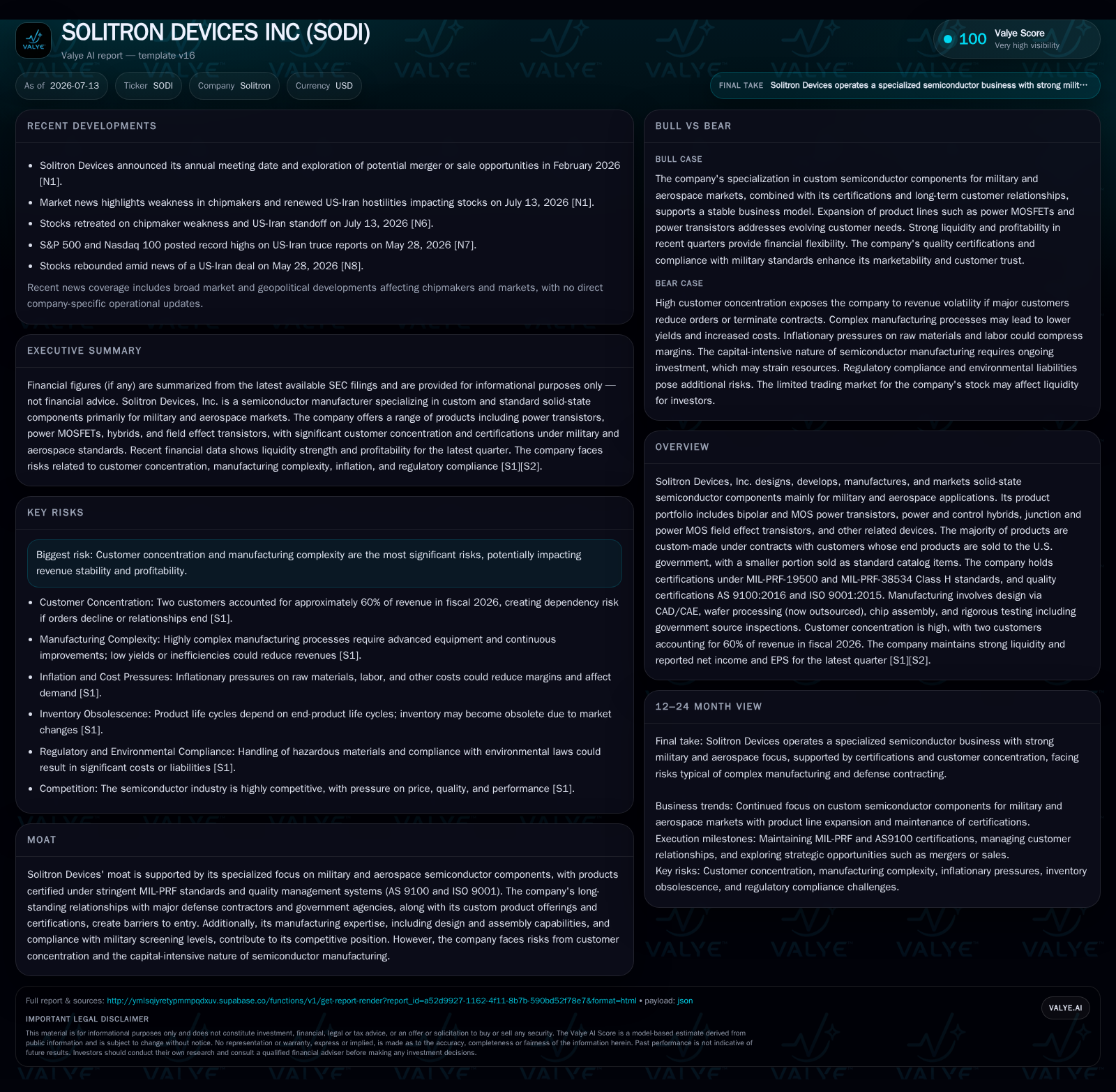
Solitron Devices Inc., specializing in military and aerospace semiconductor components, reported a stable but concentrated customer base with two clients accounting for 60% of revenues in fiscal 2026. The company is experiencing shifts in its product mix, notably growth in power MOSFETs at the expense of hybrids and power transistors, reflecting evolving market demand. Manufacturing complexity and yield management remain critical operational constraints, with wafer fabrication outsourced but assembly and testing maintained in-house. Financially, its balance sheet shows strong liquidity with a current ratio of 4.47 but elevated total debt. Key risks include customer concentration, supply chain dependencies, and pricing pressures linked to defense budgets.
Recent Operating Update: High Customer Concentration Persists
Business Model: Custom Semiconductor Components for Military Applications
Solitron Devices operates primarily as a designer, manufacturer, and marketer of solid-state semiconductor products tailored for military and aerospace markets [S1][S20]. Its portfolio spans bipolar power transistors, power MOSFETs, power/control hybrids, junction devices, field effect transistors (FETs), among others. The business model centers on delivering highly customized semiconductor components under contracts with defense contractors whose end products serve the U.S. government. Standard catalog items like JAN transistors provide a minor complementary revenue stream.
Manufacturing is a hybrid model — the company outsources wafer fabrication (silicon processing) yet retains core competencies in chip assembly, rigorous testing regimes including government source inspections to meet MIL-PRF-19500 and MIL-PRF-38534 Class H certifications [S1]. Maintaining these certifications along with ISO 9001:2015 and AS9100:2016 quality management systems is non-negotiable for sustaining competitive positioning within defense contracts.
Revenue mechanics predominantly involve fixed-price or cost-plus contracts tied to government procurement timelines; volume and pricing may hinge on contract renewals or changes in military platform demands. Margins rely heavily on manufacturing yield improvements — complex processes can reduce output efficiency — and product mix shifts that move toward higher-margin offerings.
Industry Structure and Competitive Positioning
The defense semiconductor segment is characterized by high barriers due to stringent quality standards imposed by U.S. military procurement regulations. Companies such as Solitron must invest in specialized manufacturing capabilities compliant with MIL-PRF standards while managing long qualification cycles for new components.
Competition typically revolves around price competitiveness balanced against assured reliability essential for mission-critical applications. While larger peers may have scale advantages or deeper R&D budgets, Solitron's niche specialization coupled with robust certification credentials constitute important moat elements. However, the highly bespoke design requirements limit rapid scaling or commoditization potential.
The company shares industry risks endemic to suppliers serving consolidated defense primes experiencing mergers or restructuring — fewer but larger customers shift negotiation leverage dynamics [S22]. Outsourcing wafer fabrication aligns Solitron with foundry-dependent peers yet preserves control over final customization stages deemed critical by regulatory agencies.
Growth Drivers: Product Mix Evolution and Strategic Acquisition
Solitron reported evolving product mix trends: power MOSFETs increased their share from 15% to 24% year-over-year through fiscal 2025–26 while traditional power transistors decreased from 43% to 39%, accompanied by a decline in hybrids’ share from 33% to 27% [S1]. This likely reflects broader industry shifts favoring MOSFET technology for improved power efficiency in aerospace platforms demanding advanced electrical performance.
The acquisition of Micro Engineering Inc. (MEI) in September 2023 bolstered Solitron’s capabilities by adding expertise focused on design layout solutions addressing low-to-mid volume projects requiring engineering flexibility [S1]. As MEI specializes in overcoming manufacturing challenges efficiently for customized electronic components research and development processes could accelerate time-to-market for new designs — a key competitive advantage within long military qualification spans.
Defense and aerospace spending trends remain primary growth tailwinds supported by new military platform programs necessitating certified semiconductors that comply with MIL-PRF standards; rising demand for power-efficient devices enhances opportunities within existing product lines.
Risks and Constraints: Manufacturing Complexity & Supplier Dependencies
Manufacturing complexity represents a double-edged sword for profitability — while high technical barriers offer protection against commoditized competition, they introduce yield volatility which affects production costs materially [S22]. Solitron acknowledges challenges inherent in process upgrades or new technology transitions leading to delivery delays or lower production volumes temporarily.
Maintaining aging proprietary equipment requires capital-intensive investments; unplanned downtime or replacement delays could impair fulfillment rates damaging customer relationships [S1]. Outsourced wafer fabrication exposes Solitron to supplier capacity constraints or raw material price swings particularly affecting silicon wafers and specialty metals like copper [S21].
Customer concentration risk remains acute given two customers contributing above half revenues — loss or renegotiation could materially impact financial performance swiftly. Extended contract renewal lead times typical of defense procurement cycles complicate visibility into order books.
Regulatory compliance with conflict minerals rules adds supply chain scrutiny; inability to certify conflict-free metals might disqualify Solitron from certain procurement channels [S21]. Moreover, inflationary pressures on operational inputs could compress margins if cost increases cannot be passed through due to fixed-price contracts [S11].
What To Watch Next: Backlog Indicators & Contract Renewals
Key near-term execution metrics include backlog levels relative to book-to-bill ratios providing signals on demand sustainability given customer concentration. Monitoring project qualification cycle times remains crucial as accelerated device approvals could enable faster revenue recognition.
Continued integration progress post-MEI acquisition will indicate whether enhanced design/manufacturing efficiency translates into new contract wins or margin improvements. Any announcements regarding contract renewals from top customers would offer critical insight into stability considering prime contractor consolidation trends.
Technological innovation adoption rates — e.g., further MOSFET penetration — also merit attention given possible impact on product mix profitability trajectory.
Financial Profile Discussion
As of May 31, 2026, Solitron reported cash & equivalents totaling approximately $6 million against current assets of $13.9 million and current liabilities at $3.1 million yielding a strong current ratio of roughly 4.47, indicating liquidity adequacy [F1]. Total debt stood at about $3.7 billion with net debt closely aligned, reflecting significant leverage that requires ongoing management focus [F1].
Operating income stood at $1.62 million while net income was around $0.81 million as per latest available figures ending February 2026 [F1], illustrating modest profitability margins consistent with capital-intensive manufacturing industries dependent on cyclical government spending.
Working capital management will be key alongside careful capital expenditure prioritization—particularly given the ongoing need to maintain aged manufacturing equipment—to protect cash flows while supporting capacity where justified by orders.
Conclusion
Solitron Devices exemplifies a focused specialist within the military/aerospace semiconductor OEM supplier base reliant on rigorous standards compliance and complex manufacturing capabilities paired with deep customer relationships predominantly concentrated among few large defense contractors. While product line evolution towards power MOSFETs aligns well with industry trends favoring efficient power devices for advanced platforms, persistent customer concentration combined with capital intensity constrains revenue stability.
Operational efforts targeting yield enhancements and post-acquisition synergies remain pivotal alongside risk mitigation related to supply chain dependencies amid inflationary pressures. Financially solvent through sound liquidity metrics yet holding substantial debt obligations mandates prudent capital stewardship as they navigate renewal cycles amid fluctuating government procurement dynamics.
Investors examining Solitron should prioritize updates relating to backlog visibility, contract renewals from major customers, integration outcomes from MEI acquisition, execution on manufacturing yield improvements, and regulatory compliance developments impacting supply chains—all central variables shaping the company’s medium-term operating landscape.
Disclaimer: This analysis does not constitute investment advice but aims to provide an informed perspective based solely on publicly available information cited within SEC filings and related disclosures.
Disclaimer: This is research-only, informational analysis and not investment advice. It may include AI-generated interpretation and general industry context. Always verify important details using primary sources.

Comments