
LogProstyle’s Integrated Renovation and Ryokan Model Strengthens Niche Position with Steady Growth
The company leverages supply chain control and a unique hospitality approach to drive consistent revenue expansion in Japan’s real estate and tourism markets.
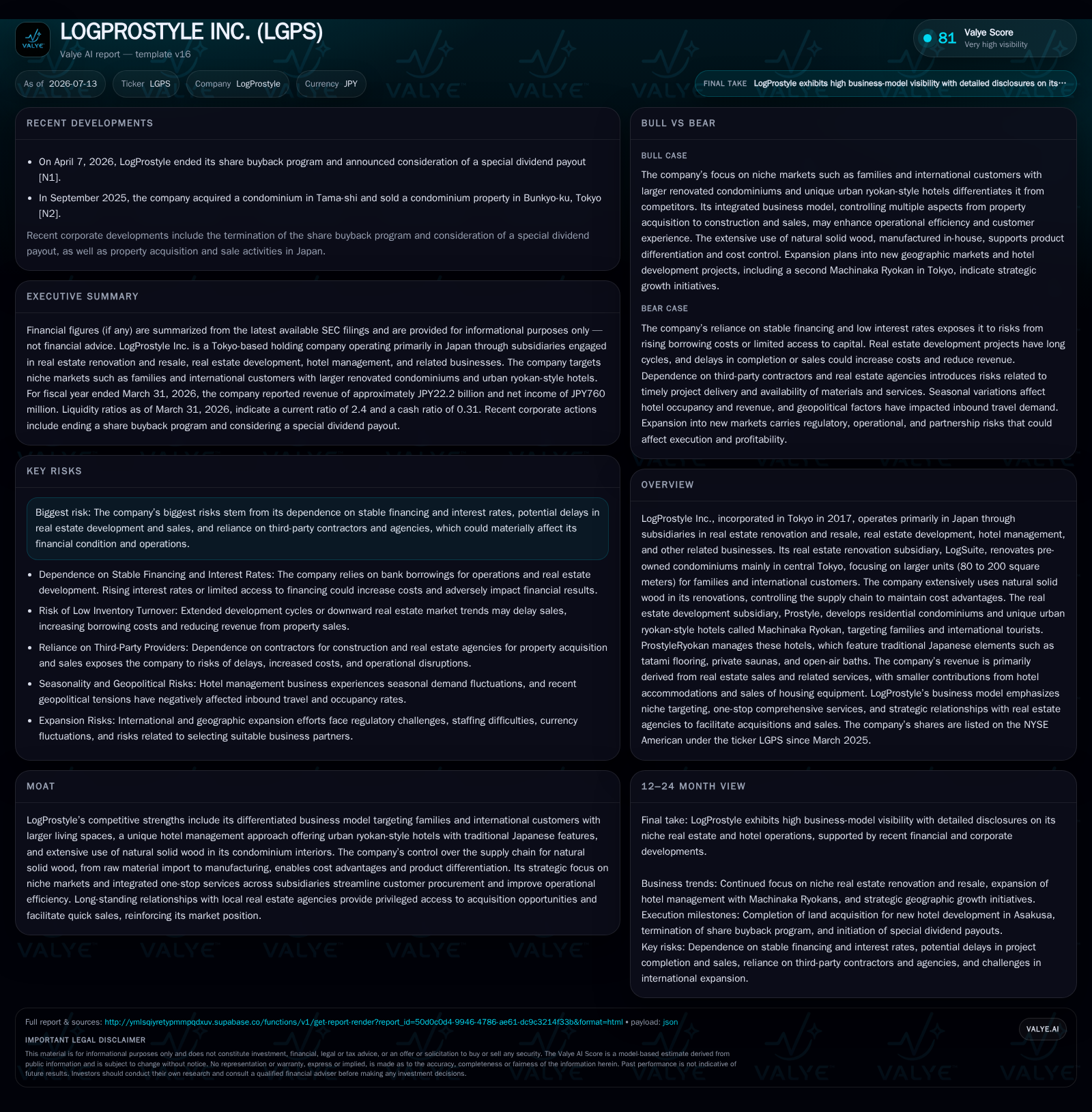
LogProstyle Inc. posted a 7.6% revenue increase in fiscal year 2026, driven primarily by its core real estate renovation and resale segment. The firm’s integrated business model, combining condominium renovations featuring in-house natural solid wood production with niche urban ryokan-style hotel management, supports strong gross margin improvement. Despite the capital-intensive nature of real estate development and elevated debt levels, LogProstyle maintains liquidity through careful project financing aligned to property sales. Expansion plans target geographic diversification and hotel growth, yet risks remain around interest rates, project timing, and reliance on third-party contractors. Near-term focus includes execution of land acquisitions and new hotel developments while monitoring operating cash flow.
Recent Operating Update
arterly cash dividend totaling US$0.046 per share annually starting Q3 FY2026 distribution cycle, indicating operational confidence amidst capital demands [S2]
Business Model Details
LogProstyle operates through an integrated platform encompassing real estate renovation and resale (via subsidiary LogSuite), residential development (Prostyle), and boutique hotel development plus management focused on the Machinaka Ryokan concept (ProstyleRyokan). The key value proposition is the niche targeting of larger family-sized urban condominium units (80–200 sqm) enhanced with natural solid wood interiors made predominantly in-house leveraging supply chain control — from raw material importation (mainly from the U.S.) through manufacturing — allowing cost advantages and product differentiation that are rare among peers targeting mass markets [S1][S16].
The real estate renovation process typically takes about one year per unit including design and construction phases, with sales initiated during construction largely through digital channels such as their proprietary LogRenove platform alongside traditional real estate brokers [S16]. This hybrid channel approach supports steady customer acquisition across individual buyers focusing on quality family homes rather than typical smaller urban condos.
Complementing this, the development subsidiary creates new residential condominiums but also unique 'urban ryokan' hotels that emphasize authentic Japanese cultural features like tatami floors, private saunas, and open-air baths integrated within city locations attractive to both domestic families seeking cultural experiences and inbound foreign tourists seeking upscale accommodation alternatives to standard hotels [S16]. ProstyleRyokan leases these properties from developed owners under contracts granting full operational control combined with rent paid monthly, effectively consolidating hotel revenues while managing occupancy rates and average daily rates (ADR) internally [S16].
Cross-subsidiary operations benefit from one-stop service integration — LogSuite handles renovation procurement through its manufacturing arm OkinawaIgeto that controls key materials; LogArchitects manages construction; Prostyle oversees development strategy; and sales processes are coordinated across subsidiaries — all designed to streamline execution times, maintain quality control through end-to-end oversight, and mitigate external supplier dependency where possible [S16][S23]
Industry Structure & Competitive Position
The company operates primarily within Japan's dense metropolitan housing market but distinguishes itself through upscale condo renovations that focus on larger floor plans unusual in Tokyo’s typical sub-50 sqm units favored by singles/investors [S16]. This niche focus sets it apart from higher-volume regional renovators who target smaller or mass-market units.
Its vertically-integrated supply chain controlling natural solid wood products not only reduces raw material costs but also gives it product uniqueness hitherto uncommon given most competitors procure construction materials from third parties [S20]. It competes indirectly with large diversified developers such as Mitsui Fudosan or Tokyu Fudosan Holdings who operate across broader commercial/residential segments but lack equivalent specialized luxury condo renovation focus or boutique ryokan hotel expertise.
Hospitality-wise, its small portfolio of Machinaka Ryokans targets a niche market linking cultural authenticity with modern convenience inside urban cores — a segment less served by mainstream national or international hotel chains traditionally focused on standard room offerings or resorts outside city centers. This positions LogProstyle uniquely while reducing direct competition with standardized hotel operators.
Growth Drivers
Several structural factors underpin growth prospects:
Urbanization Trends & Family Demand: Rising appetite among families for larger residences in central Tokyo aligns directly with LogSuite's renovated condos emphasizing space and quality materials.
Increasing International Tourism: Post-pandemic rebounding inbound tourists seeking authentic Japanese experiences fuel demand for urban ryokans managed under ProstyleRyokan, which blends heritage design with professional hospitality operations [S16].
Supply Chain Control: By internally managing the solid wood import-to-manufacture pipeline via OkinawaIgeto subsidiary, LogProstyle can better control input costs amid global supply disruptions—a significant margin lever as raw material prices fluctuate internationally [S20]
Geographic Expansion Plans: While current operations concentrate on central Tokyo metro areas, strategic intent is clear to extend renovation services into other key cities like Osaka, Kyoto, Nagoya as well as select overseas markets including U.S., leveraging partnerships or acquisitions of local real estate firms once conditions align [S9][S22].
Development Pipeline: Acquisition of new land plots such as the Asakusa site for a second Machinaka Ryokan signals long-term expansion intent in hospitality assets designed to leverage operational synergies near existing properties enhancing asset utilization [S7][S24]
Risks & Constraints
LogProstyle faces typical constraints inherent to capital-intensive real estate development businesses:
Interest Rate Exposure: Rising interest rates materially impact financing costs as reflected by an increase in interest expense (+64.9%) year-over-year due to higher average balances and effective rates impacting profitability trends [F1][S1].
Project Timing Risks: Delays in property completions or legal settlements could prolong cash conversion cycles increasing liquidity pressures; this timing sensitivity is accentuated by reliance on external contractors whose performance can be unpredictable due to labor or supply shortages exacerbated by macroeconomic shocks or geopolitical trade disruptions impacting imported woods usage [S20][S9]
Dependency on Imported Materials: Heavy reliance on U.S.-sourced natural solid wood exposes the company to exchange rate volatility and tariff changes potentially raising input costs despite internal production efficiencies; timely contract execution with suppliers is critical given terms tied closely to shipping schedules impacting renovation timelines [S20]
Competitive Pressures: Larger domestic developers possess deeper pockets for land acquisition and marketing initiatives; sustaining differentiation vis-à-vis price sensitivity remains an ongoing challenge though mitigated somewhat by brand recognition in premium segments enhanced through proprietary digital channels such as LogRenove platform [S20].
Hotel Segment Seasonality: Though not highly cyclical overall, hotel operations experience seasonal variability linked to holidays influencing occupancy rates (key KPI), necessitating careful cost management during off-peak periods alongside maintaining ADR benchmarks amid tourism fluctuations.
What To Watch Next
Key near-term milestones include:
- Progress updates on construction commencement (expected November 2026) and subsequent delivery of new Machinaka Ryokan facility at Asakusa scheduled for mid-2028 opening which will test scalability of boutique hospitality concept while unlocking potential shared operational resources with existing properties nearby [S7][S24].
- Execution of targeted regional expansion plans: monitoring any announcements regarding acquisitions or joint ventures into Osaka, Kyoto or overseas markets will signal strategic traction beyond Tokyo-centric models currently dominating revenue.
- Operating cash flow swings relative to inventory build-out pace provide indication if capex discipline aligns adequately with projected sales velocity mitigating liquidity risk.
- Monitoring financing terms renegotiations or new credit facilities especially if interest rate environment shifts materially impacting refinancing flexibility given current debt exposure levels.
- Tracking occupancy rate evolution alongside ADR trends within the Machinaka Ryokan portfolio will shed light on competitive positioning effectiveness versus conventional hospitality players.
Financial Profile Discussion
As of March 31, 2026, companyfacts data shows LogProstyle with cash & equivalents of approximately JPY2.28 billion and total debt near JPY15.5 billion, resulting in net debt around JPY13.3 billion [F1]. The current ratio stood at about 2.4, indicating adequate short-term liquidity support, though this depends on timely asset sales and refinancing ability amid ongoing capital expenditures, particularly for hotel projects like the Asakusa expansion
Gross profit margin improved notably to nearly 20%, up from 17.2% prior year, driven by efficient supply chain management related to controlled sourcing and manufacturing of solid wood materials essential for remodeling differentiated condominiums—an important durable cost advantage supporting future pricing power unless commodity inflation escalates abruptly beyond hedging capabilities [F1]
Operating expenses rose significantly (+28%) mainly due to higher outsourcing fees linked partly to investor relations efforts post-public listing reflecting increased stakeholder engagement activities plus elevated tax burdens—pressures that warrant close expense oversight going forward given moderate operating income margin enhancement (+0.6 ppt) still leaves limited buffer against macro uncertainties.
Despite positive net income growth (+0.8%), negative operating cash flow underscores the capital-intensive nature: inventory accumulation for ongoing projects raises working capital needs temporarily stressing free cash flow which management seeks to offset via staggered financing aligned closely to project sale cycles; however any notable project delays would exacerbate liquidity strains ([F1], [S1], [S11]).
In summary, LogProstyle's disciplined integration of product/service capabilities coupled with strategic niche targeting supports robust operational profitability but requires vigilant financial stewardship specifically around debt service capacity amid rising cost headwinds and investment demands inherent in expanding geographically and scaling hotel assets.
Disclaimer: This analysis is based solely on publicly available information through SEC filings up to July 13, 2026 and does not constitute investment advice.
Financial position in context
As of 2026-03-31, companyfacts shows 2,281,913,000 JPY in cash and equivalents and 15,542,783,000 JPY of total debt [F1]. The same snapshot implies net debt of roughly 13,260,870,000 JPY, keeping balance-sheet context relevant but secondary to the operating story [F1]. Current assets of 19,994,451,000 JPY and current liabilities of 8,330,834,000 JPY imply a current ratio near 2.4x for 2026-03-31 [F1].
Disclaimer: This is research-only, informational analysis and not investment advice. It may include AI-generated interpretation and general industry context. Always verify important details using primary sources.

Comments