
Tokyo Lifestyle’s International Expansion Tests Operational Leverage and Margin Resilience
Rapid global store growth drives revenue gains but intensifies margin pressures amid operational and currency risks.
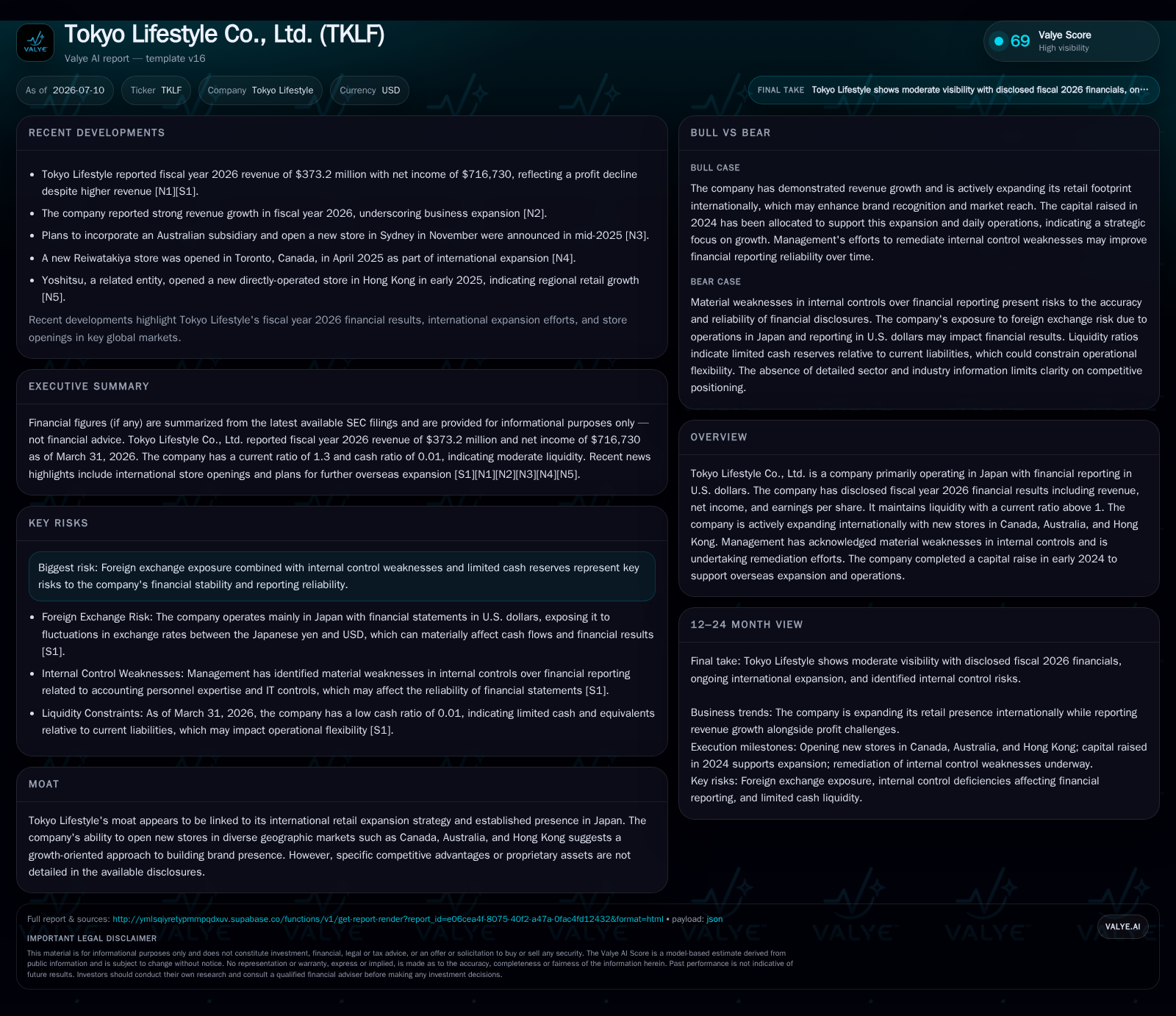
Tokyo Lifestyle Co., Ltd.’s fiscal year 2026 results reveal robust top-line growth propelled by expanding physical retail stores in new international markets like Canada, Australia, and Hong Kong. However, this expansion coincides with compressed gross margins driven by a shift toward franchise and wholesale channels that carry lower margins, as well as operating expense increases to support growth. Additionally, management discloses material weaknesses in internal controls and faces foreign currency translation losses from yen-dollar volatility. These factors highlight a tension between growth ambitions and profitability resilience within an increasingly complex multinational retail footprint.
Recent Quarter Signals Robust Global Sales but Compressed Margins
Diverse Product Portfolio Powers Growth but Price Pressure Looms
Tokyo Lifestyle’s revenue base is supported by a wide-ranging product assortment encompassing Japanese beauty and health products, luxury goods such as branded watches and handbags, collectible cards (notably Pokémon cards), electronics including gaming consoles like Nintendo Switch and Xbox Series, sundry home goods, food and beverage items, and advertising services linked to key opinion leaders (KOLs) supporting online celebrities [S1]. This diversified product mix facilitates customer acquisition and repeat visits across both physical stores and e-commerce platforms, contributing to revenue resilience. The advertising services segment, leveraging influencer partnerships, represents a growing higher-margin revenue stream that complements traditional merchandise sales [S1]. Nevertheless, competitive pricing pressures and supplier cost inflation have constrained the company’s ability to fully pass through increased costs, resulting in margin compression [S1]. The gross margin decline from 11.4% to 7.5% year-over-year reflects these dynamics alongside the channel mix shift favoring franchise and wholesale sales [S11].
Supplier Relationships and Cost Management Underpin Margin Trends
In the retail consumer goods sector, maintaining favorable supplier relationships and cost controls is critical given typically thin gross margins. Tokyo Lifestyle operates without long-term exclusive supply agreements but strategically focuses on direct sourcing from cosmetics and pharmaceutical companies, where product costs can be 5–8% lower than distributor prices [S1]. This direct sourcing approach enhances pricing competitiveness and product availability but is subject to supplier capacity constraints, especially as the company scales store openings internationally [S1]. The expansion of franchise and wholesale channels, while diluting gross margin due to lower unit profitability, aligns with an asset-light retail model that reduces capital expenditure and operating expenses per store [S1][S18]. This tradeoff reflects a common strategy among lifestyle retailers balancing growth with cost efficiency.
Balancing Physical Store Rollouts with E-Commerce Penetration Gains
Tokyo Lifestyle continues to invest in omnichannel retailing, integrating physical stores with e-commerce platforms supported by KOL-driven advertising campaigns [S1][N2]. The company’s online sales contribute to product mix diversification and higher-margin revenue streams, with a noted 22.7% decline in online cost of revenue relative to sales, indicating improving operational efficiency in digital channels [S11]. Despite this, physical store operations remain the dominant cost driver, requiring significant capital expenditures for new store openings and logistics infrastructure in overseas markets [S11]. Operating expenses increased in absolute terms due to headcount growth, marketing spend, and logistics enhancements but improved modestly as a percentage of revenue from 9.1% to 6.7%, suggesting emerging economies of scale [S9][S18]. These investments aim to drive customer foot traffic and average transaction value, key retail KPIs supporting sustainable revenue growth.
Intensifying Risks: Foreign Exchange Fluctuations and Control Weaknesses
Tokyo Lifestyle’s multinational operations expose it to foreign currency risk, particularly from yen depreciation against the US dollar. The company reported an unrealized foreign currency translation loss exceeding $2.1 million in FY2026 due to yen weakness and currently does not employ hedging strategies to mitigate this exposure [S17][S1]. Such volatility can materially impact reported earnings and cash flow, complicating profitability management. Additionally, the company disclosed material weaknesses in internal controls related to accounting expertise and IT general controls, which pose risks to financial reporting accuracy and require ongoing remediation efforts [S22]. These governance challenges add uncertainty to operational execution and investor confidence.
Growth Levers: Geographic Expansion and Strategic Promotions
Tokyo Lifestyle’s growth strategy centers on expanding its store footprint internationally, with new market entries in Canada, Australia, and Hong Kong complementing its established presence in Japan [N2][S1]. The company leverages promotional events tied to large-scale e-commerce campaigns, such as quarterly sales spikes driven by marketplaces like Rakuten in March, June, and September, which boost customer traffic and sales volume seasonally [S19]. These marketing initiatives, combined with a diversified product portfolio and omnichannel retailing, support customer acquisition and retention. However, growth is constrained by supplier capacity limitations and intensifying competitive pricing pressures from specialty and mass-market retailers [S1][N2]. Monitoring same-store sales growth, inventory turnover, and e-commerce sales contribution will be critical to assessing the effectiveness of these growth levers.
Watchpoints Ahead: Dividend Proposals, Performance Milestones, and Remediation Progress
Tokyo Lifestyle has proposed a year-end dividend of JPY 1.890 per share payable in September 2026, signaling management’s confidence in underlying cash flow stability despite margin pressures [S3]. Key operational watchpoints include progress on internal control remediation, early performance metrics from new international stores such as comparable sales and customer foot traffic, and the trajectory of e-commerce penetration. Additionally, management’s approach to foreign exchange risk mitigation and efforts to stabilize gross margins through supplier negotiations and channel mix optimization will be pivotal. Operating expense efficiency as the store base expands internationally will also be a critical indicator of operational leverage realization.
Financial Profile Discussion
In summary, Tokyo Lifestyle exemplifies a mid-sized lifestyle consumer retailer navigating the complexities of international expansion. The company’s robust revenue growth, fueled by diversified product offerings and omnichannel retailing, is tempered by margin compression driven by channel mix shifts toward lower-margin franchise and wholesale sales, supplier cost pressures, and foreign exchange volatility. Operational challenges include managing supplier relationships, controlling operating expenses amid store rollouts, and addressing internal control weaknesses. The company’s ability to leverage promotional events, enhance e-commerce penetration, and execute disciplined cost management will be key determinants of its capacity to convert top-line momentum into sustained profitability.
Disclaimer: This is research-only, informational analysis and not investment advice. It may include AI-generated interpretation and general industry context. Always verify important details using primary sources.

Comments