
YSX Tech Expands Auto Insurance Aftermarket Services Amid Margin Compression and Regulatory Risks
YSX Tech reported 16.8% revenue growth in fiscal 2026 driven by increased auto insurance aftermarket volume amid tightening margins and structural challenges.
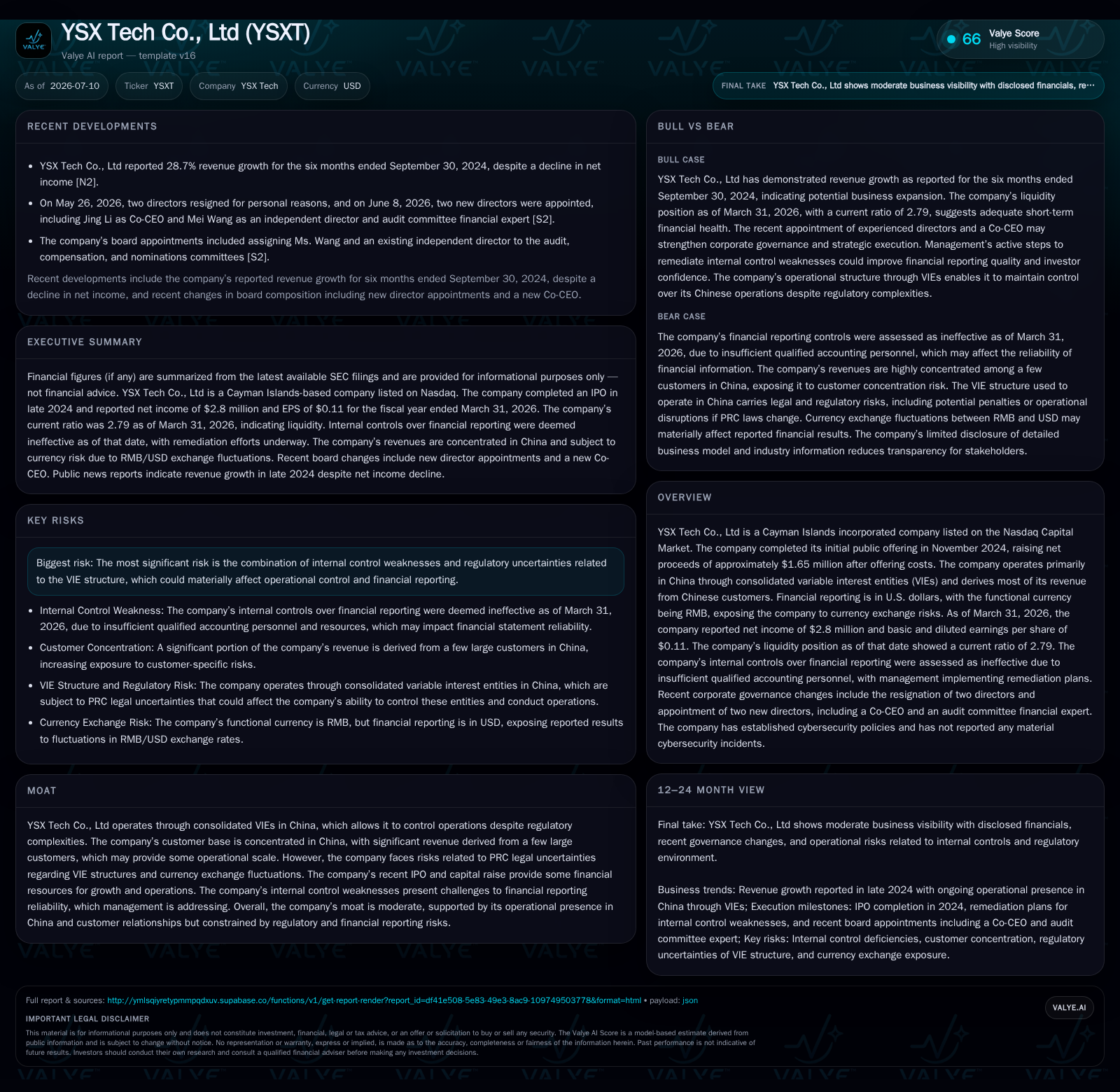
YSX Tech Co., Ltd, a Nasdaq-listed provider of auto insurance aftermarket value-added services primarily in China, delivered revenue of $83.5 million for fiscal 2026, up 16.8% from $71.5 million the prior year. Growth was driven by expanded service volume from insurer contracts, offset partially by a shift in service mix toward lower-priced offerings and a contraction in scenario-based customized services. Gross margins declined to 8.6% due to elevated subcontractor costs and reduced high-margin service lines, reflecting ongoing margin pressure typical in this outsourcing-intensive sector. The company operates via consolidated variable interest entities (VIEs) in China, which underpins operational control but carries regulatory and tax uncertainty risks. Recent governance changes include new director appointments aimed at strengthening financial oversight after internal controls were deemed ineffective. Liquidity remains solid with a current ratio near 2.8 and net income of $2.8 million for the latest fiscal year, but customer concentration and foreign exchange exposure warrant monitoring.
Recent Operating Update
YSX Tech Co., Ltd filed its latest quarterly report on June 8, 2026, highlighting key governance changes with the resignation of two directors and the appointment of Jing Li as Co-CEO alongside Mei Wang as an independent director and audit committee financial expert [S2]. These leadership adjustments are part of the company’s efforts to address previously identified internal control deficiencies over financial reporting as of March 31, 2026, signaling a focus on strengthening corporate governance amid operational scaling [S1][S2].
For the fiscal year ended March 31, 2026, YSX reported revenue of $83.5 million, a 16.8% increase from $71.5 million in the prior year, driven primarily by a 27.4% surge in auto insurance aftermarket value-added services revenue [S1]. This growth reflects expanded service volumes secured through contracts with major insurance companies and brokerages across China, where YSX operates predominantly via consolidated variable interest entities (VIEs) to maintain operational control despite foreign investment restrictions [S1][S23]. However, revenue from other scenario-based customized services declined sharply by 64.2%, and software development and IT services revenue contracted by 91.7%, indicating a strategic retrenchment or market contraction in higher-margin, technology-driven segments [S1][S21].
Business Model
YSX’s business model centers on providing value-added services that support auto insurers’ claims management processes, including coordinating outsourced repair, towing, vehicle inspection, car wash, and maintenance services post-claim [S1]. The company generates revenue primarily through service contracts with insurers and brokerages, where fees are typically structured on a per-claim or volume basis, influenced by the service mix and negotiated pricing terms.
The cost of revenue is heavily weighted toward subcontractor expenses, which accounted for approximately 91% of total revenue costs in fiscal 2026 [S1][S20]. These subcontractors perform the physical services outsourced by YSX, making subcontractor utilization rates and cost management critical levers for margin control. The company’s gross margin contracted to 8.6% in FY26 from 10.3% in FY25, pressured by rising subcontract costs, a shift toward lower-priced service offerings, and the decline of higher-margin customized services [S20][S21].
Customer concentration remains a significant risk factor, with two third-party insurers representing over half of total revenues, alongside related party customers contributing 27.5% of revenue [S23]. This concentration exposes YSX to potential volatility from contract renewals or pricing negotiations. The company’s service volume growth is closely tied to auto insurance claim cycles, which are influenced by vehicle ownership trends and regulatory policies promoting outsourcing of claims-related services in China.
Industry Structure and Competitive Position
YSX operates within the auto insurance aftermarket value-added services sector, which involves managing repair workflows and coordinating service providers for insurers and vehicle owners. The sector is characterized by high outsourcing levels, regulatory oversight, and thin gross margins due to competitive pricing and elevated subcontractor costs.
The company’s use of VIE structures allows it to maintain operational control in China despite foreign ownership restrictions, but this exposes it to regulatory and tax uncertainties, including potential reclassification as a PRC resident enterprise for enterprise income tax purposes, which could materially impact tax liabilities and shareholder returns [S1]
Competitors in this space include claims management firms and technology platform providers that focus on improving claims processing efficiency and cost control. While companies such as Mitchell International and CCC Information Services emphasize technology integration, YSX’s competitive advantage lies in its localized presence and regulatory navigation within China’s unique market environment. However, the company faces margin pressure industry-wide due to the high cost of outsourced services and insurer-driven cost containment efforts.
Growth Drivers
YSX’s revenue growth in FY26 was primarily driven by increased service volumes in its core auto insurance aftermarket value-added services segment, reflecting successful contract expansions with insurers and brokerages [S1]. The company is also exploring opportunities to broaden its value-added service offerings beyond traditional repair coordination, although recent declines in scenario-based customized services suggest ongoing adjustments or client rationalization in these segments.
The company’s ability to manage subcontractor costs and optimize service mix will be key to sustaining margin improvements [S1][S21]. Additionally, mitigating customer concentration risk through diversification or deeper insurer partnerships could enhance revenue stability. Technological enhancements to streamline service management and claims processing may also provide competitive differentiation, although YSX’s recent reduction in software development revenue indicates a current deprioritization of this area
Risks and Operational Challenges
Key risks include regulatory uncertainty related to the VIE structure and foreign investment restrictions, which could affect YSX’s contractual rights and tax status [S1]. The potential classification as a PRC resident enterprise for tax purposes could lead to a uniform 25% enterprise income tax on worldwide income and withholding taxes on dividends paid to non-resident shareholders, adversely impacting net income and shareholder returns [S1].
Customer concentration risk remains elevated, with two insurers accounting for the majority of third-party revenue and related party customers contributing significantly, increasing vulnerability to contract loss or pricing pressure [S23]. The company’s dependence on subcontractors for service delivery also exposes it to vendor capacity and cost fluctuations, which directly affect gross margins.
Internal control weaknesses identified in the latest annual report pose challenges for financial reporting reliability, though recent board appointments of directors with accounting and technology expertise aim to remediate these deficiencies [S1][S2]. Foreign exchange risk is present as the company’s functional currency is RMB, and fluctuations against the U.S. dollar can impact reported financial results; the RMB appreciated modestly by 1.6% in FY26, providing some favorable currency impact [S1][S23].
Financial Profile
YSX maintains a solid liquidity position with current assets of approximately $54.3 million against current liabilities of $19.5 million as of March 31, 2026, resulting in a healthy current ratio of 2.79, supporting working capital needs and operational flexibility [F1]. Total debt stood at about $2.2 million as of September 30, 2025, representing modest leverage relative to asset size [F1].
Despite top-line growth, net income declined by roughly 30% to $2.8 million in FY26 due to margin compression and increased subcontractor costs, while operating income was $3.5 million, indicating moderate profitability from core operations [F1]. The company’s cost of revenues remains dominated by subcontractor expenses, accounting for approximately 91% of revenue, underscoring the critical importance of vendor cost management and utilization efficiency [S1][S20].
What to Watch Next
Future quarterly filings will be important to assess progress on internal control remediation, including auditor evaluations and any material restatements or disclosures related to financial reporting reliability [S2]. Monitoring service volume trends and backlog related to insurer contracts will provide insight into the sustainability of revenue growth.
Changes in customer concentration ratios or initiatives to diversify the client base could mitigate operational risks. Developments regarding PRC tax authority assessments of YSX’s residency status will be critical given the potential tax implications [S1].
Liquidity and working capital management, particularly accounts receivable aging and subcontractor advance payments, should be observed closely to evaluate cash flow dynamics. Additionally, competitive pressures from technology-enabled claims service providers may influence YSX’s pricing power and market positioning, necessitating strategic responses to maintain relevance and profitability.
This analysis is based strictly on recent SEC filings and publicly available disclosures without speculative extrapolation about future outcomes or unidentified competitors or clients.
Disclaimer: This is research-only, informational analysis and not investment advice. It may include AI-generated interpretation and general industry context. Always verify important details using primary sources.

Comments