
DGAC Navigates Critical Milestones in SPAC Lifecycle Amid Capital and Regulatory Constraints
DISCIPLINED GROWTH ACQUISITION Corp’s recent quarterly filing underscores the capital structure, timing pressures, and shareholder dynamics shaping its path to a business combination.
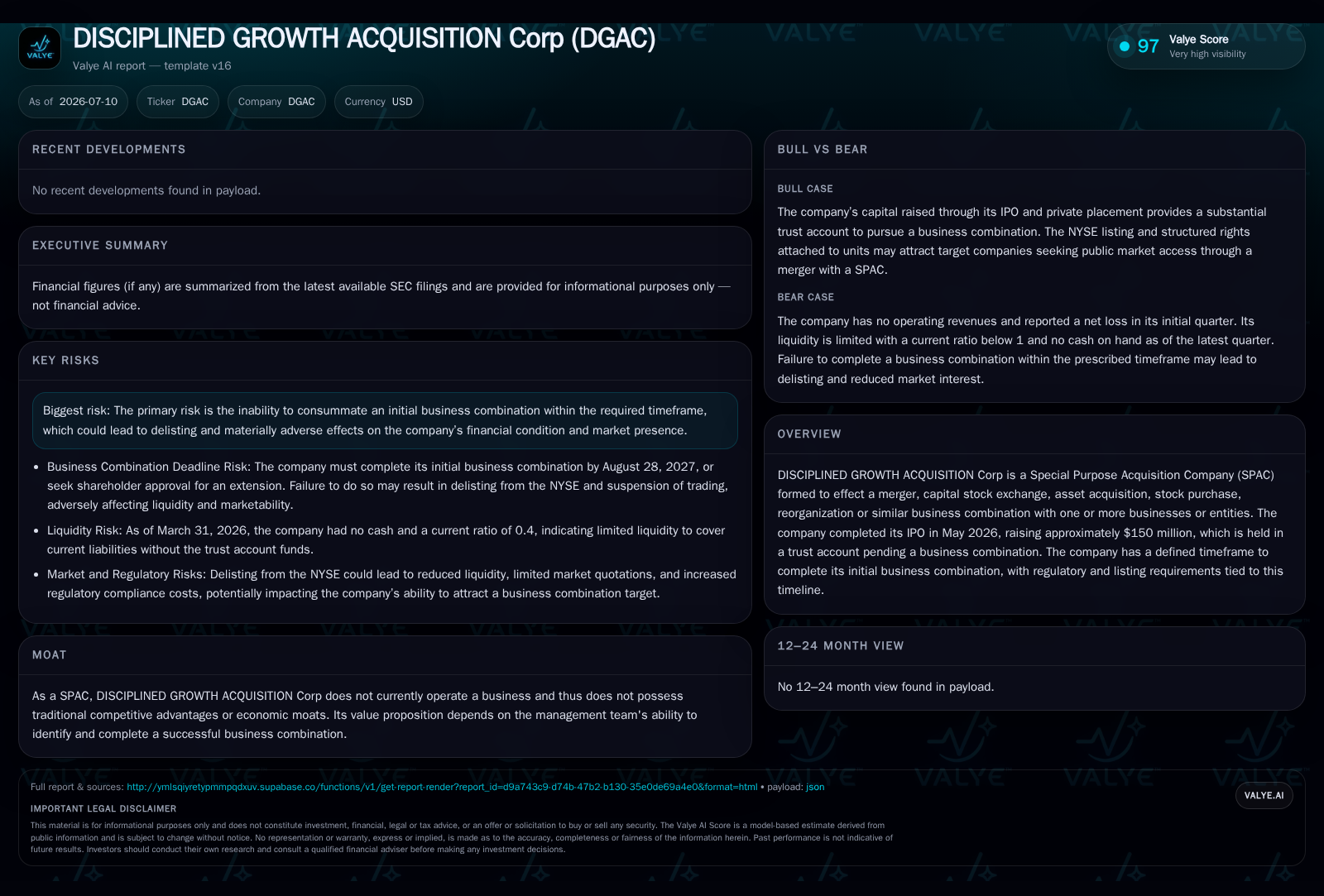
DISCIPLINED GROWTH ACQUISITION Corp completed its IPO in May 2026, raising over $150 million placed in a trust account to finance a future business combination. The company faces a fixed August 2027 deadline to close this transaction, with potential extensions subject to shareholder approval but posing dilution risks that could reduce acquisition capital. Sponsor participation through private placements and over-allotment exercises signals alignment with public investors. Redemption rights remain a key variable influencing available funds for deals. Regulatory requirements impose delisting risks if the combination is not consummated by 2029, emphasizing urgency. The next milestones include merger announcements, shareholder votes on extensions or deals, and redemption activity that will determine execution viability within the constrained timeframe.
DISCIPLINED GROWTH ACQUISITION Corp: Navigating SPAC Lifecycle Dynamics and Strategic Milestones
DISCIPLINED GROWTH ACQUISITION Corp (DGAC) operates as a Special Purpose Acquisition Company (SPAC), a financial vehicle designed to raise capital through an initial public offering (IPO) and hold those funds in a trust account while seeking to merge with or acquire a private company. This de-SPAC transaction enables the private company to become publicly listed without undergoing a traditional IPO process. DGAC’s business model centers on sourcing and executing an initial business combination within a defined timeframe, generating value primarily through successful deal execution rather than operating revenues prior to merger [S2][S3].
Capital Structure and Trust Account Safeguards
DGAC completed its IPO on May 28, 2026, issuing 15 million units at $10 each, raising gross proceeds of $150 million [S3]. Concurrently, the Sponsor and affiliates purchased 345,000 private placement units at the same price, contributing an additional $3.45 million without underwriting fees, thereby increasing net proceeds available for acquisition activities [S12]. The underwriters exercised a partial over-allotment option, issuing approximately 750,000 units and raising about $7.5 million, further bolstering the trust account [S13]. In total, DGAC secured roughly $158.3 million, all deposited into a segregated U.S.-based trust account managed by Odyssey Transfer & Trust Company as trustee [S8].
This trust account structure is a cornerstone of SPAC operations, legally restricting the use of funds to consummating a qualifying business combination or returning capital to shareholders if no transaction occurs. The trust preserves investor capital by insulating it from general corporate liabilities and operational expenses, except for limited permitted releases such as tax obligations and dissolution costs [S8]
Unit Composition and Dilution Mechanics
Each DGAC unit comprises one Class A ordinary share and one right to receive one-quarter of a Class A share upon consummation of the initial business combination [S3]. This fractional share right is a common SPAC feature designed to provide shareholders with additional equity upside post-merger, effectively diluting ownership but aligning incentives for successful deal closure. Investors should anticipate that the exercise of these rights, along with sponsor promote shares and warrants typically issued in SPAC structures, will impact post-combination capitalization and ownership percentages.
Regulatory and Timing Constraints
DGAC’s amended Articles of Association set a firm deadline of August 28, 2027, to complete its initial business combination [S2]. Failure to meet this deadline requires shareholder approval to extend the combination period up to May 26, 2029, the maximum allowed under New York Stock Exchange (NYSE) listing rules [S20][S21]. Extensions, while providing additional time, erode trust account balances due to ongoing administrative and legal expenses, thereby reducing acquisition capital and increasing execution risk [S2].
The NYSE mandates suspension and delisting of SPAC securities if no business combination is consummated by the ultimate deadline, which would significantly impair liquidity, market access, and the company’s attractiveness as an acquisition vehicle [S20][S21]. Delisting risks also elevate regulatory burdens and may shift trading to less liquid over-the-counter markets.
Sponsor Alignment and Capital Commitment
DGAC’s Sponsor has demonstrated alignment with public shareholders by participating in private placement unit purchases and over-allotment exercises totaling hundreds of thousands of units at $10 each [S14]. This at-risk capital commitment signals confidence in the Sponsor’s ability to source and execute a viable business combination. Sponsor promote structures typically grant founders a percentage of post-merger equity, incentivizing deal completion but also contributing to dilution.
Despite this alignment, as of July 2026, DGAC has not disclosed any definitive merger targets or pending transaction announcements, leaving execution prospects reliant on Sponsor expertise amid a competitive SPAC market where numerous vehicles vie for attractive private companies [S2]
Redemption Rights and Acquisition Capital Availability
Public shareholders retain statutory redemption rights, allowing them to redeem their shares for a pro-rata portion of the trust account prior to closing the business combination [S2]. Elevated redemption rates can materially reduce the cash available to finance acquisitions, forcing sponsors to either downsize deal valuations or seek additional financing through private investment in public equity (PIPE) transactions. PIPE financing, while augmenting capital, introduces complexity and potential valuation negotiation challenges.
Redemption activity serves as a critical operating KPI, reflecting investor confidence in proposed deals and broader sentiment toward SPAC structures. High redemption rates often signal skepticism, complicating deal structuring and execution.
Competitive and Market Context
DGAC operates within a crowded SPAC landscape where vehicles such as Pershing Square Tontine Holdings, Social Capital Hedosophia, and Churchill Capital exemplify the model of raising capital to facilitate private-to-public transitions. DGAC’s capital raise of approximately $158 million is within the typical range for SPAC IPOs targeting mid-market private companies.
Key competitive variables include Sponsor reputation and track record in deal sourcing, redemption rates reflecting investor confidence, and timing pressures imposed by regulatory deadlines. Market sentiment toward SPACs has fluctuated in recent years, with increased scrutiny on deal quality and redemption dynamics influencing execution risk.
Outlook and Key Milestones
Looking ahead, critical indicators to monitor include the timing and nature of merger announcements, shareholder proxy solicitation periods for deal or extension approvals, redemption election levels following deal disclosures, and evolving market sentiment toward SPAC vehicles broadly [S2][S3].
Maintaining shareholder engagement and minimizing redemptions correlate strongly with higher probabilities of successful deal closure within prescribed deadlines. Conversely, protracted searches or elevated redemptions foreshadow heightened operational risks and potential liquidity challenges.
DGAC’s ability to navigate these dynamics will shape its prospects for completing a business combination and transitioning into an operating public company.
--
This analysis synthesizes publicly available disclosures as of July 10, 2026, situating DISCIPLINED GROWTH ACQUISITION Corp within established SPAC frameworks emphasizing capital preservation, sponsor alignment, and regulatory imperatives defining near-term strategic challenges.
Disclaimer: This is research-only, informational analysis and not investment advice. It may include AI-generated interpretation and general industry context. Always verify important details using primary sources.

Comments