
ADM Tronics Advances Proprietary Medical Devices While Managing Operational Losses
ADM Tronics intensifies investment in medical device R&D amid cash-flow pressures and supply chain risks in a diversified industrial hardware portfolio.
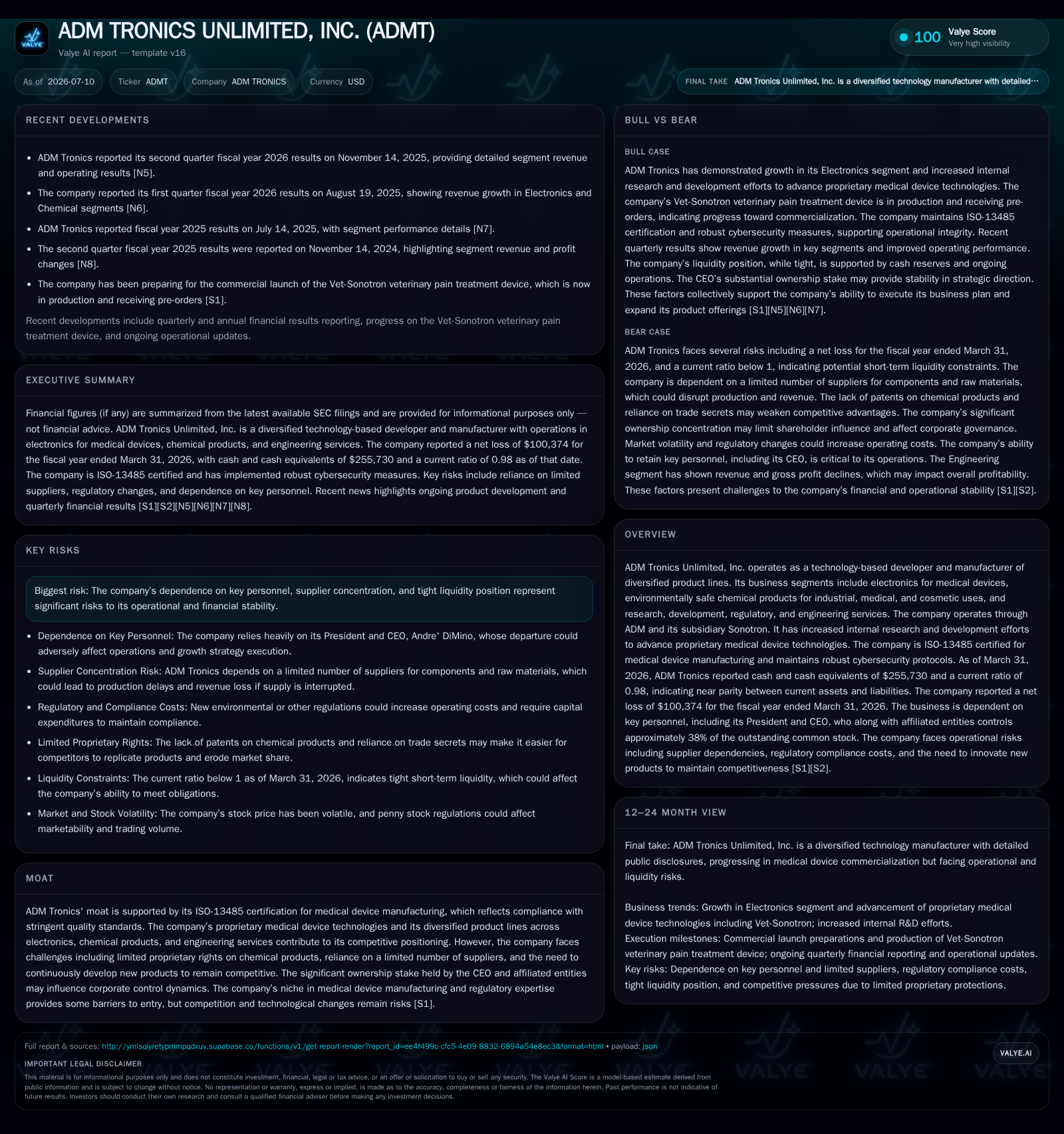
ADM Tronics Unlimited operates in diversified segments including medical device electronics, specialty chemicals, and regulatory engineering services, leveraging ISO-13485 certification to deepen proprietary medical technology development. The latest quarterly filing reveals elevated cash usage driven by higher marketing, production labor costs, and R&D to fuel innovation despite a net loss of $100,374 for fiscal 2026. The company's liquidity is tight with a current ratio just below 1, highlighting near-term financial challenges. Supply chain concentration for specialty chemical inputs and dependence on limited customers remain notable operational risks. Growth focuses on expanding proprietary devices, regulatory service contracts, and environmentally safe chemical products.
Q3 FY2026 Operational Costs Challenge Sustained Growth Expectations
ADM Tronics Unlimited, Inc. reported continued operational losses in its latest quarterly filing dated February 13, 2026, driven primarily by increased marketing expenditures, rising production labor costs, and elevated research and development (R&D) investment aimed at advancing proprietary medical device technologies [S2]. Despite these cost pressures, the company achieved a modest 5% revenue increase for fiscal 2026, supported by a 20% rise in electronics sales and a 10% increase in chemical product revenues, partially offset by a 40% decline in engineering services revenue [S5]. This mixed performance underscores the challenges of balancing growth initiatives with near-term profitability in a capital-intensive industrial hardware environment.
Proprietary Medical Device R&D as a Differentiation Lever
ADM Tronics leverages its ISO-13485 certification—an internationally recognized quality management standard specific to medical device manufacturing—to underpin its strategic focus on proprietary technology development within its medical electronics segment [S1][S2]. This certification not only ensures compliance with stringent regulatory requirements but also serves as a significant market access barrier against less specialized competitors. The company’s increased internal R&D efforts are directed toward developing novel medical device designs that aim to generate higher gross margins than traditional contract manufacturing alone.
This strategic shift reflects an effort to move beyond commoditized contract manufacturing revenues toward more defensible products protected by intellectual property and regulatory approvals. Key performance indicators (KPIs) to monitor include R&D expenditure as a percentage of sales, product development cycle times, patent filings, and regulatory milestones such as FDA clearances. Success in these areas will be critical to translating R&D investment into sustainable commercial advantage and improved profitability.
Diversified Revenue Streams and Quality Management Regimes
ADM’s operations span three primary revenue segments: electronics for medical applications, environmentally safe chemical products for industrial, medical, and cosmetic uses, and research, development, regulatory, and engineering services focused on compliance and quality assurance [S1]. Revenue recognition policies vary by segment: electronics revenues are recognized upon shipment with limited warranty exposure, chemical product revenues are recognized when distributors assume inventory without return rights, and engineering services revenues are recognized monthly over the contract period as performance obligations are met [S1].
Gross margin profiles differ significantly across these segments, with electronics generating approximately 44% gross profit, chemicals around 22%, and engineering services about 18% [S2]. These margins reflect the varying cost structures and operational complexities inherent in precision electronics manufacturing versus commodity-like chemical sales and time-based service contracts. The company’s limited warranty claims on electronic products—historically under $2,000 annually—indicate effective quality assurance processes that support predictable margin outcomes despite product diversity.
Industry Peer Context: Certification, Innovation Pressure, and Product Breadth
Within the industrial hardware sector focused on medical device components, ADM Tronics’ ISO-13485 certification positions it alongside specialized peers who combine precision manufacturing capabilities with rigorous compliance frameworks essential for regulated markets. Unlike pure contract manufacturers that compete primarily on price and volume, ADM emphasizes innovation-driven differentiation supported by internal R&D intensity—a key competitive metric in this sector.
Peers typically include specialty chemical producers focusing on environmentally safe formulations and contract electronics manufacturers offering integrated regulatory consultancy alongside product assembly. ADM’s diversified portfolio spanning electronics, chemicals, and engineering services mirrors some broader industrial players but requires adept management of disparate supply chains, customer relationships, and regulatory compliance demands.
Navigating Supply Chain Concentration Risks in Specialty Chemicals
A significant operational risk for ADM arises from reliance on a limited number of suppliers providing specialized raw materials critical to its chemical product lines [S20]. While the specialty chemicals market is broad, customer specifications and regulatory requirements restrict ADM’s sourcing flexibility, exposing the company to supply interruptions, input cost volatility, and potential production delays. These factors could adversely impact revenues and gross margins if not effectively managed.
Efforts to mitigate supply chain concentration through alternative sourcing or raw material substitution have been limited, reflecting the inherent complexities of specialty chemical manufacturing. Consequently, cost control initiatives, inventory turnover optimization, and supplier relationship management remain pivotal levers to sustain profitability amid these upstream constraints.
Growth Vectors: Market Expansion in Regulatory Services & Technology Commercialization
ADM’s growth strategy is multi-faceted, targeting accelerated commercialization of internally developed proprietary medical device technologies leveraging its ISO-13485 certified manufacturing platform; expansion of environmentally safe chemical products driven by increasing regulatory and consumer demand; and growth in fee-based research, development, quality assurance, and regulatory consulting services [S1][S2]. This approach aims to prioritize higher-margin proprietary products while stabilizing revenue streams through diversified service contracts.
Monitoring order backlog and book-to-bill ratios within the engineering services segment will provide early indicators of demand shifts influenced by evolving regulatory landscapes. Additionally, tracking R&D efficiency metrics—such as the ratio of successful product launches or patent filings relative to R&D spend—will be essential to assess the durability of ADM’s innovation-driven competitive advantage.
Key Risks: Cash Constraints, Personnel Dependence, and Product Development Pace
Liquidity remains a critical concern for ADM, with a current ratio of 0.98 as of March 31, 2026, indicating that current liabilities slightly exceed current assets and leaving limited buffer against unexpected capital needs [F1][S3]. The company’s cash and cash equivalents stood at $255,730 at quarter-end, down from $382,969 a year earlier, primarily due to cash used in operations totaling $124,059 during the nine months ended December 31, 2025 [S2]. This tight liquidity profile necessitates vigilant working capital management and expense control, especially given ongoing cash burn from increased marketing, production labor, and R&D costs.
Governance risks also arise from significant insider ownership: the CEO and affiliated entities control approximately 38% of outstanding shares, potentially influencing strategic decisions in ways that may not align with minority shareholder interests [S1]. Maintaining alignment among stakeholders is essential to support disciplined capital allocation and growth investments.
Operationally, the pace of new product development and regulatory approvals is a critical risk factor. Delays or failures in obtaining intellectual property protections or FDA clearances could erode ADM’s competitive positioning. Additionally, evolving FDA requirements and environmental regulations increase product lifecycle management complexity and costs, requiring continuous investment in compliance and quality assurance [S13][S18].
Outlook & Milestones: Monitoring Backlog Conversion and Profitability Metrics
Key performance indicators to watch include the conversion rate of engineering services backlog into recognized revenue, which will reflect demand health and contract execution efficiency. Gross margin trends by segment will reveal pricing power and cost management effectiveness amid inflationary pressures. Operating expense control, particularly in marketing and production labor efficiency, will be critical to managing cash burn and extending financial runway.
Progress on intellectual property registrations and regulatory approvals will serve as leading indicators of innovation momentum and potential for margin expansion. The company’s guidance expresses optimism about achieving profitability in the next fiscal year, contingent on successful pipeline commercialization and revenue growth [S12]. Achieving this milestone would materially improve liquidity and reduce financial risk.
Financial Profile Discussion: Liquidity Tightness Balanced Against Cash Flow Expectations
ADM’s financial position reflects the challenges of sustaining growth in a capital-intensive industrial hardware sector. As of March 31, 2026, cash and cash equivalents totaled $255,730, with current assets of $1,022,014 and current liabilities of $1,046,312, resulting in a current ratio of 0.98 [F1]. Total debt remains modest at approximately $55,105, yielding a net cash position when considering cash on hand [F1].
The company expects net cash provided by operating activities to be the primary source of liquidity in fiscal 2027, relying on growth in profitable revenues and new customer acquisition to generate positive cash flow [S3]. If cash generation falls short, ADM has indicated the ability to reduce discretionary expenses to preserve liquidity.
Conservative expense management combined with successful commercialization of higher-margin proprietary technologies will be essential to extending the financial runway without resorting to dilution or restructuring beyond current disclosures.
This analysis synthesizes publicly reported data drawn primarily from ADM Tronics Unlimited’s latest quarterly (10-Q) filing dated February 13, 2026 [S2] and comprehensive annual (10-K) report filed July 10, 2026 [S1][S3], contextualized using industrial hardware sector knowledge. It does not constitute investment advice but aims to provide insight into operational dynamics shaping ADM's strategic positioning amid present financial constraints.
Disclaimer: This is research-only, informational analysis and not investment advice. It may include AI-generated interpretation and general industry context. Always verify important details using primary sources.

Comments