
Royale Energy Faces Capital Intensity and Liquidity Strains in Upstream Oil and Gas Operations
Small independent producer Royale Energy reports continuing net losses and liquidity pressure amid volatile commodity-driven upstream exploration challenges.
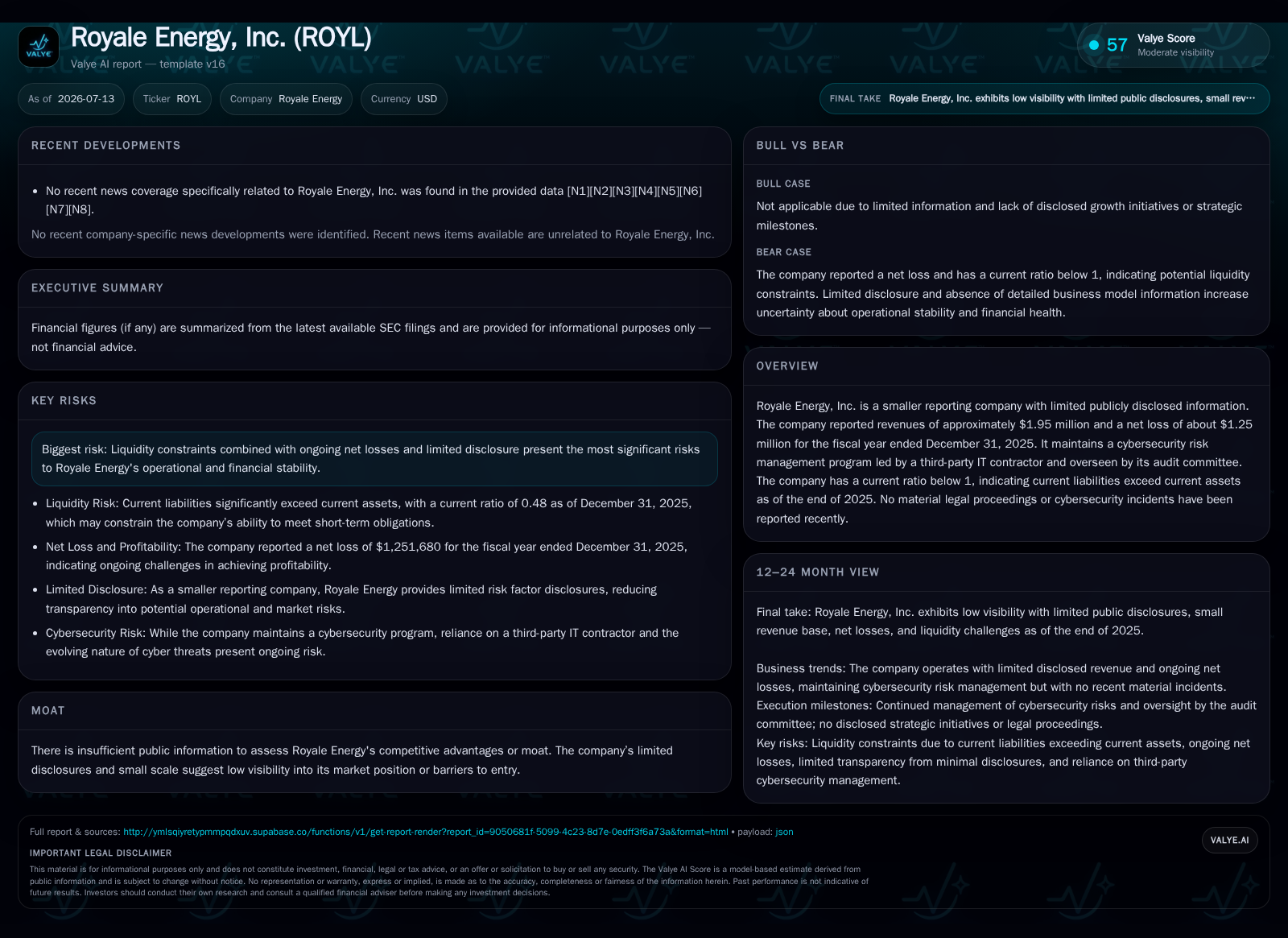
Royale Energy, Inc. operates as a smaller independent upstream oil and gas producer, generating revenue by owning working interests in producing leases. The company recorded modest revenue of approximately $1.95 million but sustained a net loss of about $1.25 million for fiscal 2025, highlighting ongoing operating cash flow deficits and limited scale. Its current ratio under 0.5 signals material liquidity constraints that could restrict capital-intensive exploration and development activities without additional financing. Industry context underscores typical risks for small independents, including capital intensity, commodity price sensitivity, and reserve replacement challenges. Royale’s recent acquisition of non-operated working interests in Texas reflects its strategy to increase production foothold but must be balanced against tight financial resources.
Recent Operating Update
Royale Energy’s latest quarterly filing dated November 26, 2025 confirms sustained financial pressures common among smaller independent producers in the upstream oil and gas sector [S2]. While no new risk factors were disclosed specifically around commodity pricing or operational disruptions—the filing states risk factors are not applicable per its smaller reporting status—the firm continues to face typical challenges of low-scale exploration companies.
Importantly, the reported current ratio as of December 31, 2025 stands at approximately 0.48 [F1], signaling substantial short-term liquidity risks since liabilities more than double current assets. This imbalance typically constrains funding for drilling activities or timely payments on operational obligations without resorting to external financing or asset sales.
Business Model Overview
Royale Energy operates primarily as an independent upstream oil and gas exploration and production company focusing on acquiring non-operated working interests in producing oil and gas leases rather than direct field operations [S1][S17]. This strategy leverages existing infrastructure managed by operators while entitling Royale to a portion of produced hydrocarbons proportional to its working interests.
Revenue generation follows standard upstream mechanics: sales volumes—measured in barrels of oil equivalent (BOE)—combined with realized commodity prices determine gross income streams before deducting royalty burdens paid to mineral rights owners and lease operating expenses including labor, equipment maintenance, energy usage, and compliance costs.
Royale does not disclose exact production volumes or proved reserves publicly but its acquisition history indicates attempts to aggregate acreage positions that provide steady cash flow from producing properties.
The September 2025 acquisition involved purchasing multiple non-operated working interests across seven Barnett shale wells in Ector County Texas within the Pradera Fuego project from Pradera Fuego LP for $1.5 million—all paid with cash on hand—reflecting strategic capacity expansion albeit within tight financial resource limits [S17]. Such acquisitions can accelerate reserve replenishment provided underlying well performance sustains economic payback.
Industry Structure and Competitive Position
The upstream oil and gas industry is characterized by capital intensity coupled with commodity price volatility impacting both cash flow predictability and investment planning. Small independents like Royale compete against larger integrated majors’ upstream segments (e.g., ExxonMobil) but more directly fit among independent operators such as Whiting Petroleum or Oasis Petroleum who often operate regionally focused asset portfolios.
Royale's limited scale suggests it lacks significant pricing power in midstream transport contracts or downstream sales arrangements relative to larger peers. Instead, profitability depends heavily on controlling finding and development costs per BOE and minimizing lease operating expenses relative to realized hydrocarbon prices.
Competitive positioning also depends on access to attractive acreage or accretive acquisitions that can deliver positive reserve replacement ratios over time—a metric essential given natural reservoir decline rates reduce production volumes annually. Limited disclosure on Royale’s reserves or operational uptime constrains visibility into these critical KPIs.
Growth Drivers
Main growth levers for small upstream producers revolve around: (1) acquisition-led reserve growth as seen in Royale’s recent Barnett shale interests purchase; (2) operational cost control enhancing netbacks per barrel; (3) favorable commodity pricing environments that lift revenue potential; (4) leveraging technological advances such as horizontal drilling or enhanced recovery techniques; (5) strategic entry into prolific basins with scalable infrastructure;
Royale’s documented acquisition strategy aligns with broader peer trends where targeted non-operated interests add near-term production without large upfront capex typically associated with drilling explorations [S17][F1]. However, absent disclosed production volume gains or improvements in operating cash flow to offset losses indicates growth execution is at nascent stages
External macro factors like global demand for oil and gas remain critical; temporary commodity price spikes may boost revenues but sustained profitability requires continuous investment capability.
Risks and Constraints
Liquidity remains arguably Royale’s foremost risk vector given a sub-0.5 current ratio placing stress on working capital management amid negative operating cash flow trending worse by over 22% year over year [F1]. This reduces runway opportunities for new exploration or development projects unless supplemented by equity raises or debt refinancing.
Another structural challenge derives from industry cyclicality where downturns sharply compress commodity prices reducing revenues while fixed lease operating expenses persist—exposing smaller players without diversified assets pools or hedging programs.
Reserve replacement uncertainty compounds as failure to economically replace declining reserves accelerates production drops curtailing future revenue streams—though Royale has made acquisition moves to partially mitigate this risk so far.
Regulatory compliance costs tied to environmental policies impose ongoing expenditures which smaller firms with less operational scale find proportionally heavier.
Cybersecurity risks are actively managed through third-party IT contractors overseeing protective controls under board audit committee supervision [S1], mitigating incident risks that could disrupt operational data integrity or financial systems.
What To Watch Next
Key upcoming milestones include monitoring subsequent quarterly filings for indications of stabilized or increased production volumes from newly acquired wells as well as any reduction in net operating losses or improvement in free cash flow conversion metrics.
Capital allocation decisions will be critical: whether Royale scales further through similar accretive acquisitions or attempts organic acreage development could signal its strategic trajectory.
Commodity price trends remain a fundamental external driver affecting refinery demand patterns influencing realized pricing power achievable by producers like Royale.
Lastly, any updates on financing arrangements addressing liquidity constraints will be pivotal measures of the company’s operational sustainability going forward.
Financial Profile Discussion
Royale Energy’s latest full-year financials manifest continued challenges typical of smaller-scale upstream entities dependent on constrained internal cash generation paired with high capital demands [F1]. Despite generating nearly $2 million in revenue for FY2025—a slight decline from prior years—the enterprise operates at meaningful net losses exceeding $1.25 million after accounting for all direct costs, overheads, depreciation/amortization expenses reflective of asset base wear-downs [F1].
Liquidity ratios underline material stress; total debt was around $1.4 million mid-2025 against roughly $1.1 million cash equivalents at calendar year-end yielding net debt near $300k—modest leverage—notwithstanding severely unfavorable current liabilities exceeding current assets by over double causing a critical current ratio below 0.5 signaling short-term funding mismatch risks requiring either asset sales, refinancing extension, or equity injections [F1]
Notable changes in auditor firms did not reveal adverse opinions suggesting accounting practices remain consistent though transparency remains limited given the company’s smaller reporting status exemptions limiting detailed disclosures about reserves or unit economics [S21].
In sum, financial metrics portray an early-stage upstream player navigating pronounced cyclical headwinds combined with inherent capital intensity where execution efficacy will hinge upon managing liquidity carefully while aligning acquisitions tactically toward stable producing assets capable of reversing free cash flow deficits sustainably.
© Valye News analysis based solely on public SEC filings dated through July 2026. This report does not constitute investment advice.
Disclaimer: This is research-only, informational analysis and not investment advice. It may include AI-generated interpretation and general industry context. Always verify important details using primary sources.

Comments