
SolarWindow Technologies Advances Transparent Photovoltaics Amid Funding and Commercialization Challenges
SolarWindow Technologies continues progressing its LiquidElectricity® Coatings, targeting diverse sectors with transparent solar solutions while facing typical early-stage commercialization hurdles.
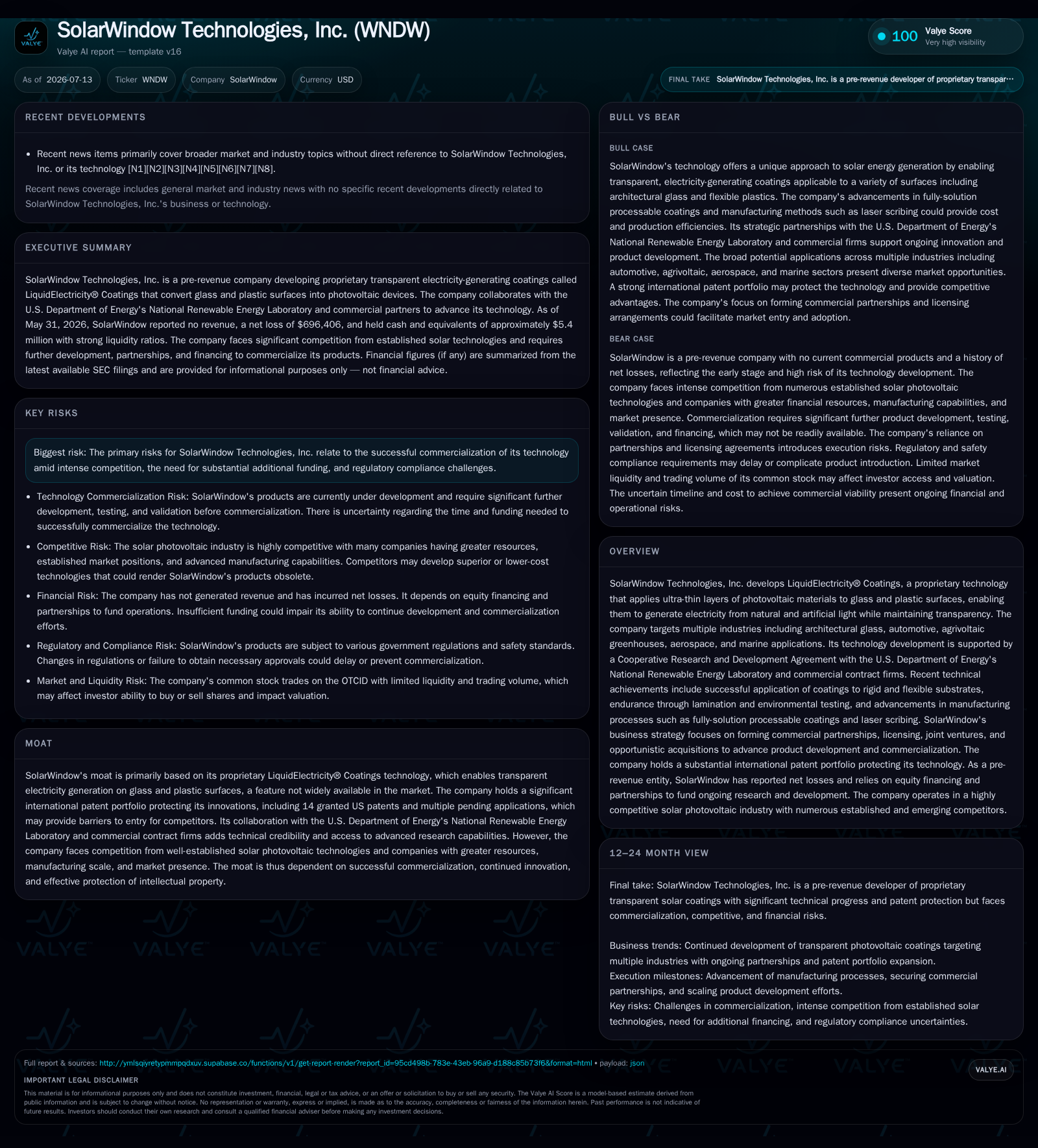
SolarWindow Technologies, Inc. remains a research-driven company advancing proprietary ultra-thin photovoltaic coatings that enable electricity generation from glass and plastic surfaces without sacrificing transparency. The company is developing its technology primarily through collaborations with the U.S. Department of Energy’s National Renewable Energy Laboratory and commercial partners, focusing on architectural, automotive, aerospace, and other niche markets. Despite steady R&D progress and a robust patent portfolio protecting its innovations, SolarWindow has yet to generate revenue and relies heavily on external funding to continue its advanced product development and scale-up efforts. Key risks include commercialization uncertainties, intense competition from established solar providers, regulatory hurdles, and capital requirements.
Recent Operating Update
The company’s financials show operating losses exceeding $2 million annually with no revenue since inception. Despite this, it retains cash reserves above $5 million as of February 2026 with a strong liquidity position demonstrated by a current ratio near 15.8x due to low current liabilities [F1]. This cash buffer provides runway for research activities but is unlikely sufficient for large-scale manufacturing deployment without additional funding.
Business Model Overview
SolarWindow Technologies is developing ultra-thin transparent photovoltaic coatings that can be applied to conventional glass or plastic substrates—enabling these surfaces to generate electricity from sunlight or artificial light sources while preserving visibility and clarity. These LiquidElectricity® Coatings consist of layered organic photovoltaic (OPV) materials including hole transport layers, active light-harvesting layers, electron transport layers, and conductive contacts [S1]. This layered chemistry framework allows tailoring of power output, optical transparency, durability, and manufacturability.
The company aims to monetize technology primarily through licensing agreements, joint ventures with manufacturers or commercial partners, and potentially integrated product sales once scale manufacturing is established. Their business model hinges on securing contracts or partnerships with entities in construction (architectural glass), automotive (electric vehicles’ glass surfaces), agrivoltaics (greenhouses), aerospace, marine vessels, and defense sectors where embedded solar capability aligns with electrification trends.
Revenue drivers are expected to be volume growth in licensing or product adoption combined with pricing based on proprietary technology usage rights or direct sales of treated materials [S1]. Margins would improve as manufacturing yields increase through process optimizations such as solution-processable coatings and laser scribing techniques that enhance scalability
Industry Structure and Competitive Position
Within the broader solar photovoltaic sector dominated by crystalline silicon panels and thin-film manufacturers like First Solar (thin-film peer candidate), SolarWindow occupies a focused niche specializing in transparent OPV coatings suitable for vertical surfaces like windows—a segment increasingly referred to as building-integrated photovoltaics (BIPV). Unlike opaque panels, transparent coatings preserve aesthetics critical for architectural or vehicle glass applications.
SolarWindow’s moat derives primarily from its extensive patent portfolio—14 granted U.S. patents backed by international filings protecting liquid coating chemistry composition and application methods—and strategic collaboration through a CRADA with the National Renewable Energy Laboratory (NREL) which provides access to cutting-edge research infrastructure [S1]. This intellectual property foundation creates technology barriers limiting easy replication by competitors.
However, significant challenges remain: major solar manufacturers have greater scale manufacturing capabilities; alternative transparent solar technologies exist such as those developed by companies like Ubiquitous Energy who also target similar use cases; and incumbent industries may exhibit cautious adoption due to cost premiums or certification hurdles. Hence SolarWindow competes not solely on innovation but must demonstrate reliable performance metrics such as conversion efficiency (%), durability under lamination processes, substrate compatibility (rigid/flexible glass/plastic), plus cost-effectiveness through manufacturing yield improvements.
Growth Drivers
Several macro trends underpin growth opportunities:
- Increasing demand worldwide for renewable energy integration at urban scale drives interest in BIPV solutions offering power generation coupled with real estate utility.
- Electrification across automotive (including autonomous vehicles) requires self-powered glass components.
- Agrivoltaic applications in greenhouses combine crop cultivation with energy harvesting.
- Aerospace and marine sectors seek lightweight energy sources compatible with strict safety requirements.
- Government incentives favor clean-tech innovation enhancing funding availability.
- Ongoing advancements in Organic Photovoltaic materials elevate power conversion efficiency while retaining transparency.
- Improvements in manufacturing processes targeting fully solution-processable coatings optimize production throughput allowing scale commercialization [S1]
Collectively these dynamics suggest a structurally growing market for transparent PV coatings if technical thresholds around performance durability and economics can be met.
Risks and Growth Constraints
Critical risks revolve around execution uncertainty:
- SolarWindow has not yet generated revenue indicating commercial traction is early stage; substantial additional capital will be necessary to fund final product development phases including expensive equipment acquisitions noted by management [S12][S24].
- Intense competition from well-funded incumbents producing traditional PV panels or emerging transparent technologies may compress market share potential unless distinct advantages are proven.
- Regulatory hurdles especially related to electrical safety certifications for window-integrated products could delay market entry or impose costly modifications; compliance complexity grows given multiple jurisdictions targeting architectural or automotive sectors [S17][S27].
- Patent portfolios protect technology but litigation or invalidation risks remain inherent given competitive stakes; also rights enforcement involves legal costs.
- Adoption lag due to customer switching from existing suppliers or conservative purchasing cycles impedes rapid uptake.
- Supply chain disruption risks persist amid global economic uncertainties affecting raw materials availability vital for chemical production steps.
- Operating losses have persisted without revenue generation indicating ongoing cash burn; failure to secure further financing would restrict R&D continuity representing existential risk [S1][F1].
What to Watch Next
Key upcoming milestones include:
- Progression toward pilot-scale manufacturing demonstrating improved production throughput (square meters/month) enabled by recent advances such as laser scribing techniques cited in disclosures [S1].
- Execution of licensing deals or joint ventures providing third-party validation of commercial viability.
- Advances in power conversion efficiency metrics achieved under lamination conditions alongside durability testing results enhancing confidence for end-use adoption.
- Further patent grants augmenting intellectual property coverage timelines extending protection into the late 2030s which would sustain competitive positioning.
- Guidance updates on cash runway reflecting additional financing rounds or capital raises critical to maintaining operational expenditures beyond the next twelve months timeframe referenced by management [S2][F1].
- Regulatory approvals or certifications attained facilitating entrance into architectural glass markets subject to stringent codes.
Financial Profile Discussion
Operating losses totaled roughly $2.36 million in fiscal year 2025 driven mainly by continuing research activities where R&D spending increased moderately by about 5% year-over-year reflecting personnel additions despite reductions in some contract costs [$622K total] while selling general & administrative expenses decreased slightly highlighting cost controls amid limited revenues [S14][F1]
No recent disclosures indicate new debt issuances; historical total debt stood around $3.6 million per last available data circa 2018. The company’s cash and equivalents balance was approximately $5.4 million as of February 2026, with current assets of about $4.8 million and current liabilities near $306,000 as of May 2026, resulting in a strong current ratio of approximately 15.8x [F1]. This reflects a solid liquidity position supporting ongoing research activities but highlights the need for additional funding to support commercialization efforts.
Funding sustainability remains pivotal since management acknowledged that current resources suffice only through one year post-reporting date corresponding roughly mid-2027 horizon assuming steady R&D cadence but breaching this would necessitate equity issuance dilutive events or entering licensing arrangements potentially less favorable economically [S12][S24][F1]. This capital dependence underscores execution risk common among pre-commercial renewable energy innovation firms transitioning toward scalable production.
Disclaimer
This analysis presents factual information extracted from publicly available SEC filings along with informed industry interpretation grounded in sector knowledge specific to solar photovoltaic technologies involving organic transparent coatings. It does not constitute investment advice or research views but aims to provide a detailed understanding of SolarWindow Technologies’ business status, industry context, opportunities, and challenges based strictly on cited data sources.
Disclaimer: This is research-only, informational analysis and not investment advice. It may include AI-generated interpretation and general industry context. Always verify important details using primary sources.

Comments