
BAB, Inc. Shows Steady Franchise Revenue Amid Unit Count Stability and Strategic Brand Leverage
BAB, Inc. maintains a resilient franchise-based revenue model with modest royalty growth despite a stable store footprint and evolving market dynamics.
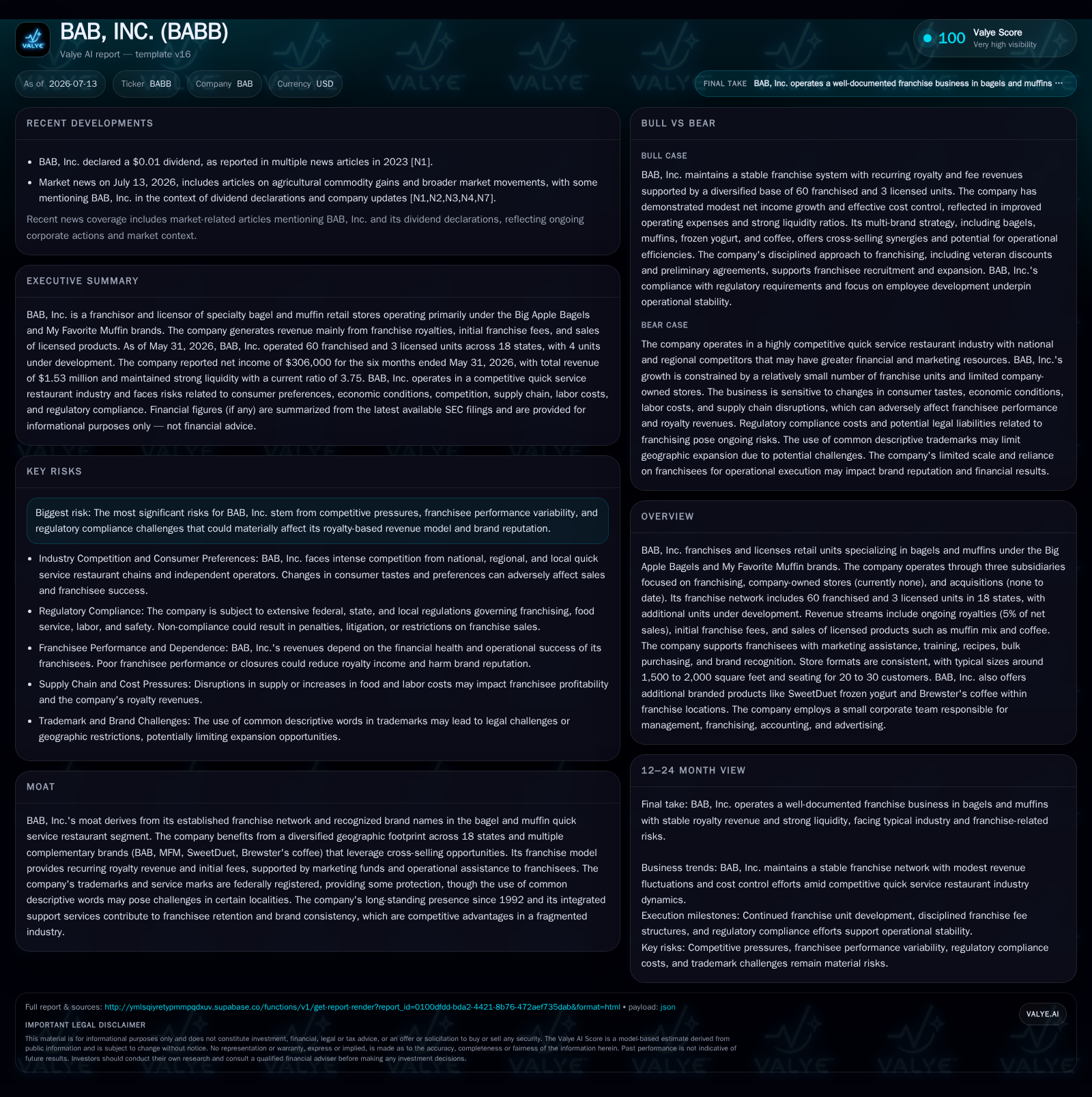
BAB, Inc.'s latest quarterly filing reveals consistent royalty revenue growth supported by a stable franchise network of 60 franchised and 3 licensed units across 18 states. While total revenues hold steady, initial franchise fees increased modestly due to new store openings, offsetting declines in licensed product income. The company’s multi-brand strategy leveraging Big Apple Bagels, My Favorite Muffin, SweetDuet frozen yogurt, and Brewster’s coffee supports cross-selling opportunities within its franchises. Key risks include competitive pressures in the fragmented quick service bakery space and dependence on franchisee operational performance. BAB’s solid liquidity and low leverage underpin disciplined capital deployment and future dividend considerations.
Recent Operating Update
BAB, Inc. reported results for the second quarter ended May 31, 2026 that reflect a stable operating environment within its franchised quick service bakery network. The company currently operates a franchise network of 60 franchised units and 3 licensed units distributed across 18 states, with four additional units under development [S2]. Compared to the year-earlier period with 61 franchised units and four licensed units, this indicates minor unit count stability with modest churn.
In the six months ended May 31, 2026, BAB generated system-wide revenue (aggregate sales at all franchise locations) of $20.3 million versus $20.0 million for the same period in 2025 [S2]. This static system-wide sales level underscores stable customer traction across stores despite incremental competitive pressures and general economic headwinds typical for quick service restaurant operators.
Meanwhile, initial franchise fee revenue rose by approximately $3,000 (17%) to $15,000 for the six months ended May 31, reflecting one new store opening in early 2026 versus more muted franchise activity last year [S2], [S25]. This modest uptick signals some ongoing appetite among potential operators interested in joining BAB's brands.
Conversely, licensing fee income—including sales of proprietary My Favorite Muffin mixes, Brewster’s coffee bean products, frozen bagels sourced from third parties, plus ancillary revenues from sign shop services—declined by about $19,000 (13.6%) year-over-year through May 31 [S2]. This drop may stem from supply or demand fluctuations related to these non-royalty product lines or adjusted purchasing patterns at franchised locations.
Marketing Fund revenues also contracted slightly (8.8% decrease in Q2), accompanied by proportionate reductions in marketing expenses managed at corporate level responsible for brand promotion efforts among franchisees [S25]. Management continues reviewing expense controls carefully during rising labor and ingredient cost inflation influences seen across the grocery-backed QSR bakery segment.
Total operating expenses fell by roughly $91,000 (7.5%) in the same period due mostly to payroll savings linked to employee retirements partially offset by upticks in professional services fees and depreciation/amortization costs [S7]. This leaner cost structure partly benefited operating income stability under subdued top-line growth.
Business Model Overview
BAB operates primarily as a franchisor focused on two well-defined quick service restaurant bakery concepts: Big Apple Bagels (BAB), featuring daily fresh bagels with cream cheese spreads and premium coffee offerings; and My Favorite Muffin (MFM), offering an extensive muffin selection complemented by specialty bagel sandwiches at select locations [S1]. These flagship brands are supplemented with SweetDuet branded frozen yogurt as an add-on option within select stores and Brewster’s coffee sold both internally at franchises as well as through other approved channels.
The company generates recurring revenue mostly from royalties calculated as a percentage (5%) of net sales reported by its franchised outlets—a model common in bakery-focused QSR franchises due to predictable cash flow scalability without company-operated retail overheads. Initial franchise fees provide incremental upfront cash on unit openings or transfers but remain a smaller proportion of total revenue given relatively low opening counts annually.
Additional revenue derives from licensed product sales including proprietary baking mixes (MFM mix), brewed coffee beans under Brewster's label, frozen bagels sourced externally but branded under BAB umbrella, as well as corporate merchandising such as signage—a diversified supplement helping smooth royalty revenue volatility tied solely to retail foot traffic [S1], [S2].
Supporting this closed-loop ecosystem is BAB’s provision of operational support including brand trademarks protection (federally registered but subject to local descriptive term risk), training programs for franchisee staff on recipes and operations consistency, bulk purchasing power enabling economies on ingredients/baked goods inputs, marketing funds allocation supporting system-wide brand campaigns alongside individualized local marketing assistance to improve customer traffic retention patterns.
At end-May 2026 BAB directly employs just eleven corporate-level personnel tasked predominantly with management oversight functions across accounting/finance reporting/compliance/franchisee relations—as typical for asset-light franchisors not burdened by operating stores directly (1 corporate-owned stores currently) enhancing margin profile materially compared to chain operators running dozens/hundreds of company outlets [S1], [S2].
Industry Structure & Competitive Positioning
BAB participates in the intensely fragmented US quick service restaurant segment specializing in bakery and café offerings such as bagels, muffins, coffee drinks alongside complementary snacking options like frozen yogurt. The sector is characterized by high numbers of small independent franchisors plus regional chains competing aggressively on food quality taste experience convenience location pricing among an evolving base of health-conscious consumers.
Peers encompassing broader bakery-café or coffee chains include Panera Bread (multi-brand operator with hybrid ownership/franchising), Einstein Bros. Bagels (bagel-specialist franchisor), Dunkin’ Brands (coffee & baked goods giant), Bruegger's Bagels (regional bagel chain), plus JAB Holding Company portfolio brands offering scale beyond BAB's footprint—the latter peer set illustrating scale/mix advantages BAB currently lacks but which it partially mitigates using niche branding synergies between its two primary brands plus Brewster's coffee.
BAB leverages multi-brand product complementarity enabling cross-selling opportunities inside individual outlets—nonetheless unit economics remain challenged fundamentally by regional competitive intensity where many small QSRs face pressure from fast casual entrants offering premium bakehouse alternatives along with specialty beverage programs attracting millennial/Gen Z cohorts seeking experiential engagement beyond grab-and-go formats.
Retention risk among franchisees is elevated given operator sensitivity to rising real estate rents labor shortages food cost inflation regulatory compliance complexities impacting cash flows critically supporting royalty remittances—thus sustained success hinges upon effective support program delivery including marketing initiatives training refreshers recipe innovation aligned with health trends navigating regulatory uncertainties such as wage hikes or food safety directives.
Growth Drivers
Key avenues identified include expansion into new state markets via selective franchise development targeting regions demonstrating demographic alignment favoring breakfast/snack quick service occasions—a market seen growing amid continuing consumer preference shifts toward convenience away-from-home eating occasions especially breakfast which accounts for a high proportion of bagel/muffin consumption occasions.
Incremental introduction of complementary branded products like SweetDuet frozen yogurt inside established BAB/MFM units broadens menu appeal extending customer visit frequency/average ticket value.[S1] Increasing operational efficiencies achievable via consolidation of supplier contracts serving both brands reduces unit input costs driving margin improvements helpful under inflationary end-market conditions.[S1] Robust marketing fund contributions sustaining continuing brand awareness campaigns critical to maintain customer traffic amid crowded consumer marketplace compete effectively against national chains offering loyalty-driven promotions. Innovation pipeline focusing on health-conscious menu variants aligns well with evolving dietary shifts providing potential differentiation benefits relative to peers slow adapting such trends. Growth through nontraditional channels such as wholesale distribution of proprietary mixes or packaged coffee aims at alternate income diversification beyond purely store-based royalties/licensing fees.
Risks & Constraints
Variability in individual franchisee operating performance poses significant risk since weak stores reduce royalty intake directly impacting corporate earnings; sustained downturn in certain key territories could dampen system-wide revenue trends disproportionately. Market competition intensity threatens both customer retention volumes price elasticity affecting AUVs per store constraining unit economics impacting upfront incentive attractiveness undermining new franchise development pipelines.,[S1] Regulatory headwinds including minimum wage increases labor regulations growing food safety scrutiny increase operator cost burdens potentially triggering closures limiting footprint expansion opportunities.,[S1] Brand dilution risk heightened since trademarks heavily rely on somewhat generic descriptive words necessitating periodic legal vigilance restraining aggressive geographic expansion where local rivals claim rights occasionally impacting store approvals/license renewals. Economic downturns reducing discretionary spending especially affect breakfast/snack categories as consumers trade down reducing volumes jeopardizing royalty stability jeopardizing dividend outlook potential.,[S2] Supply chain disruptions affecting licensed product availability may impact retail consistency undermining store-level sales volumes reducing royalty receipts notably if proprietary ingredient suppliers face interruptions.,[S2] Increasing ingredient raw material prices labor cost inflation squeeze operator margins restraining unit profitability requiring continued corporate support investments stressing resources if prolonged.,[S7] Location availability challenges including lease negotiation difficulties may constrain new unit build-outs or transfers limiting network growth potential particularly outside core Midwest/Western US markets within which BAB predominantly operates [S1], Legal risks related to franchising agreements intellectual property enforcement could lead to costly disputes diverting management attention creating uncertain business environment fracturing trust networks critical for franchisor-franchisee alignment.,[S1]
What To Watch Next
Monitor quarterly updates for:
- Changes in number of franchised/licensed units indicating uptake or attrition signaling footprint momentum or fatigue.
- Trends in system-wide sales growth across quarters signaling consumer acceptance/national economic impact.
- Royalty rate stability/changes reaffirming pricing power or signs of competitive discount pressures.
- Development pipeline progress including announced new openings/transfers confirming strategic expansion pace.
- Marketing fund contribution levels aligned vs spend reflecting brand investment commitment sufficiency.
- Earnings trends particularly net income/cash flow generation shaping capacity for ongoing dividends/cash distributions clarity.
- Regulatory developments affecting wage laws food safety impacting operational cost outlooks explicitly discussed during earnings commentary.
Financial Profile Discussion
As of May 31, 2026 BAB maintained strong liquidity reflected by unrestricted cash holdings exceeding $2.2 million alongside current assets nearly $2.7 million against current liabilities below $720 thousand yielding a robust current ratio near 3.75 indicative of solid short-term financial flexibility supportive of day-to-day operations without reliance on external funding sources [F1], [S2].
Cash flow from operations has been sufficient to cover declared cash distributions/dividends made regularly on a quarterly basis albeit conservative amounts ($0.02 per share Q1 then $0.01 Q2/Q3 announced) subject to Board discretion balancing financing needs against shareholder returns signaling prudent capital stewardship prioritizing long-term business viability over aggressive payout expansion presently [S2], [S25].
Overall financial position exemplifies typical attributes of smaller-scale asset-light franchisors maintaining conservative balance sheets enabling discretionary flexibility while preserving capacity to invest selectively into franchise support initiatives critical for maintaining competitive positioning within fragmented quick service bakery industry segment.
Disclaimer: This report is intended solely for informational purposes based on publicly available SEC filings and does not constitute investment advice or research view regarding BAB, Inc.
Disclaimer: This is research-only, informational analysis and not investment advice. It may include AI-generated interpretation and general industry context. Always verify important details using primary sources.

Comments