
Circle Internet Group Advances ARC Token Presale With Institutional Backing
Recent institutional agreements for ARC Tokens mark a pivotal step in Circle's blockchain network development and adoption strategy.
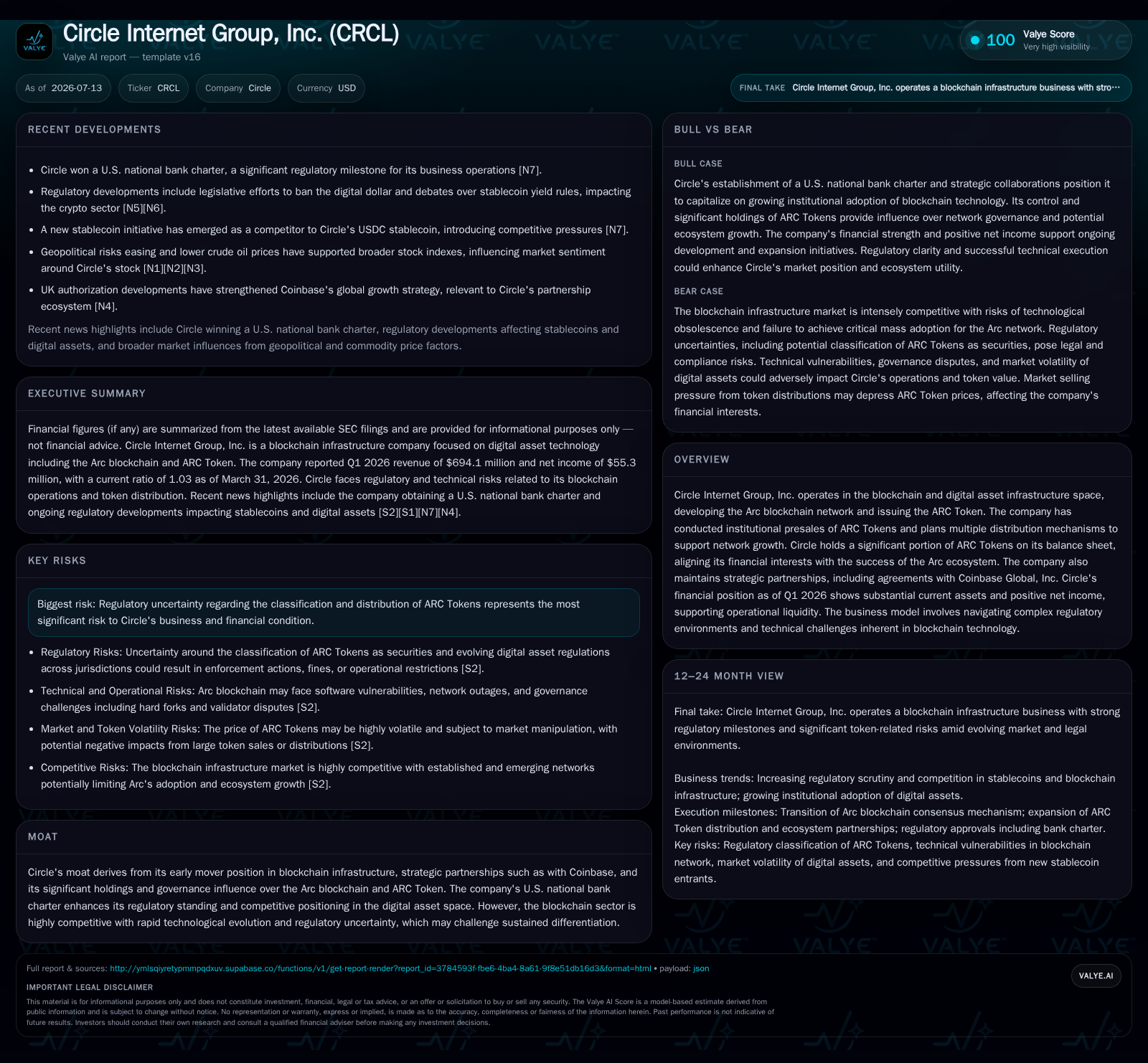
Circle Internet Group has significantly progressed its Arc blockchain ecosystem by concluding additional institutional presale agreements totaling 67.5 million ARC Tokens shortly after its May 2026 quarterly report. This coordinated capital influx underscores operational momentum toward launching the Arc network’s native token and reflects investor confidence amid a complex regulatory environment. The company's business model centers on monetizing through ARC Token sales, leveraging balance sheet holdings aligned with network success, and strategic partnerships with major players such as Coinbase Global. Nonetheless, Circle faces intrinsic industry risks around regulatory uncertainty and competitive scalability pressures within the rapidly evolving blockchain infrastructure sector.
Institutional ARC Token Presale Advances Near-Term Viability
Circle Internet Group markedly advanced its foundational layer-1 blockchain project, Arc, through a secondary institutional presale closing in late June 2026. Under new token purchase agreements signed June 29-30, the company agreed to issue an additional 67.5 million ARC Tokens at $0.30 each—a transaction implying a $3 billion fully diluted valuation for the native coordination asset underpinning the Arc network [S3]. This tranche follows earlier May agreements involving approximately 740 million tokens led by high-profile investors including a16z crypto [S2], collectively injecting hundreds of millions of dollars into funding ongoing development operations.
These developments combine to improve Circle's near-term liquidity profile for this capital-intensive phase while signaling external confidence in the eventual launch readiness and commercial viability of the Arc platform. Lock-up restrictions on these tokens prohibit transfers for no less than one year after the network transitions to a Proof-of-Stake or delegated Proof-of-Stake consensus mechanism—expected mechanisms which govern block validation while balancing decentralization with performance efficiency [S3]. Such contractual provisions demonstrate alignment incentives designed to ensure ecosystem stability during early adoption cycles.
"Arc" Blockchain Product Strategy Anchored by Native Tokenomics
Circle’s core business model hinges on monetizing digital asset issuance through institutional presales of its ARC Tokens while concurrently retaining significant token holdings on its balance sheet, thus maintaining substantial financial interest in Arc's success [S1]. The network operates on delegated proof-of-stake consensus—a protocol choice that requires selected validators to confirm transactions securely while empowering community governance structures that influence economic parameters and security assumptions.
Issuance pricing at $0.30 per token implies targeted network capitalization consistent with emerging blockchain infrastructure peers, but actual revenue recognition is likely conservative given extended lock-ups and contingent issuance terms related to technical progress milestones [S2]. Validators’ participation rates and token distribution dynamics will be crucial KPIs measuring whether delegated proof-of-stake effectively incentivizes both security and scalability.
Ecosystem Growth Hinges on Strategic Exchanges Partnership
Strategic alliances amplify Circle’s competitive positioning in token distribution channels and ecosystem reach. Notably, the partnership with Coinbase Global—the leading U.S.-based digital asset exchange—allows for streamlined market access both for retail and institutional users integrated into Arc's future transactional layers [S1]. Such arrangements also enhance digital asset custody capabilities and support developer integrations critical for growing decentralized applications (dApps) atop Arc's platform.
This relationship exemplifies synergies found where blockchain infrastructure providers leverage exchange ecosystems for fungible token liquidity and user acquisition advantages. Compared with decentralized standalone blockchains lacking major exchange partnerships, Circle benefits from established distribution pipelines that contribute positively to adoption metrics.
Competitive Differentiation Amid Evolving Blockchain Infrastructure
Despite strategic progress, Circle confronts stiff competition from entrenched players such as Ethereum—the dominant smart contract platform with vast developer communities—and rising competitors like Solana offering high throughput capabilities. Those platforms come with deeper developer engagement levels and broad dApp deployment footprints challenging Arc’s ability to capture market share quickly [S2].
However, Circle addresses some differentiation points through enhanced regulatory credibility obtained via obtaining a U.S. national bank charter—a notable milestone reported publicly—that can increase trust among institutional partners wary of compliance risks in digital assets [N2]. While this charter elevates regulatory standing relative to many blockchain rivals operating without such licenses, it also entails heavier compliance costs and operational complexity that could weigh on margins.
Growth Drivers: Adoption Metrics, Developer Ecosystem, and Regulation
Multiple factors underpin potential growth trajectories for Circle’s Arc network: accelerating integration of decentralized finance (DeFi) applications expands demand for secure low-cost block space; increasing numbers of active validators indicate upcoming network decentralization; positive trends in developer onboarding signal enhanced ecosystem vitality; finally, incremental regulatory clarity around token launches can broaden institutional participation beyond early presale buyers [S2][S3][S1].
Tracking these indicators will provide tangible insights into whether arc execution unfolds according to plan or faces setbacks amid competitive or technological headwinds.
Risks Posed: Regulatory Uncertainty and Competitive Scalability Challenges
The clearest material risk revolves around continued regulatory ambiguity concerning the classification and distribution of ARC Tokens. Failure to launch timely or meet legal conditions may trigger reputational damage alongside potential disputes with token purchasers—unsettled issues acknowledged explicitly by management in public filings discussing contingencies tied to Proof-of-Stake transition timing deadlines set for May 2028 or earlier failure triggers [S2]
Technical risks accompany as well: novel software protocols inherently carry vulnerabilities or software bugs possibly causing asset losses or network downtime if undetected during audits prior to launch. Meanwhile scalability constraints or privacy compromises could reduce user retention rates compared with better-optimized competing chains.
Catalysts Ahead: Network Launch Timing, Token Distribution Milestones
Key upcoming milestones include progress toward completing the transition from initial test stages toward full implementation of Proof-of-Stake consensus mechanisms—which will form operational foundations enabling official ARC Token deployment [S2][S3]. Subsequent scheduled distributions following mainnet launch will test community receptivity beyond institutional presales.
Monitoring sequencing adherence against these timelines offers critical validation junctures illuminating execution capabilities amid inherent blockchain project uncertainties.
Financial Profile Discussion: Balance Sheet Alignment with Token Economics
As of Q1 2026 ending March 31st, Circle held liquidity with approximately $1.52 billion in cash and equivalents alongside current assets totaling nearly $79.6 billion relative to current liabilities around $77 billion—yielding a current ratio of 1.03 indicating near parity between liquid assets and short-term obligations [F1]
Holding substantial ARC Tokens on-balance-sheet also ties financial fortunes directly to token price appreciation aligned with network adoption gains—embedding intrinsic leverage within corporate earnings potential upon successful deployment.
This analysis synthesizes recent SEC disclosures alongside industry context framing Circle Internet Group within a highly competitive yet opportunity-rich blockchain infrastructure sector characterized by rapid technological innovation balanced against strategic regulation navigation efforts. While results remain early-stage amid long-horizon developmental timelines characteristic of layer-1 blockchain projects, recent institutional backing regenerates confidence indicators vital for transforming technical product potential into scalable commercial ecosystems.
Disclaimer: This report is for informational purposes only and does not constitute investment advice or solicitation.
Disclaimer: This is research-only, informational analysis and not investment advice. It may include AI-generated interpretation and general industry context. Always verify important details using primary sources.

Comments