
Lexaria Bioscience Faces Nasdaq Compliance Challenge While Advancing DehydraTECH Licensing and R&D
Lexaria reports ongoing financial losses with solid patent protection but must regain Nasdaq listing compliance amid competitive drug delivery sector risks.
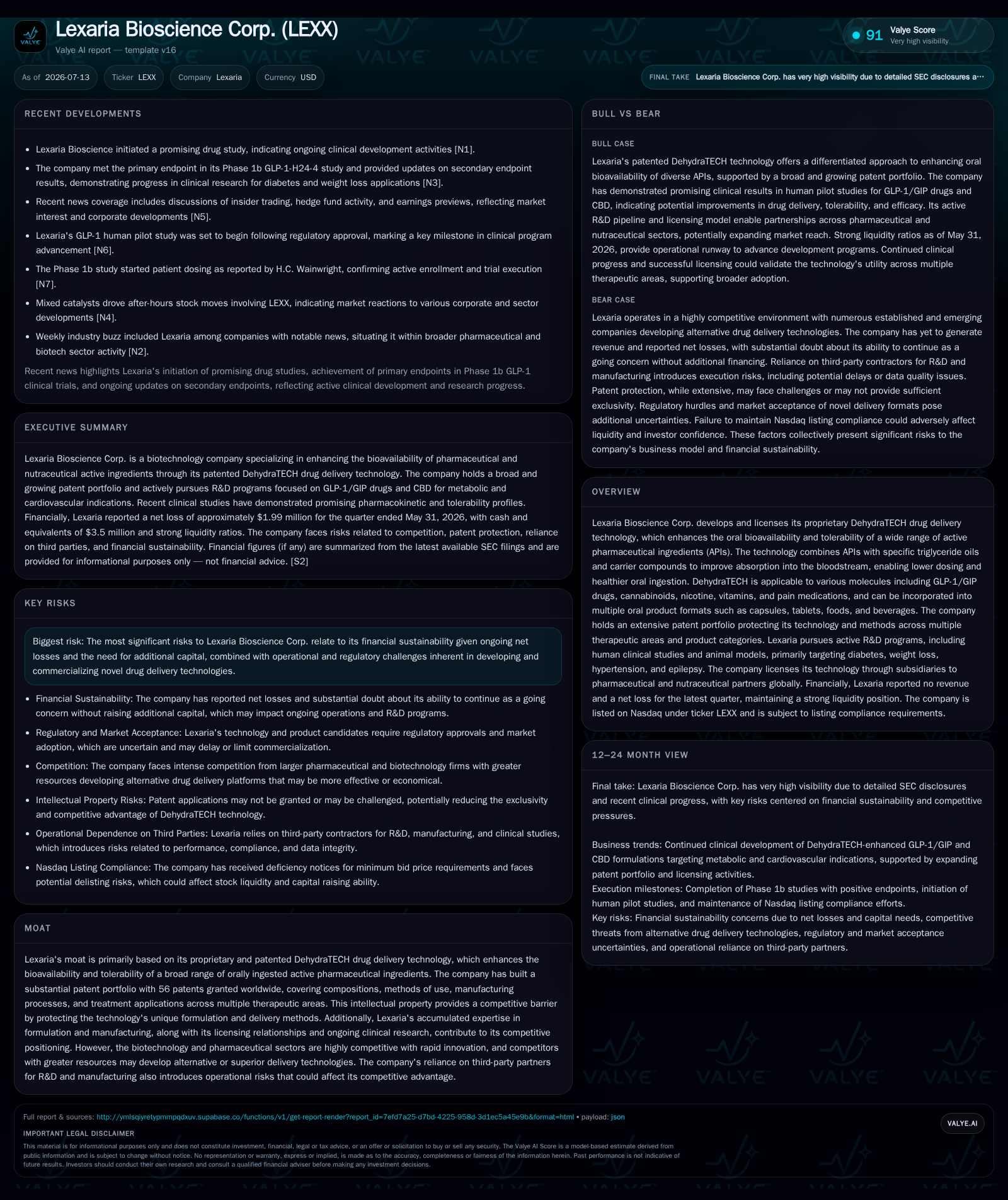
Lexaria Bioscience Corp. continues to develop and license its proprietary DehydraTECH oral drug delivery technology, enhancing bioavailability across pharmaceuticals and nutraceuticals. The company maintains a robust global patent portfolio and diversified licensing agreements covering key therapeutic areas such as diabetes and cannabinoids. However, Lexaria remains unprofitable with significant net losses and modest revenues, facing near-term pressure from a Nasdaq minimum bid price deficiency that could lead to delisting unless addressed. The competitive biotech drug delivery environment and required capital for R&D pose ongoing risks to execution and financial sustainability.
Recent Operating Update
Lexaria Bioscience's most recent quarterly filing as of July 2026 reveals continuing cash reserves of approximately $3.5 million with current assets well exceeding liabilities (current ratio of 10.6), indicating short-term liquidity is stable [F1]. However, the company remains deeply unprofitable with operating income losses over $11 million in the last reported fiscal period ending August 31, 2025 [F1]. The critical near-term corporate challenge is Lexaria's failure to maintain Nasdaq's minimum closing bid price of $1.00 per share over a sustained period. They received a deficiency notice in February 2026 and have been granted through early August 2026 to regain compliance or request an extended cure period [S2][S15]. The potential need for a reverse stock split to restore compliance looms but offers no guaranteed solution given market price volatility.
This regulatory hurdle adds pressure on management to stabilize market perception while advancing commercial milestones.
Business Model Analysis
Lexaria operates within the biotechnology drug delivery sector via its patented DehydraTECH platform—a proprietary formulation process combining active pharmaceutical ingredients (APIs) with long-chain fatty acid-rich triglyceride oils infused into carrier substrates to significantly enhance oral absorption efficiency [S1]. This platform targets improved patient outcomes by increasing bioavailability which can enable lower dosing requirements, reduce systemic side effects, improve tolerability, and replace less healthy ingestion routes.
DehydraTECH’s flexibility extends across various molecules such as glucagon-like peptide-1 (GLP-1) and glucose-dependent insulinotropic polypeptide (GIP) drugs—important in diabetes care—as well as cannabinoids (both psychoactive and non-psychoactive), nicotine analogs used in cessation therapies, vitamins, hormones, pain medications, antivirals, among others [S1]. Such broad applicability allows multiple product categories like pharmaceuticals, nutraceuticals, over-the-counter remedies, foods, beverages, capsules, tablets, and oral pouches.
Monetization occurs primarily through licensing agreements where Lexaria licenses its technology to pharmaceutical companies or consumer product manufacturers who incorporate DehydraTECH into their formulations. Revenue streams are based on upfront license fees and ongoing royalties pegged to sales volume of DehydraTECH-enabled products. This reliance on partners' successful development pipelines creates a payer structure wherein licensees carry commercialization burdens while Lexaria benefits from recurring royalties when products reach market.
An additional value driver includes expert advisory services provided by Lexaria during formulation integration into clients’ manufacturing processes—a service that builds switching costs through proprietary know-how.
Industry Structure & Competitive Positioning
Lexaria occupies the niche segment of biotech specializing specifically in oral drug delivery platforms focused on improving API bioavailability—a subspace characterized by intense R&D requirements, high regulatory scrutiny, patent-centric competitive barriers, and collaboration-dependent commercial models.
Its major peers include divisions within Catalent or Becton Dickinson involved in similar pharmaceutical formulation innovations but generally enjoy more diversified product portfolios and larger scale operations. These peers also tend to have more extensive clinical validation progress coupled with deeper financial resources.
Lexaria counters this with a substantial international patent estate comprising over fifty-six granted patents worldwide covering compositions of matter, manufacturing techniques, methods of use across therapeutic areas notably in metabolic conditions (e.g., diabetes) and epilepsy as well as consumer health applications like nicotine cessation products [S1][S22]. This IP breadth forms a significant moat by legally impeding direct competitors from replicating their proprietary formulation approach.
However, Lexaria faces competition from technologies employing nanotechnology-based microencapsulation aimed at enhancing water solubility and intestinal uptake—an alternative route which may compete directly on some targeted APIs but potentially lacks the comprehensive performance advantages exhibited by DehydraTECH as demonstrated in early scientific testing [S23].
Competitor firms include well-capitalized pharmaceutical biotech companies developing alternative delivery systems that may prove more effective or cost-efficient over time. Moreover, large pharmaceutical players investing heavily in licensing or internal development pose dynamic entry threats.
Growth Drivers
Lexaria’s growth prospects are tied fundamentally to expanding commercial adoption of DehydraTECH via licensing partnerships that yield royalty streams aligned with end-product sales. Key levers include:
- Clinical validation progress: Positive outcomes from human studies targeting GLP-1/GIP therapies for diabetes/obesity increase industry confidence enhancing partner interest.
- Patent portfolio expansion: Continued issuance of patents extending exclusivity supports barriers against encroaching technologies.
- R&D pipeline breadth: Diversifying molecular targets beyond currently licensed APIs creates new opportunities for product innovation across pharmaceuticals and nutraceuticals.
- Market demand for improved oral formulations: Growing chronic disease prevalence fuels need for safer oral drugs facilitating patient compliance.
- Strategic licensing deals: Establishing new collaborations especially in lucrative regions (Europe, Australia) widens revenue base.
Importantly, licensing deals already cover geographic territories such as Europe (with Valcon Medical A/S), Australia (exclusive licensee for certain GLP-1 analogs), alongside US nutraceutical partnerships [S13], enabling cross-market penetration potential once regulatory hurdles clear.
Risks & Watchpoints
The primary risks stem from several intersecting areas:
- Nasdaq listing risk: Failure to meet minimum bid price threatens trading liquidity exacerbating funding challenges.
- Financial sustainability: Continuing net losses necessitate further capital raises that could dilute existing shareholders; absence of meaningful product-derived revenue compounds uncertainty [F1][S7].
- Clinical & regulatory uncertainty: Advancement through FDA or analogous foreign regulatory pathways involves unpredictable timelines; setbacks or adverse safety/efficacy results can cause program suspension or termination damaging valuation [S18][S25].
- Competitive obsolescence: Emergence of rival delivery platforms presenting equivalent/better performance risks eroding DehydraTECH's market relevance [S23][S27].
- Partner dependence: Reliance on licensees for commercialization execution creates revenue realization uncertainty given dormant licenses or undefined development timelines among some partners [S13].
- Intellectual property enforcement: Challenges outside key jurisdictions or unanticipated patent invalidation reduce exclusivity value reducing competitive protection [S20][S28].
- Operational execution risk: Recruiting specialized R&D talent amidst industry competition remains critical yet challenging given company size constraints [S16].
Monitoring these risks requires close attention to clinical trial milestone achievements, partner announcements regarding commercialization progress or withdrawal from license agreements, regulatory interactions including NDA submissions or approvals indicated publicly or via filings.
What to Watch Next
Investors and industry watchers should monitor:
- Progress updates from pivotal clinical trials related to key GLP-1/GIP formulations; positive data releases would be catalytic.[N/A specific but implied from S1]
- Regulatory submissions or approvals evidencing late-stage maturation enhancing commercial prospects.
- Licensing activity announcements indicating new partnerships or expansions reflecting market acceptance.
- Financial reports evidencing improvements in revenue recognition attributable to royalties versus continued reliance on equity financing.
- Nasdaq compliance status updates towards achieving the minimum bid price requirement deadline August 3rd 2026.
- Patent grants or challenges affecting core intellectual property coverage especially across major markets like US/EU/Japan/Australia.
Financial Profile Discussion
As of May 31, 2026, Lexaria reported $3.5 million in cash and equivalents with total current assets at approximately $4.06 million against current liabilities near $0.38 million resulting in a robust current ratio of 10.6, signaling ample short-term liquidity coverage [F1]
The company does not pay dividends nor repurchase shares reflecting standard biotech sector practices prioritizing reinvestment into pipeline advancement over shareholder distributions currently [S12].
Given these factors alongside listing compliance challenges posed by Nasdaq’s minimum price rule notification received earlier this year [S2], maintaining investor confidence will depend heavily on demonstrating tangible progress toward clinical/regulatory milestones plus successfully growing revenues through partnerships licensing adoption accelerating royalty generation potential.
This analysis uses information sourced exclusively from Lexaria Bioscience Corp.’s SEC filings as recently as July 13, 2026 ([S2], [S15], et al.) plus companyfacts data effective May 31, 2026 ([F1]). Sector context was informed by standard biotechnology drug delivery industry knowledge without extrapolating unsupported financial forecasts or peer comparisons beyond cited evidence. This memo does not constitute investment advice but aims to provide rigorous industry-focused analytical insight grounded solely in verified disclosures.
Disclaimer: This is research-only, informational analysis and not investment advice. It may include AI-generated interpretation and general industry context. Always verify important details using primary sources.

Comments