
Iron Horse Acquisition II Advances AI Battery Intelligence Merger with Electra Vehicles
Iron Horse Acquisition II progresses its de-SPAC process with Electra Vehicles, targeting a public listing in the AI battery intelligence sector amid stable risk and critical shareholder vote milestones.
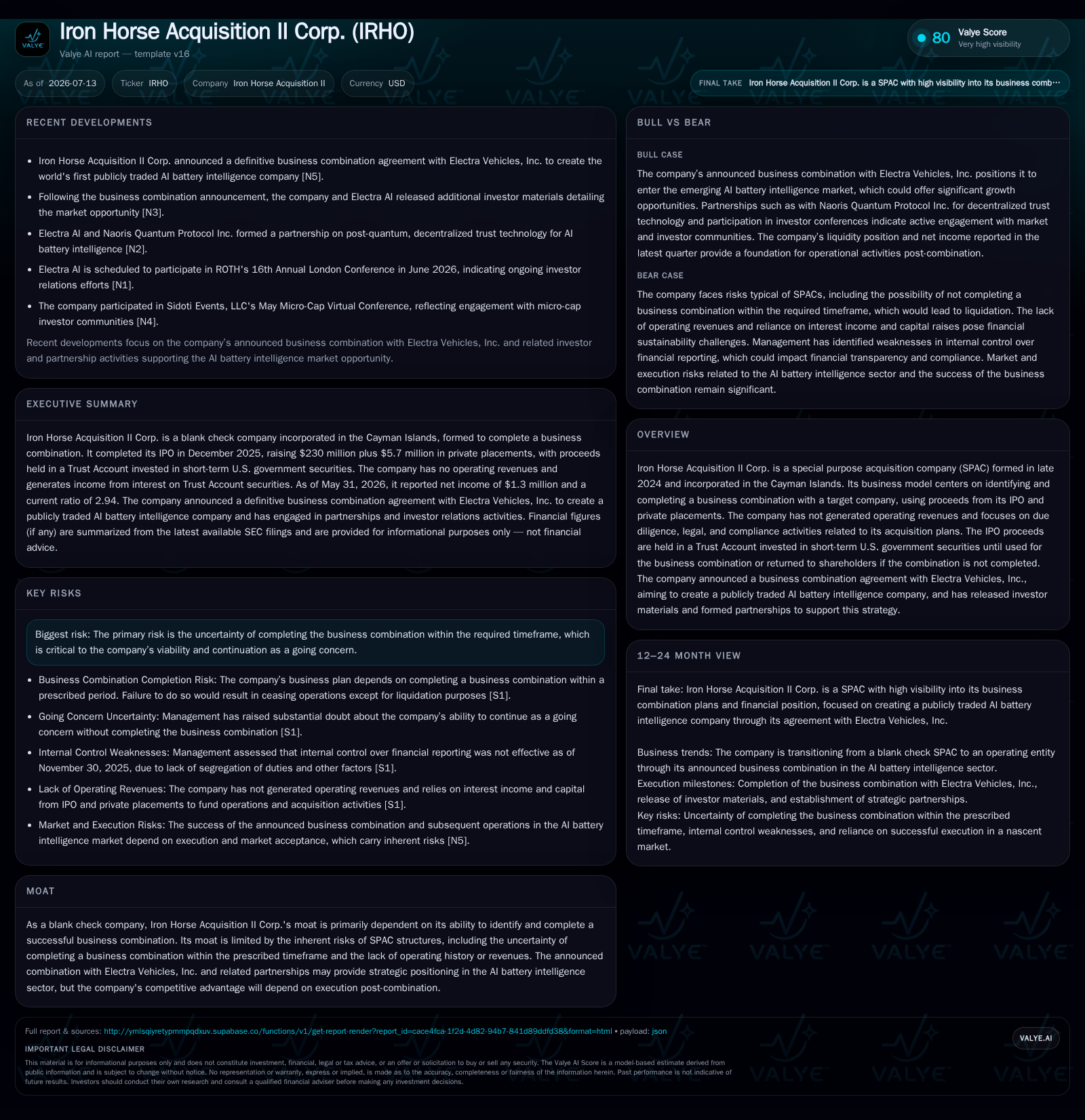
Iron Horse Acquisition II Corp. (IRHO), a Cayman Islands-based SPAC, reaffirmed its stable risk profile in the latest quarterly filing while advancing its business combination agreement with Electra Vehicles, Inc. This merger aims to create a publicly traded entity focused on AI-enabled battery performance solutions primarily for electric vehicles and energy storage markets. The company maintains a robust trust account from IPO proceeds to support expected transaction completion, while incurring typical pre-combination due diligence and legal expenses. Execution risks remain centered on timely deal closure and shareholder redemption levels ahead of upcoming proxy statements and votes.
Latest Quarterly Update Anchors De-SPAC Momentum Amid Stable Risk Profile
In its most recent quarterly report filed July 13, 2026, Iron Horse Acquisition II Corp. (IRHO) reaffirmed that there have been no material changes to the risk factors identified in its earlier annual report. This consistency underscores a currently stable operating environment despite the inherent uncertainties of SPAC transactions. The filing notes ongoing costs related to due diligence, legal compliance, and business combination preparation — standard expenses for SPACs moving toward deal closure [S2]. More importantly, this report arrives at a pivotal moment following the company’s announcement and investor communications regarding its definitive merger agreement with Electra Vehicles, Inc., indicating forward momentum in the de-SPAC process [S3]. This juncture highlights the company's focus on successfully navigating regulatory approvals and shareholder voting requirements within prescribed deadlines.
SPAC Business Model Mechanics: Capital Raise, Trust Account Integrity, and Deal Execution Costs
Iron Horse Acquisition II operates under the classic SPAC model: raising capital via an initial public offering (IPO) followed by private placement units (PPUs), placing these proceeds—totaling approximately $235.7 million—into a trust account invested conservatively in U.S. government treasury securities until used or returned [S1][F1]. This approach safeguards investor funds while mitigating risk prior to completing a business combination. The capital raise included $230 million from IPO units priced at $10 each plus $5.7 million raised through private placements involving both the company sponsor and Cantor Fitzgerald & Co. Importantly, these funds are earmarked not only for the acquisition but also cover ongoing legal, accounting, and due diligence expenses associated with identifying and vetting potential targets. Such costs decrease the net enterprise value that the combined entity will ultimately reflect post-merger.
Shareholder protections are built into this structure via redemption rights allowing public investors to opt out of the combined company before closing. This dynamic impacts how much capital remains available for post-merger operations and increases complexity in managing deal timing risks. Therefore, safeguarding trust account solvency throughout is vital to ensuring sufficient resources to complete the transaction on favorable terms.
'Electra Partnership': Strategic Focus on AI-Driven Battery Intelligence Market Entry
The announced merger partner, Electra Vehicles, Inc., offers a distinctive value proposition focused on leveraging artificial intelligence to advance battery performance across electric vehicles (EVs), battery energy storage systems (BESS), and fleet operators [S3][N1]. This intersection of clean technology with AI software analytics addresses pressing efficiency and longevity challenges in rapidly growing EV markets—a sector benefiting from strong secular tailwinds globally.
Electra’s technological capabilities include predictive analytics for battery health management that can reduce operational costs for large-scale fleet operators while contributing to energy grid stability via optimized BESS integration. Additionally, partnerships such as the recent collaboration with Naoris Quantum Protocol enhance cybersecurity aspects through post-quantum decentralized trust mechanisms—a critical facet given increasing concerns around data integrity in connected infrastructure [N3].
This strategic positioning not only situates IRHO’s post-combination entity at the cutting edge of emerging battery intelligence solutions but may foster competitive advantages through interdisciplinary tech synergies that extend beyond traditional OEM battery suppliers or software firms.
Competitive Context: Industry Peers and Typical SPAC Execution Challenges Highlighted
While Iron Horse Acquisition II is relatively new in its lifecycle as a blank-check company incorporated in late 2024, it faces execution dynamics familiar across the SPAC ecosystem. Notably, peer sponsors like Pershing Square Tontine Holdings (PSTH) represent examples of large-cap entities pursuing high-profile targets but also illustrate how sponsor reputation critically influences deal quality and market reception.
Similarly, Social Capital Hedosophia Holdings pioneered many structural norms later adopted widely among SPACs yet also revealed pitfalls including protracted timelines or inability to close deals resulting in liquidation scenarios [S1]. Common challenges revolve around time-constrained windows—usually 18 to 24 months—to consummate business combinations; failure triggers return of IPO proceeds but ends sponsor promote incentives.
For IRHO, completing its merger with Electra timely is essential to avoid these existential business risks. Furthermore, managing shareholder redemption rates is pivotal since excessive redemptions dilute cash available for initial operating budgets post-merger. Effective communication via proxy statements and investor presentations thus becomes crucial in shaping perceptions ahead of shareholder votes.
Growth Catalysts: Investor Appetite and Regulatory Climate Toward Alternative Public Listings
The broader SPAC model benefits currently from heightened investor appetite for alternative avenues into innovative industries where traditional IPOs might be lengthier or more uncertain processes. Emerging technologies such as AI-driven battery management resonate strongly due to global decarbonization commitments accelerating EV adoption.
Additionally, gradual regulatory adaptations have aimed at enhancing transparency around de-SPAC transactions without straining their fundamental utility—helping sustain viable deal pipelines across varied sectors [N1][N2]. IRHO’s focus on clean tech innovation aligns well with these macro tailwinds that can drive attractive valuations once operationally active.
Furthermore, sponsor experience matters; those able to source disruptive target companies with scalable models generally secure stronger investor interest both pre- and post-merger—providing leverage across future capital raises or strategic alliances.
Key Risks: Redemption Rights, Time Constraints, and Sponsor Execution Track Record Evaluated
Despite progress made, inherent risks loom. Foremost among these is failing to complete the agreed business combination within specified timeframe; IRHO must consummate its merger by September 2027 or face liquidation events reverting cash held back to shareholders minus allowable expenses [S1][S2]. Such an outcome would render all prior investments losses excluding returned principal.
Shareholder redemptions compound pressure because if too many investors exercise rights to redeem their shares before vote approval, it reduces cash available post-deal closure for working capital or growth initiatives—raising recapitalization or credit risks for successor operations [S3]
Uncertainties around Electra’s valuation metrics also factor heavily given this is a pre-revenue technology-driven enterprise relying on anticipated adoption curves rather than established operating history—a challenge typical of de-SPAC targets aiming at nascent sectors.
Regulatory scrutiny continues intensifying post-2023 reforms addressing disclosure standards around forward-looking statements and conflict-of-interest mitigations within SPAC deals; failure to comply could delay approvals or unsettle market confidence.
IRHO’s sponsor track record through affiliated entities offers some confidence but does not eliminate execution risk inherent in transitioning from acquisition vehicle into operating public company entity.
'What to Watch' Next: Shareholder Vote Outcomes, Proxy Statement Progress, and Redemption Levels
Critical near-term catalysts involve timely filing and mailing of definitive proxy statement/prospectus as mandated by SEC rules following registration statement submissions already made by IRHO alongside Electra [S3]. This document will detail terms of merger consideration, governance structures post-integration, potential dilution from outstanding warrants/convertible notes issued by Electra as part of financing arrangements amended recently [S18], and risks requiring careful assessment by stockholders.
Shareholder meetings slated thereafter will determine approval thresholds informing whether merger closes or shareholders redeem en masse triggering liquidation provisions.
Monitoring redemption rates gleaned from preliminary disclosures offers insight into market goodwill toward deal prospects—a key barometer influencing future trading liquidity upon stock exchange listing transition occurring subsequently.
Successful vote outcomes coupled with moderate redemptions would position IRHO strongly for scaling Electra’s AI battery intelligence platform publicly—while adverse results might signal protracted negotiations or fallback scenarios undermining strategic aspirations.
Financial Profile Discussion
As of May 31, 2026 quarter-end—the latest balance sheet snapshot available—Iron Horse Acquisition II shows current assets approximating $448K against current liabilities near $153K yielding a solid current ratio around 2.94 [F1]. This liquidity profile reflects disciplined capital conservation consistent with a non-operating shell company awaiting transaction closing.
Operating losses recorded historically total about $204K primarily attributable to general administrative activities including professional fees associated with SEC filings, compliance audits, due diligence efforts surrounding target evaluation activities predating merger finalization [F1]. While negative earnings are expected at this stage given lack of commercial operations prior to de-SPAC closure, cost control will remain important as these expenses erode capital reserved within trust accounts meant ultimately for acquired company capitalization upon closing.
In sum, financial resources appear sufficient for planned milestones barring unusual expenditure spikes or unexpected regulatory delays—setting a foundation conducive to successful transition if operational execution aligns accordingly.
Disclaimer: This analysis is based exclusively on publicly available filings and news releases as cited herein. It does not constitute investment advice nor an endorsement of any securities mentioned.
Disclaimer: This is research-only, informational analysis and not investment advice. It may include AI-generated interpretation and general industry context. Always verify important details using primary sources.

Comments