
Quartzsea Acquisition Corp Extends Business Combination Deadline Amid Redemption Activity
The recent shareholder redemptions and subsequent trust account extension heighten execution risks as Quartzsea races against its merger deadline.
Quartzsea Acquisition Corp’s latest quarterly disclosures reveal a significant exercise of shareholder redemption rights, forcing an extension of the trust termination date to October 2026. This move, conditioned on monthly deposits into the trust account, reflects mounting liquidity pressures amid a compressed transaction timeline. As a SPAC with limited current assets and ongoing deal execution needs, Quartzsea faces heightened risk around completing its pending business combination within the new deadline. Monitoring redemption trends, shareholder approvals, and merger progress will be essential to gauge whether execution hurdles can be overcome.
Shareholder Redemptions Drive Critical Trust Account Dynamics – Q2 Update
In its latest 10-Q filed July 14, 2026 [S2], Quartzsea Acquisition Corp disclosed that holders of 1,275,382 ordinary shares exercised their redemption rights in connection with the June 23 Extraordinary General Meeting [S3]. This significant redemption outflow substantially reduced capital available in the SPAC's trust account intended to fund its pending business combination. In direct response to these developments—and reflecting broader execution uncertainties—the shareholders approved an amendment to the Investment Management Trust Agreement extending the trust termination date from June 19 to October 19, 2026 [S3]. This extension is structured on a month-to-month basis requiring additional monthly deposits into the trust account based on outstanding public shares.
This liquidity management mechanism signals that Quartzsea’s closing timeline is under tangible stress. The erosion of funds through redemption exercises compresses available capital not only for merger consideration but also for administrative and transaction-related costs that typically precede deal consummations. The mandatory incremental contributions to the trust imply rising operational expense commitments directly tied to delay duration and outstanding share volume.
Quartzsea's SPAC Structure Conditions: From Unit Composition to Fee Incentives
Quartzsea operates as a classic Special Purpose Acquisition Company (SPAC), raising initial capital through issuance of units comprised of one ordinary share plus one right (entitling holders to receive one-fifth of an ordinary share upon de-SPAC) [S1]. These securities trade separately but stem from IPO proceeds placed into a segregated trust account until a qualifying business combination closes or liquidation occurs.
The revenue model for SPAC sponsors like Quartzsea hinges on successful deal closures that generate sponsor fees and post-merger equity stakes. However, shareholder redemption rights act as double-edged swords—while they provide investors an exit en route to any potential merger, high redemption rates dilute the cash pool reserved for acquisition funding and can diminish sponsor incentives by reducing overall deal scale.
Execution risk in this setup combines deal sourcing acumen with timing discipline; each passed deadline without closing triggers extended holding costs and risks sponsor dilution or transaction collapse. Quartzsea's disclosures underscore how these dynamics manifest concretely when redemption activity accelerates during critical vote windows.
Competitive Environment: SPAC Market Context and Peer Reference Points
Like many contemporaneous SPACs such as Pershing Square Tontine Holdings or Churchill Capital entities, Quartzsea confronts intense pressure from market-wide shareholder redemptions that jeopardize transactional viability. The balancing act between negotiating extensions—which often incur additional fees—and maintaining investor confidence proves universal across this cohort.
Furthermore, traditional IPO underwriters continue to offer private companies an alternative pathway to public markets that avoids some regulatory uncertainties prevalent in SPAC deals. Consequently, Quartzsea’s ability to compete depends heavily on pioneering innovative deal structures coupled with prudent timing management.
PIPE investors commonly step in post-business combination to provide needed equity injections supporting growth initiatives; however effective PIPE placement also relies on maintaining merger momentum unbroken by protracted negotiations or escalating redemptions.
Growth Prospects Hinged on Timely Business Combination Close
Quartzsea’s future growth trajectory is uniquely tethered to completing its announced mergers within the extended deadline framework [S3]. Investor appetite for growth-oriented speculative vehicles sets favorable precedent but requires demonstrable deal progression marked by strong shareholder approval rates and robust closing conditions.
The compressed timeline accentuates risks associated with regulatory delays—especially given prior experience terminating deals due to protracted approvals from bodies like Chinese regulators [S11]. Any further slippage could curtail strategic optionality.
Investor confidence will ultimately hinge on transparent progress reporting regarding merger negotiations and adherence to amended governance mechanisms established during recent shareholder votes.
Key Risks Spotlight: Redemption Impact, Liquidity Strain, Regulatory Uncertainty
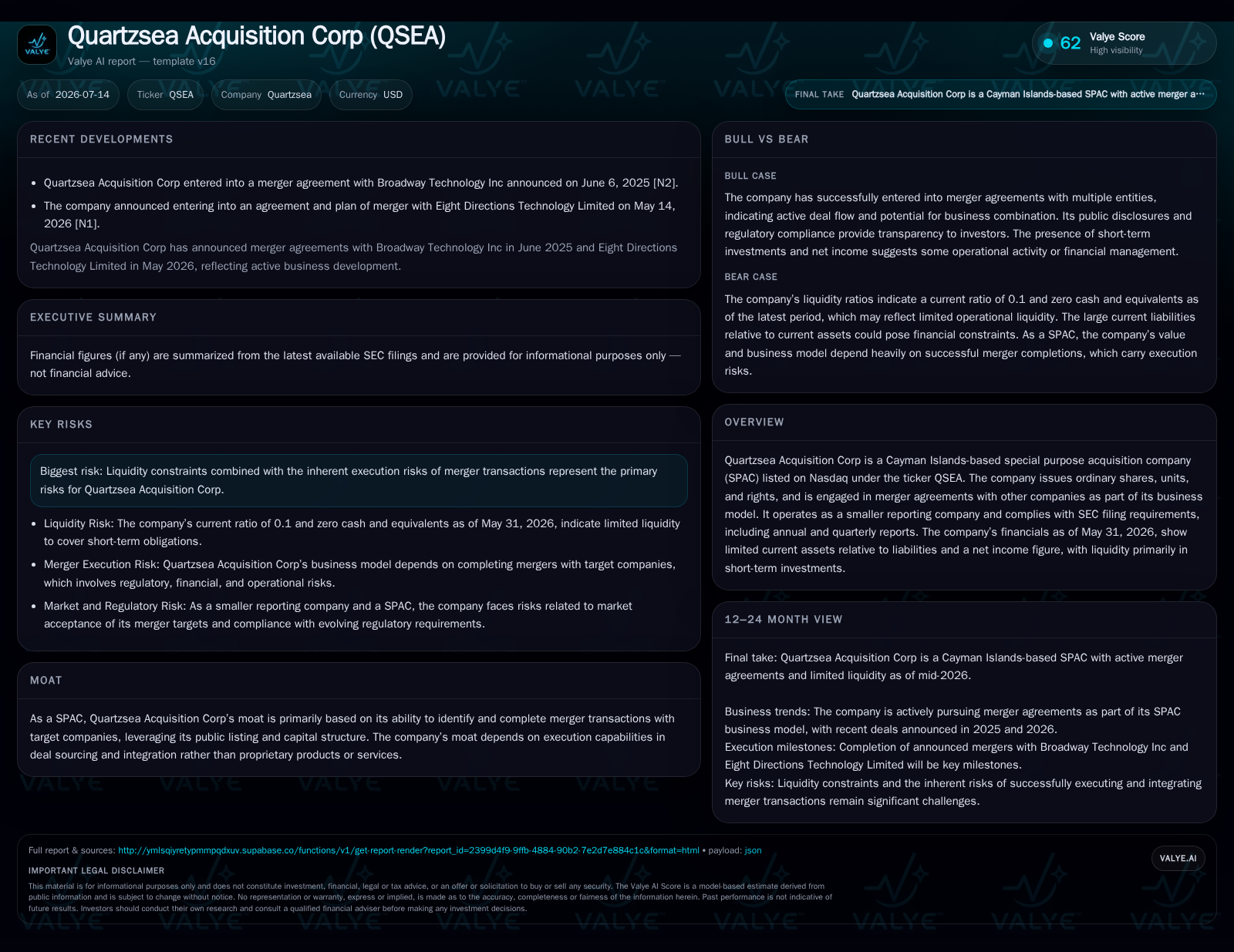
Significant redemptions undermine financing sufficiency precisely when operational runway is stretched thin. As evidenced by a current ratio of roughly 0.1 per latest financial snapshots ([F1]), immediate liquidity constraints limit flexibility for unforeseen expenses beyond those systematically managed through the trust account.
Regulatory risks remain omnipresent given cross-jurisdictional approval dependencies—the failure to secure timely clearance may derail a transaction even if shareholder sentiment remains supportive [S11]. Moreover, legal exposures stemming from previously terminated agreements further amplify reputational risk profiles.
Sponsor incentives also face challenges balancing fee realization against increasingly punitive market expectations regarding transparency and governance aligned with public market standards [S1]. These multifaceted risks converge into a tense execution environment characteristic of late-stage SPAC lifecycle stages.
Watchpoints: Upcoming Shareholder Votes, Redemption Trends & Merger Progress Updates
The next several weeks will be pivotal as Quartzsea holds requisite shareholder votes on amended agreements governing its transaction timelines [S3]. The outcomes will signal shareholder collective confidence or dissent regarding prolonged deal pursuit.
Surveillance of ongoing redemption subscription data releases will provide near-real-time insight into shifting investor sentiment—a vital metric given its direct impact on remaining merger capital pools.
Additionally, updates concerning new merger agreements or amendments thereto reported via forthcoming SEC proxy materials warrant close attention; any acceleration or stalling therein could foreshadow final resolution directionality.
Financial Profile Discussion: Capital Reserves Risk Amid Escalating Costs
As of May 31, 2026, Quartzsea reported zero cash equivalents alongside minimal current assets amounting roughly $112K compared against over $1.14 million in current liabilities ([F1]). This stark imbalance accentuates pre-combination financial fragility prevalent in many SPACs pending deal closure.
Failure to secure additional funding sources could lead to dilution via warrant exercises or refinancing maneuvers unfavorable to existing shareholders; hence these financial conditions underline urgency behind strategic extensions recently enacted [S3].
DISCLAIMER: This analysis is based solely on publicly available information from SEC filings and recognized industry knowledge frameworks as of July 14, 2026. It does not constitute investment advice or research views. Readers should consult independent sources before making decisions related to Quartzsea Acquisition Corp or related financial instruments.
Disclaimer: This is research-only, informational analysis and not investment advice. It may include AI-generated interpretation and general industry context. Always verify important details using primary sources.

Comments