
Destiny Media Technologies Advances Play MPE® Innovation to Strengthen Digital Music Distribution Moat
The July 2026 quarterly report highlights steady revenue and renewed product focus as Destiny Media fortifies its SaaS platform amid evolving digital music promotion dynamics.
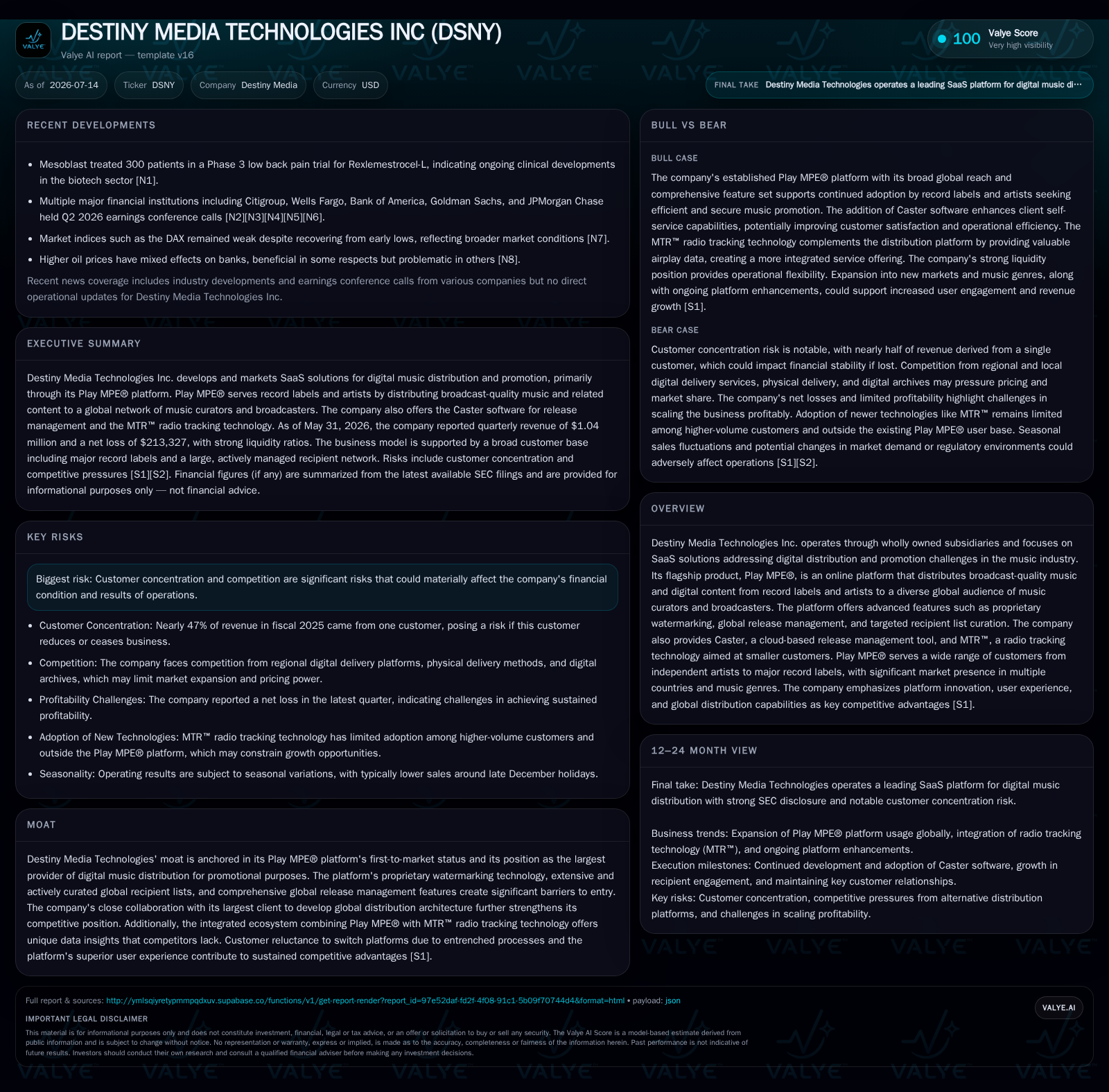
Destiny Media Technologies' latest quarterly results demonstrate stable top-line performance around $4.5 million, with ongoing operating losses reflecting sustained R&D investment into the Play MPE® platform’s innovation and user expansion. Anchored by proprietary watermarking and meticulously curated recipient lists, Play MPE® continues to serve a diverse global customer base from independent artists to major record labels. The company's moat is reinforced by its first-mover advantage and integrated offerings like the MTR™ radio tracking tool, though risks linger around customer concentration and competitive pressure from regional and physical distributors. Monitoring user engagement metrics, feature adoption rates, and geographic reach will be key to judging progress on Destiny Media’s strategic growth initiatives.
July 2026 Quarterly Results: Incremental Progress Amid Market Dynamics
This quarter’s results confirm a pattern of cautious yet focused execution — the flat revenue trajectory underscores challenges in accelerating customer acquisition or usage intensity amid competitive SaaS dynamics but also affirms resilience of Destiny's core business in promotional digital distribution. The persistent operating loss suggests further feature investments designed to deepen client engagement will continue to be prioritized.
"Play MPE®": The Cornerstone SaaS Platform Bridging Artists and Broadcasters
At the heart of Destiny Media’s business model lies Play MPE®, a cloud-hosted software-as-a-service platform providing broadcast-quality audio and other digital promotional content distribution primarily for record labels ranging from small independents up to major players such as Universal Music Group and Sony Music Entertainment [S1]. The platform enables clients to target segmented recipient lists comprising radio programmers, streaming broadcasters, DJs, TV/music supervisors, media reviewers, and event curators globally.
Revenue mechanics center on subscription or usage-based fees whereby labels pay for access to these curated delivery networks along with value-added functionalities such as metadata management and administrative security controls. These features improve efficiency in promotional campaigns by enabling precise content placement while ensuring traceable secure delivery — benefits that foster strong recurring revenue via customer retention mechanisms.
Importantly, Play MPE® operates as an active digital archive supporting long-term content availability but optimized with marketing-centric tools to drive on-air royalties and song popularity gains for customers. This dual role enhances stickiness within an industry where switching costs arise not only from contractual ties but also entrenched workflow integration.
"Watermarking Tech and Recipient Curation": Core Competitive Moat Components
Destiny Media’s moat largely derives from its proprietary watermarking technology embedded within Play MPE®. Each distributed audio file carries unique watermarks tied to individual recipients that safeguard intellectual property against unauthorized redistribution — a critical capability addressing major labels’ persistent anti-piracy concerns [S1]. This feature materially raises the barrier for competing platforms that lack equivalent security sophistication.
Coupled with watermarking is Destiny’s carefully curated global recipient list that generates network effects; artists and labels attract more broadcasters who find curated content relevant while labels deepen their engagement over time. This tight ecosystem cultivates high customer retention rates and mitigates churn risks by imposing significant switching costs both operationally and culturally across the industry’s distribution workflows.
From a SaaS economics perspective, these advantages afford Destiny more efficient Customer Acquisition Cost (CAC) payback due to longer contract durations and higher Net Revenue Retention (NRR). They also reduce vulnerability to pricing pressure seen in commoditized digital services.
"Industry Fragmentation": Peer Landscape and Resilience of First-Mover Advantage
While Destiny Media holds a leading position with its Play MPE® platform as the largest global provider for promotional digital music distribution [S1], competition remains fragmented especially on regional levels. Competitors include specialized local SaaS platforms serving niche territories or customer subsets along with traditional physical media distributors who still maintain footholds among certain label segments uncomfortable with fully digitized workflows.
Further indirect competition comes from digital archives acting more as content repositories than active promotional tools. Adjacent peers like Kobalt Music Group or SoundCloud participate in overlapping spaces but tend to emphasize rights management or consumer streaming respectively rather than targeted promotional distribution designed into Destiny’s SaaS offering.
In this context, Destiny’s early entrance combined with comprehensive feature breadth allows it to capitalize on economies of scale where smaller competitors face fragmented reach or narrower functionality sets—solidifying its niche leadership.
"Growth Engines": Platform Innovation, Independent Artist Adoption, and Global Reach Expansion Opportunities
Management has underscored ongoing investments aimed at expanding Play MPE®’s functionality including new release management tools and marketing process enhancements designed to grow activity metrics on both supply (artists/labels) and demand (recipients) sides [S1]. Heightened user engagement would increase volume-based revenue drivers such as downloads or streams processed through the system.
A noteworthy growth vector lies in increasing adoption among independent artists who traditionally lacked access to high-end promotional platforms. By creating tiered offerings tailored for smaller users plus leveraging the integrated MTR™ radio tracking service launched recently (targeting airplay monitoring for underserved smaller clients), Destiny aims to broaden its Total Addressable Market (TAM) beyond major label dependence [S19].
Geographically, Destiny maintains presence across North America ($2.14 million revenue), Europe ($2.21 million), Australasia ($160k), and Africa ($19k), signifying diverse international penetration but also indicating room for expansion especially outside established Western markets [S24]. Success in driving higher Monthly Active Users (MAU) internationally alongside advances in feature adoption will materially influence future growth profiles.
"Risk Factors": Customer Concentration, Competitive Pressures, and Technological Evolution Challenges
Despite competitive moats, risks persist notably around sizable customer concentration—with one label accounting for nearly 47% of total revenues in fiscal year 2025 highlighting exposure should this relationship falter or renegotiate terms unfavorably [S24]. Competition from emerging regional SaaS providers or a resurgence of physical distribution modalities poses demand disruption risks.
Technologically, maintaining superiority of watermarking innovations remains essential; any failure could degrade platform security perceptions causing client churn. Additionally, evolving data privacy laws or copyright regulations could impose operational complexities or compliance costs impacting margin sustainability. Integration risks with increasingly complex label IT environments also present potential customer experience hurdles that might elevate churn if unresolved swiftly.
Economic downturns affecting marketing budgets within record labels could cyclically suppress transactional volumes given promotional spending sensitivity.
"Catalysts to Monitor": User Metrics, Feature Rollout Success, Geographic Penetration, and Client Retention Trends
Key indicators observers should track include shifts in MAU reflecting acceptance of new features introduced by Destiny; movements in churn rate post-platform upgrades signaling retention efficacy; expansion velocity of international shipments particularly beyond core North American/European hubs; renewal rates among top-tier clients evidencing satisfaction; plus uptake levels of the complementary MTR™ tool which may reveal cross-sell effectiveness.
Incremental improvements in Average Revenue Per User (ARPU), along with pipeline updates regarding new contracts or partnerships disclosed in forthcoming filings would provide tangible signposts toward successful scaling outcomes.
"Financing Capacity": Liquidity Position Supports Continued Strategic Investment
As of May 31, 2026, Destiny maintains $1.397 million in cash and equivalents supported by working capital conducive to ongoing investment capacity [F1]. This liquidity position, with current assets of approximately $2.11 million against current liabilities near $741,000, yields a current ratio of 2.85, indicating ample liquidity to support sustained R&D expenditures vital for retaining technological leadership within a fast-evolving SaaS music promotion landscape [F1].
Operational losses recorded reflect strategic prioritization of innovation over short-term profitability—a typical profile during growth phases within software industries where platform durability predicates eventual margin leverage.
This analysis is based solely on publicly available SEC filings including the latest quarterly Form 10-Q dated July 14, 2026 [S2], annual Form 10-K from November 24, 2025 [S1], as well as financial detail extracted from company facts dated May 31st, 2026 [F1]. No forward-looking investment advice or price research views are provided herein.
Disclaimer: This is research-only, informational analysis and not investment advice. It may include AI-generated interpretation and general industry context. Always verify important details using primary sources.

Comments