
BlueOne Card Advances Payment Hub Platform Amid ISO 20022 and Remittance Market Expansion
BlueOne Card evolves from prepaid card management to a global fintech platform provider leveraging Millennium EBS acquisition.
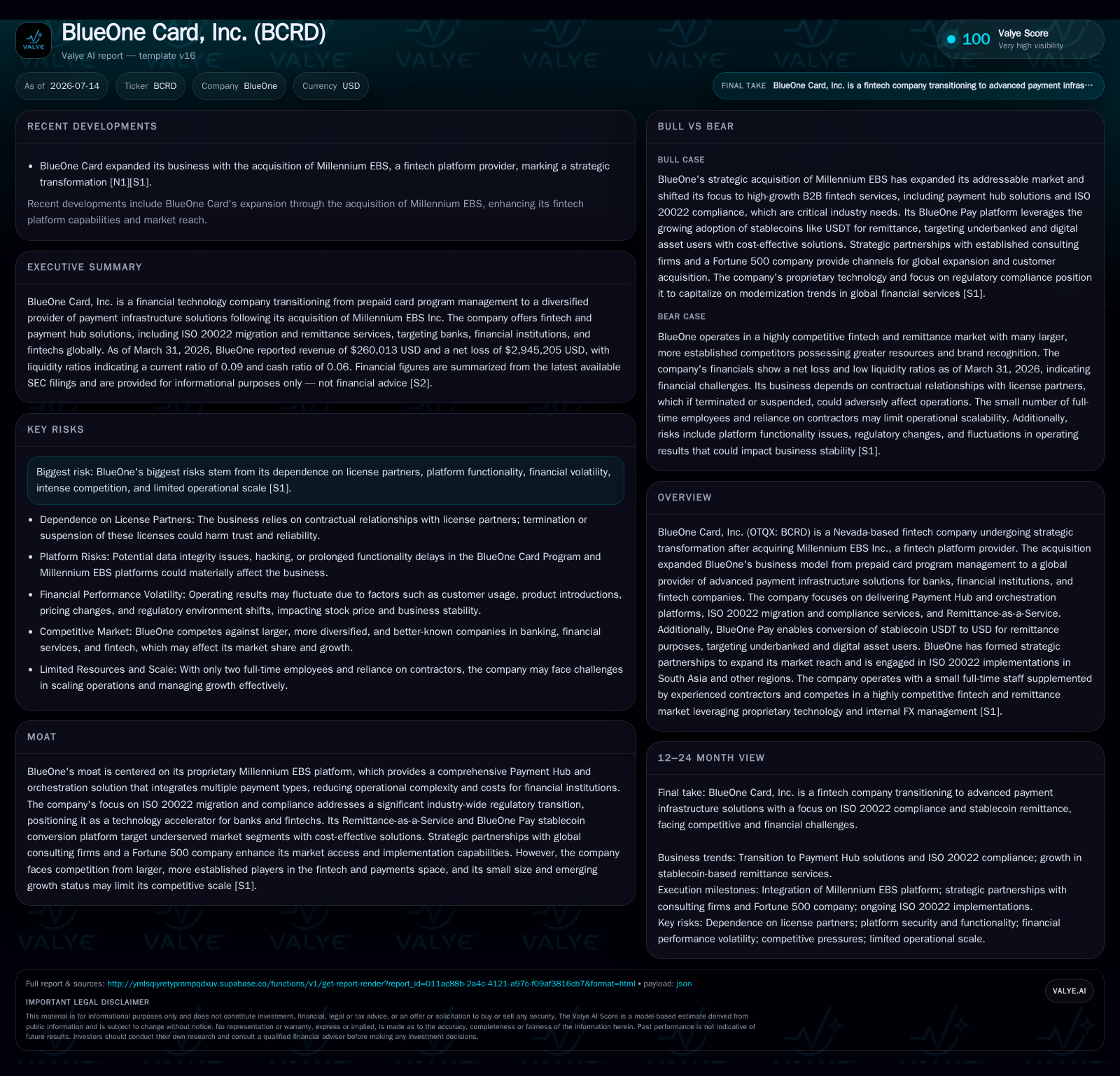
BlueOne Card, Inc. has transformed its business model through the acquisition of Millennium EBS, shifting focus toward advanced payment infrastructure solutions including Payment Hub orchestration, ISO 20022 migration services, and Remittance-as-a-Service. The company targets banks, financial institutions, and fintech companies globally, with an emphasis on compliance and payment modernization amid regulatory shifts. Despite strategic partnerships that enhance market reach, BlueOne continues to face financial challenges, operating losses, and risks typical of small emerging fintechs, such as dependence on license partners and competitive pressures.
Recent Operating Update
BlueOne Card, Inc. (now BlueOne Technologies, Inc.) reported in its latest quarterly filing dated February 17, 2026, ongoing operational challenges typical of emerging fintech platforms undergoing strategic transformation [S2]. The company maintains an allowance for probable losses on accounts receivable and notes receivable using the current expected credit loss method, reflecting credit risk management in revenue realization from its customer base. Additionally, BlueOne accounts for vehicle lease liabilities under ASC 842 by capitalizing right-of-use assets and corresponding lease liabilities on the balance sheet, aligning with GAAP lease reporting standards [S2].
A May 2026 8-K filing notes the engagement of a new independent auditor with no disagreements reported, while also highlighting ongoing legal matters under evaluation that could affect future financial conditions [S3]
Business Model and Strategic Transformation
BlueOne’s business model pivot centers on the December 2024 acquisition of Millennium EBS Inc., a New Jersey-based fintech platform provider [S1]. This acquisition marks a fundamental shift from a prepaid card program management focus to delivering scalable, enterprise-grade Payment Hub infrastructure and orchestration technologies targeting banks, financial institutions (FIs), payment processors, and fintech companies globally.
The Millennium platform is BlueOne’s core growth engine, offering a suite of integrated fintech solutions:
Payment Hub and Orchestration Platform: This centralized middleware aggregates multiple payment types—including ACH, wire transfers, card networks, and real-time payment rails—into a single system. By streamlining transaction processing workflows, it reduces operational complexity and lowers costs for clients while enhancing payment routing flexibility.
ISO 20022 Migration and Compliance Services: With the global financial industry mandated to adopt the ISO 20022 messaging standard, many institutions face complex technical challenges. BlueOne’s platform accelerates compliance by bridging legacy systems with the new enriched data standard, enabling clients to meet regulatory deadlines and leverage richer payment data for operational insights [S1].
Remittance-as-a-Service (RaaS): BlueOne offers turnkey cross-border remittance solutions that allow fintech startups and service providers to enter remittance markets rapidly without heavy upfront infrastructure investments, addressing a growing demand for cost-effective international payment services.
Stablecoin Conversion via BlueOne Pay: The upcoming BlueOne Pay service facilitates conversion of USDT stablecoin deposits into USD fiat currency, disbursed through bank transfers, prepaid cards, or cash pickup [S1]. This offering targets underbanked populations increasingly transacting in digital assets, bridging cryptocurrency ecosystems with traditional payment rails while ensuring compliance through KYC verification
Revenue generation is primarily driven by subscription and licensing fees for platform access, transaction fees or revenue sharing on processed payments, consulting and implementation fees related to ISO 20022 migration projects, and value-added charges under the RaaS and stablecoin conversion services.
Industry Context and Competitive Position
BlueOne operates within the fintech payment infrastructure sector, characterized by rapid innovation driven by regulatory compliance demands and growing cross-border payment volumes. Unlike large incumbents such as ACI Worldwide, FIS, or Fiserv, which offer broad banking technology suites with extensive global reach, BlueOne positions itself as a nimble technology accelerator focused on mid-tier banks and fintechs seeking modular Payment Hub orchestration capabilities.
The proprietary Millennium EBS platform serves as BlueOne’s primary competitive moat by reducing operational friction across diverse payment types and addressing the urgent industry-wide ISO 20022 compliance mandate [S1]. Additionally, BlueOne’s integration of stablecoin conversion services differentiates it from many peers less engaged with digital asset modernization.
Strategic partnerships enhance BlueOne’s market reach, including a collaboration with Abeam Consulting, which leverages a global banking client network to promote ISO 20022 and Payment Hub solutions. Discussions with a Fortune 500 company servicing over 600 financial institutions in more than 140 countries aim to further expand global implementation of BlueOne’s compliant payment infrastructure [S1]. However, BlueOne’s relatively small operational scale compared to larger fintech vendors limits its competitive leverage and exposes it to intensified market pressures.
Growth Drivers
Several structural growth catalysts underpin BlueOne’s opportunity set:
ISO 20022 Global Mandate: The accelerated adoption timeline imposed by SWIFT and other clearing houses creates urgent demand for compliant middleware solutions. BlueOne’s Payment Hub acts as an integrative shortcut enabling clients to meet these deadlines efficiently while unlocking enriched data capabilities.
Expansion in Cross-border Remittances: Increasing migrant worker populations and digitization trends enlarge the addressable market for cost-effective Remittance-as-a-Service offerings, lowering barriers to entry for remittance providers [S1].
Digital Asset Penetration: Stablecoins like USDT are increasingly used in global remittance corridors. BlueOne Pay’s facilitation of converting these digital tokens into USD fiat currency may capture new customers underserved by traditional payment rails.
Banking Infrastructure Modernization: Many community banks and regional financial institutions require upgraded payment capabilities without prohibitive capital expenditures. Cloud-native orchestration platforms like BlueOne’s offer attractive alternatives to legacy systems.
Key operating KPIs to monitor include the number of active platform clients (banks, fintechs), transaction volume processed, platform uptime and latency, customer retention rates, and speed of ISO 20022 implementation projects.
Risks and Growth Constraints
BlueOne faces material risks typical of emerging fintech platform providers:
Dependence on License Partners: Revenue generation is heavily reliant on contractual relationships with license partners [S1]. Termination or suspension of these licenses could disrupt business continuity. The company plans to onboard secondary license holders per market to mitigate concentration risk, though execution remains uncertain
Platform Security and Stability: Given the sensitive nature of payment flows, technical issues such as data integrity lapses or cybersecurity breaches could severely undermine client trust and damage reputation [S1].
Financial Volatility and Liquidity Constraints: BlueOne reported a net loss exceeding $2.9 million for the quarter ended March 31, 2026, with operating losses reflecting ongoing investment in platform development and market expansion [F1]. The company’s current ratio stood at a precarious 0.09 as of the same date, indicating significant working capital deficits and liquidity risk. Continued shareholder support and financing are critical to maintaining going concern status [S1],[S2],[S18].
Intense Competition: Larger fintech and payment infrastructure vendors with deeper resources compete aggressively across payment orchestration and compliance solutions. Without scale or differentiated sales channels, BlueOne may face challenges in gaining sustained market share.
Regulatory Uncertainty in Digital Assets: While BlueOne Pay targets promising stablecoin flows, evolving government regulations around cryptocurrencies introduce compliance risks and potential operational constraints.
Delayed Monetization: The timeline from product rollout to meaningful revenue contribution can be lengthy, with early-stage losses likely to persist until critical mass client aggregation and transaction volume growth occur [S1]
What to Watch Next
Key milestones signaling positive momentum include:
- Securing additional license holders nationally and internationally to diversify revenue sources.
- Signing substantive new contracts demonstrating platform user growth and increasing transaction volumes, especially in Remittance-as-a-Service.
- Advancing BlueOne Pay launch with measurable stablecoin conversion uptake.
- Timely execution of ISO 20022 migration projects with clients meeting compliance deadlines.
- Announcements confirming expansion of strategic partnerships, including finalization with the Fortune 500 collaborator.
- Progress reports on liquidity improvement initiatives and reduction in operating losses.
Financial Profile Discussion
BlueOne’s financial profile reflects the challenges of scaling an emerging fintech platform. For the quarter ended March 31, 2026, the company reported revenue of approximately $260,000 alongside an operating loss of about $4.1 million and a net loss near $2.95 million [F1]. The balance sheet shows current assets of roughly $197,500 against current liabilities exceeding $2.26 million, resulting in a critically low current ratio of 0.09, underscoring significant liquidity constraints [F1].
Sustained capital inflows through shareholder support or external financing remain essential to fund ongoing operations and platform development. Monitoring cash burn rates alongside revenue growth and client onboarding metrics will be vital to assessing BlueOne’s path toward financial sustainability.
This analysis synthesizes facts disclosed primarily through recent SEC filings combined with sector-specific fintech payment infrastructure context. It emphasizes practical domain-specific implications within the evolving global payments ecosystem without speculative forecasting.
Disclaimer: This is research-only, informational analysis and not investment advice. It may include AI-generated interpretation and general industry context. Always verify important details using primary sources.

Comments