
SusGlobal Energy Faces Compliance and Capital Challenges Hindering Waste-to-Energy Operations
Operational shutdowns and mounting debt obstruct SusGlobal Energy’s ability to scale organic waste processing in Ontario.
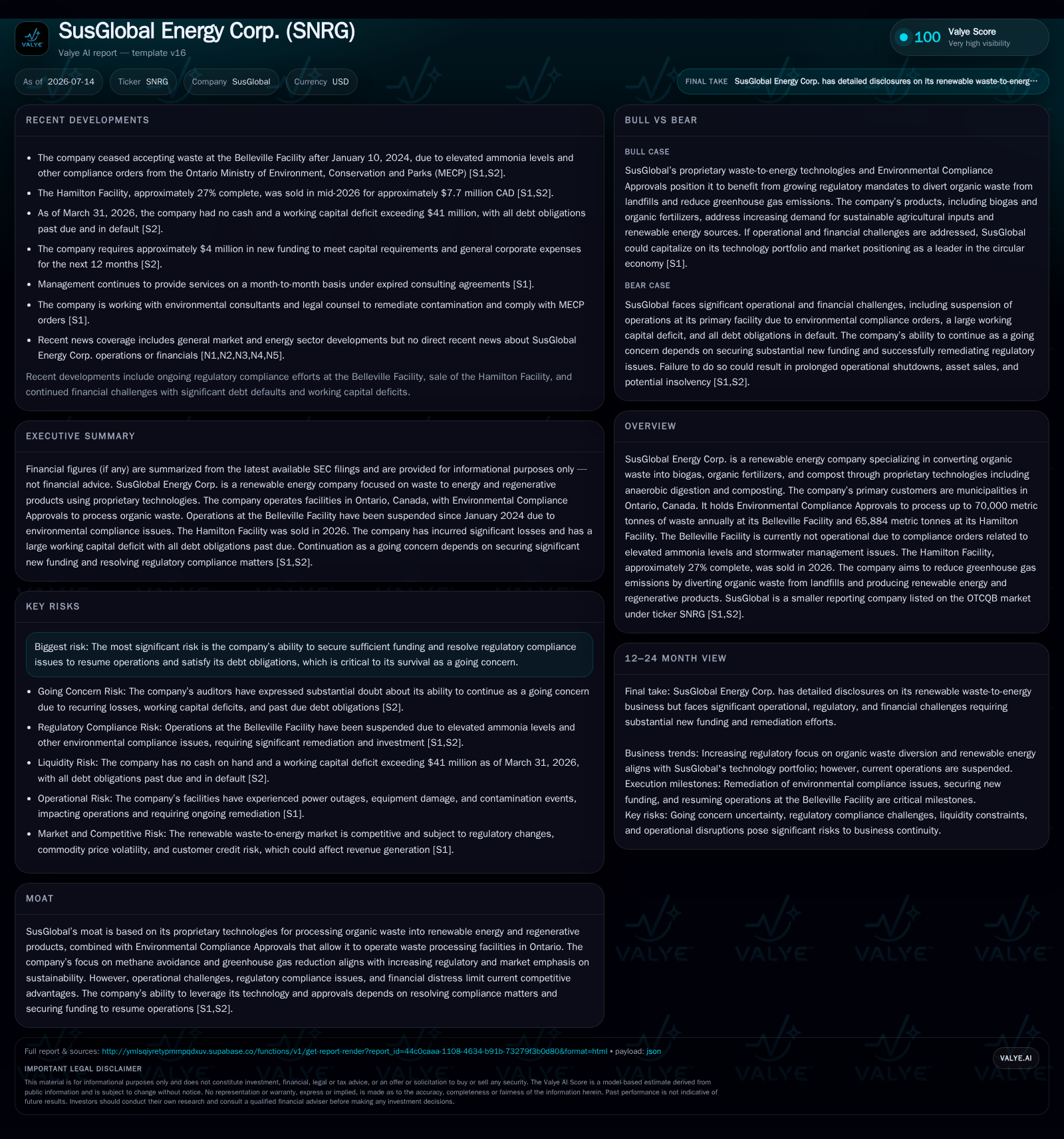
SusGlobal Energy Corp. specializes in renewable energy production from organic waste via proprietary anaerobic digestion and composting technologies. However, regulatory compliance issues have shuttered its Belleville Facility since early 2024, and the partially completed Hamilton Facility was sold in 2026. The company recorded no revenue in Q1 2026 and carries significant past-due debt totaling over $25 million, while ongoing remediation efforts demand substantial capital raises. These operational disruptions and financial constraints sharply limit near-term growth prospects despite the company's technology-driven approach to waste diversion and biogas production.
Recent Operating Update: Regulatory Shutdowns and Financial Strains
SusGlobal Energy Corp. has reported that its Belleville Facility has remained non-operational since early 2024 following a lightning-induced power surge that compromised critical electrical systems and led to elevated ammonia emissions detected by the Ontario Ministry of Labour, Immigration, Training and Skills Development [S1,S21]. As a result, the company ceased accepting organic waste after January 10, 2024, pursuant to Ministry of Environment Conservation and Parks (MECP) orders mandating extensive remediation efforts including facility repairs, cleanup of unusable waste on site, and rehabilitation of its stormwater management system [S1,S19]. These regulatory compliance challenges have materially constrained SusGlobal’s operational throughput and revenue generation capacity.
Financially, SusGlobal reported zero revenue during the three months ended March 31, 2026, a sharp decline from prior periods where revenue was primarily derived from carbon credit sales alongside tipping fees from organic waste processing [S2]. The absence of tipping fee income since early 2024 reflects the Belleville Facility’s shutdown, while carbon credit sales, historically a supplementary revenue stream, have also diminished. This revenue contraction, coupled with ongoing remediation and maintenance costs, has exacerbated the company’s liquidity challenges.
In an effort to alleviate capital pressures, SusGlobal divested its partially completed Hamilton Facility in mid-2026 for approximately $7.8 million. The Hamilton Facility, which had secured Environmental Compliance Approval (ECA) for processing approximately 65,000 metric tonnes of organic waste annually, was only 27% complete at the time of sale [S9]. This facility was intended to produce branded organic liquid fertilizer products targeting agricultural sectors such as wine and cannabis cultivation. The divestiture underscores the company’s need to prioritize capital allocation amid mounting compliance and operational expenditures.
Business Model: Waste Processing to Renewable Energy and Regenerative Products
SusGlobal’s core business model centers on processing organic waste streams—primarily sourced from municipalities—into renewable energy and regenerative products through proprietary anaerobic digestion and composting technologies [S8,S13]. The company’s revenue streams are threefold: charging tipping fees to municipalities and commercial customers for organic waste intake; selling renewable energy outputs including biogas, which can be upgraded to renewable natural gas (RNG); and monetizing carbon credits generated through methane avoidance and greenhouse gas reduction initiatives embedded in its processes [S1,S2]. Additionally, SusGlobal markets regenerative products such as compost and branded organic liquid fertilizers under the SusGro™ label through retail and agricultural channels.
The economics of SusGlobal’s model are highly dependent on facility throughput volume, measured in metric tonnes of organic waste processed annually, and operational uptime, which directly influence tipping fee revenue [S1,S2]. Renewable energy output, quantified in cubic meters of biogas or megawatt-hours (MWh) of RNG sold, contributes incremental revenue. Operating margins are sensitive to cost efficiencies across equipment rental, maintenance, labor, fuel, and utilities. Regulatory shutdowns and remediation phases disrupt these key operating variables, increasing operating costs per tonne processed and compressing margins.
Industry Structure and Competitive Position
The renewable energy waste-to-energy sector is characterized by intense competition from established firms with broader geographic reach, deeper capital resources, and operational scale advantages [S1]. SusGlobal differentiates itself through proprietary anaerobic digestion technology designed for efficient conversion of source-separated organics into multiple regenerative products, including biogas and composted fertilizers, aligning with increasing environmental sustainability mandates.
However, SusGlobal’s relatively small scale and ongoing environmental compliance challenges constrain its competitive positioning. Unlike larger municipal solid waste processors or renewable natural gas producers such as Clean Energy Fuels and Renewable Energy Group (industry references), SusGlobal’s facilities remain underutilized or shuttered due to regulatory constraints. Maintaining Environmental Compliance Approvals is critical for legal operation within Ontario’s stringent regulatory framework and is a key competitive barrier.
Growth Drivers: Regulatory Pressure and Demand for Sustainable Waste Solutions
Global organic waste volumes are rising due to population growth and expanding municipal mandates aimed at diverting organics from landfills to reduce greenhouse gas emissions. Regulatory frameworks increasingly require municipalities to partner with compliant processors capable of delivering methane avoidance benefits through anaerobic digestion technologies—a trend that aligns with SusGlobal’s strategic focus [S1,S8].
Expansion of carbon credit markets and environmental incentives further support revenue growth potential by monetizing greenhouse gas reductions [S8,S13]. Technological advancements that improve processing efficiency can lower operating costs per tonne processed, enhancing margins. Additionally, growing public and corporate sustainability commitments create demand for white-label regenerative products such as SusGro™, expanding revenue beyond traditional tipping fees
Risks and Growth Constraints: Financing Hurdles and Compliance Uncertainty
SusGlobal faces significant risks stemming from its precarious financial condition, with total debt obligations exceeding $25 million as of March 31, 2026, all of which are past due, and negligible cash reserves against current liabilities surpassing $41 million, resulting in a severely negative working capital position [S2,F1]. The company’s ability to remediate the Belleville Facility’s compliance issues and resume operations depends heavily on securing substantial external financing.
Regulatory compliance failures have led to operational shutdowns that interrupt tipping fee revenue streams essential for covering fixed costs and funding capital expenditures [S1,S21]. Stormwater management deficiencies and ammonia emission violations pose environmental liabilities that may result in fines or extended permit challenges, complicating the path to regulatory approval. Equipment obsolescence and degradation from prolonged inactivity necessitate capital-intensive refurbishment, raising breakeven thresholds absent steady throughput.
Competitive pressures from larger, better-capitalized players with scale economies may limit SusGlobal’s ability to regain market share post-remediation. Intellectual property risks related to its proprietary technologies require ongoing vigilance to avoid costly litigation or injunctions. Employee retention, particularly of specialized technical staff, is critical to operational continuity and innovation.
What to Watch Next: Funding Milestones and Regulatory Progress
Key near-term indicators include announcements of new equity or debt financing arrangements crucial for funding remediation projects at the Belleville Facility and sustaining minimal operations [S1,S2,S9]. Progress in resolving MECP orders related to stormwater management and ammonia emissions will be pivotal for regaining Environmental Compliance Approvals and resuming full-scale organic waste processing.
Monitoring carbon credit market dynamics and policy incentives will provide insight into potential revenue enhancements beyond tipping fees. Additionally, shifts in the competitive landscape, such as strategic partnerships or technology licensing agreements, could influence SusGlobal’s market positioning.
Financial Profile Discussion
SusGlobal’s financial condition as of the latest quarter reflects acute distress, with total debt obligations of approximately $25.3 million as of March 31, 2026, all past due, and cash and equivalents effectively depleted as of December 31, 2025 [S2,F1]. Current assets of $35,122 versus current liabilities of $41.2 million yield a current ratio near zero, underscoring severe liquidity constraints
Operating expenses have decreased in line with reduced activity, but fixed costs and remediation expenditures continue to pressure cash flows [S1,S3]. The company’s accumulated deficit exceeds $52 million, reflecting sustained losses since inception
In summary, SusGlobal remains financially strained and operationally constrained, requiring urgent capital infusion and successful regulatory remediation to restore production capacity and generate sustainable operating cash flows necessary for business continuity and growth.
Disclaimer: This is research-only, informational analysis and not investment advice. It may include AI-generated interpretation and general industry context. Always verify important details using primary sources.

Comments