
Ranger Gold Corp. Lacks Assets and Capital, Facing Challenges as Exploration-Stage Miner
Ranger Gold remains a shell company focused on acquiring gold mining properties but without operational assets or revenue as of early 2026.
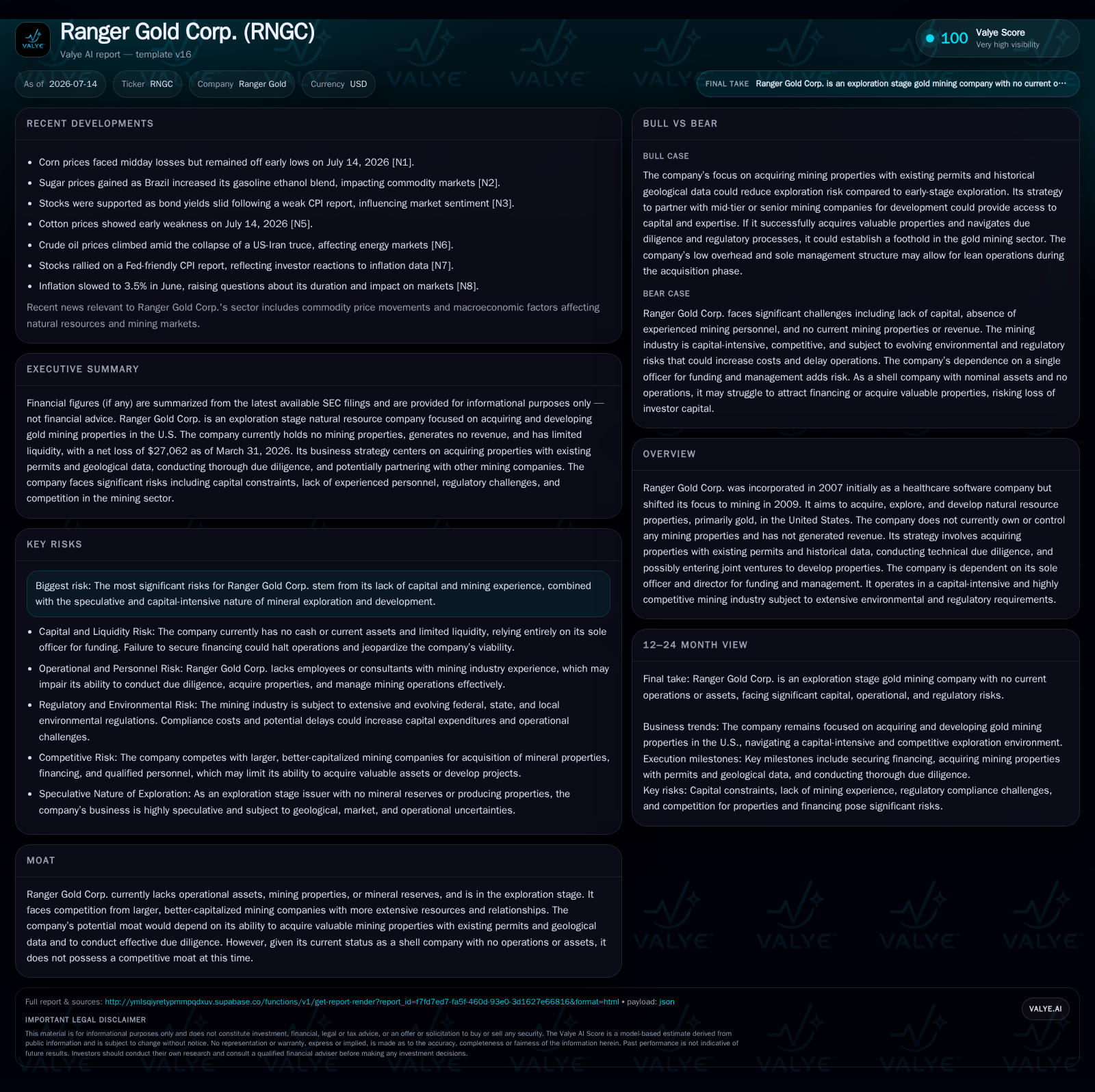
Ranger Gold Corp. operates as an exploration-stage natural resource company specializing in gold property acquisition within the U.S. The latest filings confirm it has no owned mining properties nor disclosed mineral reserves and depends entirely on its sole director for funding. Its business model centers on identifying mining claims with permits and historical data for potential acquisition or joint venture development, though capital scarcity and lack of experienced personnel present significant hurdles. The company operates at the upstream end of the mining value chain amid intense competition from better-resourced peers, and must navigate challenging regulatory and environmental requirements to progress toward production.
Recent Operating Update
Ranger Gold Corp. remains an exploration-stage entity as confirmed by its most recent quarterly filing dated February 24, 2026 [S2]. The company reported no revenues and operating losses amounting to $27,062 in the quarter ending March 31, 2026 [F1]. Consistent with prior annual disclosures from July 2026 [S1], Ranger Gold does not own or control any mineral properties, nor has it disclosed any mineral resources or mineral reserves subject to SEC mining disclosure rules. The company continues to be wholly dependent on Bryan Glass, who serves as sole officer and director, for funding ongoing operations without any binding funding commitments documented [S7]. This latest update underscores that Ranger Gold has yet to secure meaningful external financing or make property acquisitions that would transition it into an active exploration operator.
Business Model Overview
Ranger Gold's business model centers around acquiring rights—via purchase, lease, or claim—to mineral properties with a primary focus on gold within the United States. Unlike juniors who actively conduct ground-up exploration drilling programs, Ranger Gold explicitly intends to target properties already equipped with requisite permits, mine plans, and some degree of historical geological, geochemical, or geophysical data. This strategy aims to reduce exploration risk by focusing on advancing acquisitions into development rather than early-stage discovery [S7][S19].
The company may hold these properties alone or enter joint ventures with better-capitalized mining operators for further development and extraction. Potential revenue generation would stem from eventual gold production sales or property monetization through sale or leasing arrangements. However, as it currently holds no assets or mineral titles, revenue drivers remain speculative pending future acquisitions.
Notably, Ranger Gold does not plan to engage proactively in initial exploratory drilling but rather relies heavily on due diligence investigations of available data sets provided by sellers or government bodies such as the U.S. Geological Survey (USGS). These due diligence activities involve assessing title ownership issues, environmental liabilities, permitting status, water rights, royalty obligations, ore reserve potential validated by "qualified persons" (as defined under SEC regulations), and financial encumbrances affecting target properties [S14][S19]
Execution risks inherent in this business model include successful capital raising sufficient to purchase rights to mineral claims and retain consulting expertise needed for technical validation. With only one officer who lacks formal mining experience managing the Company’s affairs part-time and no employees committed full-time until asset acquisition occurs [S12], there are substantial operational limitations currently.
Industry Structure and Competitive Position
Ranger Gold operates at the extreme upstream end of the gold mining value chain: property acquisition and early-stage exploration evaluation. This segment is highly fragmented but features dominant participation from junior miners specialized in exploration activities alongside senior global producers such as Barrick Gold Corporation and Newmont Corporation that command vast financial resources and extensive technical teams.
Senior miners typically undertake large-scale mine development and production operations once viable reserves are proven whereas junior companies discover and delineate early-stage deposits often through capital-intensive drilling campaigns. Ranger Gold diverges from typical juniors by not focusing on active drilling but attempting to leverage existing permitted assets with historical data sets. Still, competitors—both juniors seeking new discoveries and larger firms expanding their portfolios—pose formidable competition in securing promising properties.
Capital availability remains a major differentiator. Well-funded peers can outbid failed attempts at acquisition or deploy extensive drilling budgets accelerating resource definition compared to Ranger’s current reliance on a single private source of funds without formal commitment [S9]. Additionally, regulatory compliance complexity increases barriers: environmental laws enforced via EPAs’ permitting regimes require significant expertise that established players have developed over time; this puts smaller explorers at possible disadvantage while engaging public scrutiny over land usage [S10][S13].
Growth Drivers
Growth prospects hinge first on securing capital adequate for property purchases or joint venture contributions. Given its status as a shell company lacking market float above $75 million currently disables immediately effective securities resale under Rule 144 safe harbors, which complicates raising retail equity capital until at least one year after ceasing shell status disclosures [S4][S15]
Rising gold prices—fuelled by macroeconomic uncertainty—could enhance the economic viability of target projects by improving expected net present values during due diligence assessments; this incentivizes investors toward junior miners servicing early-stage opportunities like Ranger Gold.
Strategic partnerships with mid-tier or senior gold miners through joint ventures could accelerate property development while reducing upfront capital strains for Ranger Gold. Successfully completing permitting phases would also materially de-risk projects improving valuation before production starts. Technological advances permitting more precise resource estimation or efficient extraction methods might lower barriers toward monetizable reserves.
The availability of detailed historical geological information combined with prior permitting represents a distinct competitive advantage in shortening time-to-production relative to ground-up grassroots explorers who face longer permitting delays.
Risks and Constraints
Capital scarcity constitutes the most salient risk—without firm financing commitments beyond founder funding promises made informally by Bryan Glass—operations stand precarious [S7]. Any interruption in founder support could precipitate immediate insolvency.
Additional risk stems from lack of operational staff experienced in minerals exploration and mine development; outsourcing all technical analysis results in dependence on consultants whose costs add pressure against thin cash reserves [S12]
Environmental regulatory compliance can impose unpredictable delays due to the necessity of federal (e.g., EPA), state agency permits (e.g., Clean Air Act, Clean Water Act), public comment periods requiring Environmental Impact Statements (EIS), plus potential liabilities under statutes like CERCLA/RCRA for contamination cleanup—all increasing project costs abruptly [S10][S13][S25]
Competition frustrates property acquisitions; larger well-funded juniors or seniors wield negotiating leverage in bidding wars limiting Ranger’s chances at acquiring valuable rights economically [S9].
Furthermore, commodity price volatility injects economic uncertainty; while higher gold prices enhance project feasibility conversely extended price declines imperil project economics delaying investment decisions.
Finally, being a former shell company restricts investor liquidity through resale limitations under SEC Rule 144 safe harbor exemptions until filing compliance milestones are met one-year post-shell cessation disclosure filings—a structural impediment to accessing broader capital markets promptly [S4][S15]
What to Watch Next
Key near-term markers include announcements regarding:
- Acquisition or leasing agreements securing mineral properties with existing permits and prior geological data,
- Documentation of executed joint venture agreements allowing shared development risk,
- Capital raises sufficient to finance initial property purchases and consulting due diligence,
- Engagements of qualified persons producing SEC-compliant technical reports validating probable mineral reserves,
- Regulatory filings confirming permit renewals or new permit grants,
- Public disclosures ceasing shell company status enabling improved securities liquidity.
Tracking any shifts in management hiring dedicated mining professionals will also signal progression from custodial shell status toward active exploration management [S7][S12].
Financial Profile Discussion
As per the latest available financial data ending March 31, 2026, Ranger Gold exhibits zero revenue reflecting absence of mining operations and recorded an operating loss totaling approximately $27K during that quarter [F1]. Current liabilities stood at $1,704 with current assets reported as zero, resulting in a current ratio near zero as of March 31, 2026 [F1]. This reflects minimal working capital sufficiency indicating pressing needs for external funding infusion.
It highlights prevailing structural deficiencies compounded by sector challenges inherent in junior gold exploration companies like Ranger Gold Corp., emphasizing monitoring execution capabilities beyond basic shell rehabilitation steps underway.
Disclaimer: This is research-only, informational analysis and not investment advice. It may include AI-generated interpretation and general industry context. Always verify important details using primary sources.

Comments