
Permian Basin Royalty Trust’s Governance Shift Complicates Royalty Income Dynamics
Recent modifications to PBT’s trust indenture introduce majority unitholder control over amendments, impacting governance amid commodity price and production uncertainties.
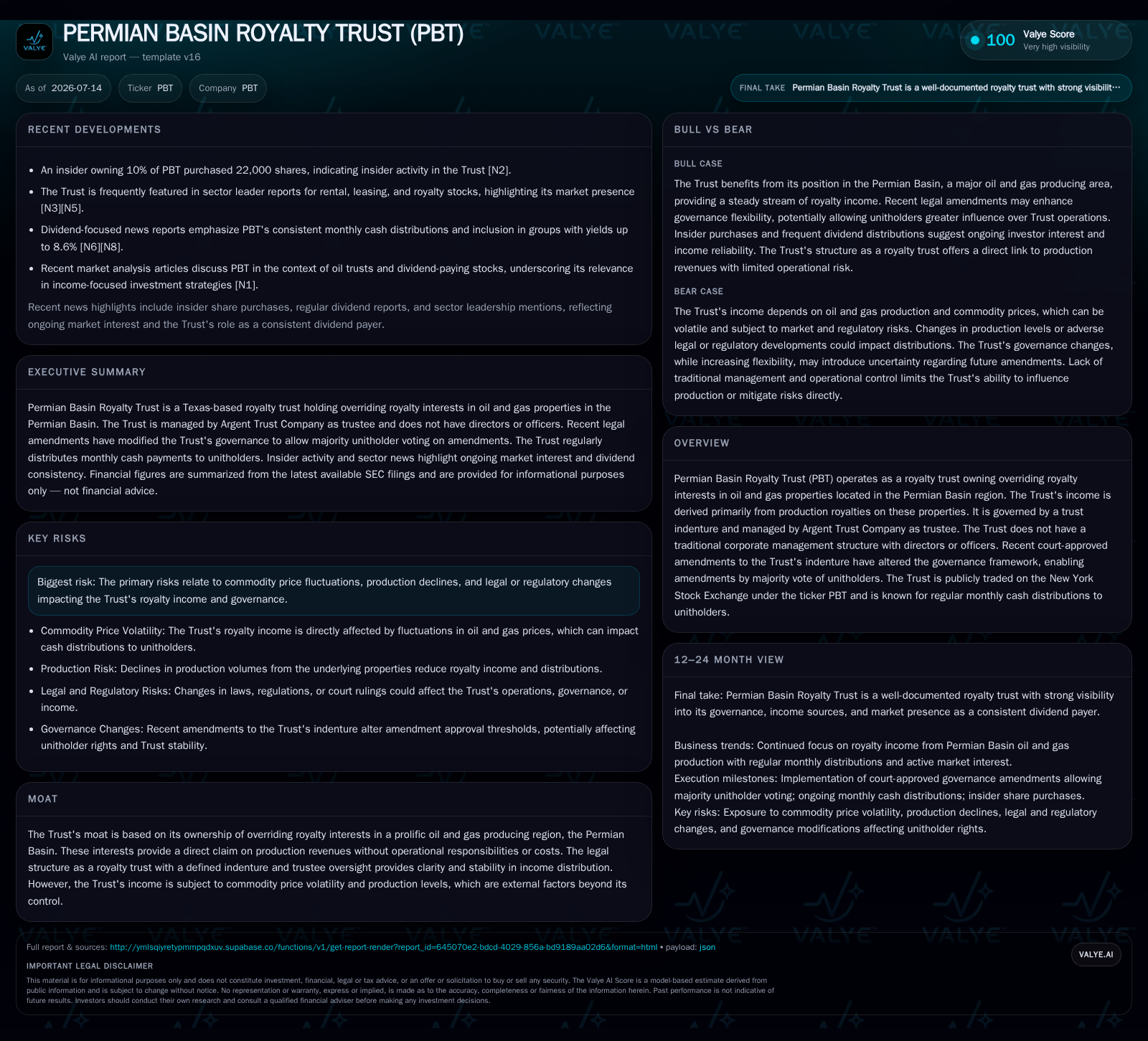
The Permian Basin Royalty Trust (PBT) continues to operate as a non-operator royalty trust with overriding royalty interests in the Permian Basin, generating income from production royalties without operational costs. Its latest quarterly filing confirms no material change in risk profile during Q1 2026 but highlights a May 2026 amendment to its trust indenture that lowers the threshold for approving amendments to a simple majority of unitholders, potentially increasing flexibility but also risk of governance disputes. The Trust's earnings hinge on external operators' production volumes and commodity prices, exposing distributions to volatility. Ongoing litigation and proposed modifications underscore governance tensions, while monthly distributions remain a core appeal. Key growth drivers and risks remain tied to production performance and oil/gas market cycles.
Recent Operating Update and Governance Changes
However, a notable development is the May 2026 amendment to the trust indenture that relaxed thresholds for modification approvals. The amendment (filed on May 8, 2026) replaced the prior requirement of obtaining approval from at least 75% of outstanding units with a simpler majority-in-interest vote of unitholders present at a quorum meeting for any amendments, including those previously prohibited [S2], [S15]. This shift centralizes more power within majority unitholders and may expedite governance decisions but raises potential concerns about minority rights protection and future strategic direction.
The trustee remains Argent Trust Company which administers the trust under the amended indenture terms. The absence of traditional management roles such as directors or officers underscores the passive ownership model focused on contractual enforcement rather than operational involvement [S2]. Recent event filings confirm continuous monthly cash distributions as the primary monetization method paid to registered unit holders on predetermined record dates most recently through June 30, 2026 [S3], [S7].
Business Model: Royalties Without Operations
As an oil and gas royalty trust, PBT’s core value proposition lies in its ownership of overriding royalty interests carved out from producing properties in the prolific Permian Basin. This ownership grants PBT entitlement to agreed percentages of revenue derived from oil and gas production volumes originating from these lands. Since it holds overriding royalty interests rather than working interests, PBT has no responsibility or exposure for exploration, drilling capex or lease operating expenses beyond nominal administrative costs managed by the trustee.
Revenue therefore fluctuates chiefly in response to two dominant factors: realized commodity prices (primarily crude oil benchmarks) and production volumes attributable to operators’ extraction activities. Neither price levels nor operator decisions to increase or curtail output are controlled by PBT; the trust simply receives a stated share based on contractually defined net overriding royalty interest percentages recorded decades ago in conveyance documents dating back to 1980 [S1], [S2]. Revenues thus retain inherent volatility linked directly to external upstream market conditions.
Cash flow generated through these royalties is distributed regularly to unitholders after minor deductions for trustee fees and administrative expenses. The monthly distribution schedule observed over successive months into mid-2026 evidences ongoing prioritization of cash yield profiles typical for oil and gas royalty trusts seeking to provide steady income streams aligned with hydrocarbon market cycles [S3], [S9], [S10].
Industry Position and Competitive Context
PBT operates within the niche sub-industry of oil and gas royalty trusts dominated by entities owning entitlements largely disconnected from operational roles but affiliated geographically with high-yield basins. The Permian Basin is among North America’s most prolific hydrocarbon producing regions supporting multiple upstream E&P companies whose activity levels ultimately drive production volumes underpinning PBT royalty revenue.
Peers such as San Juan Basin Royalty Trust occupy similar value chain positions owning overriding royalties in other basins but differ materially by geographic focus and operator footprints. PBT contrasts with upstream operators who bear drilling costs and operational risks yet benefit from commodity upside leverage. Similarly, midstream infrastructure providers influence product delivery logistics but lack direct claims on upstream gross revenues like overriding royalties confer.
The prevailing legal framework set by PBT’s Amended & Restated Royalty Trust Indenture governs all aspects including revenue allocation rules, fee structures for trusteeship by Argent Trust Company, distribution obligations, fractional unitholder rights, restrictive covenants against certain amendments (now altered), and dispute resolution mechanisms ensuring contractual clarity despite inherent external dependencies [S1], [S2]. Legal complexity surrounding recent petitions seeking judicial modification signal active stakeholder engagement around governance nuances potentially impacting future income distribution policies or asset administration.
Growth Drivers: External Production Performance + Commodity Pricing
Fundamentally growth for PBT depends on maintaining or expanding hydrocarbon output levels from properties subject to its overriding royalty interests. Operators executing drilling programs successfully offset declining well productivity inherent in mature fields thus supporting steady or growing production volumes – a critical KPI influencing royalty revenue streams absent direct control by PBT.
Furthermore, sustained or improving crude oil prices bolster realized revenue per barrel equivalents conveyed as royalties thereby enhancing distributable cash flow capacity. Operational efficiency gains or enhanced recovery technology application by operators could prolong reserve life indexes mitigating natural decline rates otherwise constraining long-term income stability.
While acquisition of additional overriding royalties could expand fee bases representing an organic growth vector typical among some trusts or MLPs, there was no disclosure of such activity in recent filings suggesting static asset scope presently.
Risks and Watchpoints
Foremost risk drivers persistently include commodity price volatility posing direct income impact given linear revenue exposure absent hedging arrangements reported; sudden market downturns reduce both volume economics (due to lower drilling incentives) and per unit royalty realizations.
Production decline from reservoir depletion is another structural threat potentially reducing recurring royalty capacity unless countered by operator drilling programs or secondary recovery methods recognized industry-wide challenges.
Legal risk remains salient due to ongoing court proceedings initiated by large unitholder SoftVest L.P., including petitions filed earlier in 2026 aiming at modifying governance provisions potentially shifting power dynamics within unit holder representation frameworks [S12], [S16], [S19]. Outcomes may affect trust indenture amendment processes thereby influencing asset stewardship priorities.
Regulatory shifts pertaining to environmental policy or tax regimes affecting extraction economics can indirectly suppress royalties collected if upstream activity diminishes accordingly.
Market liquidity constraints for trust units can exacerbate valuation volatility tied closely to fluctuating distributable cash flows resulting from unstable commodity markets.
What To Watch Next
Upcoming indicators include court rulings on petitions filed by SoftVest regarding trust indenture amendments as outcomes may redefine voting rights thresholds affecting future governance practice timelines beyond May 2026 changes already implemented.
Operationally monitor announcements of monthly cash distributions announced proximate record dates as they encapsulate real-time realizations of trust income flows reflective of prevailing commodity price conditions plus operator output performance reported externally by upstream E&Ps active in Permian Basin areas covered by trust interests.
Market responses via unit price movement provide indirect sentiment gauges assessing perceived fairness or confidence regarding amended governing documents alongside evolving energy market fundamentals.
Any disclosures related to additional royalty interest acquisitions or sales represent strategic moves altering future income potential although none have been indicated thus far.
Conclusion
Permian Basin Royalty Trust presents an archetype oil and gas royalty entity relying heavily on stable upstream production volumes sourced from one of North America’s most productive basins coupled with exposure aligned directly with commodity price cycles. Its recent governance amendments simplify alteration procedures but introduce new dimensions of shareholder engagement power balance potentially heightening contestation risks amidst ongoing litigation efforts by influential stakeholders.
The Trust maintains an investor appeal centered on monthly cash distributions underpinned by existing overriding royalty contracts devoid of operational cost burdens albeit exposed fundamentally to external production variability and pricing volatility common across this asset class sector. Monitoring court developments related to indenture modifications alongside operator-driven production metrics will be critical factors shaping near- and medium-term expectations for distributable proceeds sustainability and overall trust valuation dynamics.
This analysis is based exclusively on publicly available SEC filings up through July 14, 2026. It aims to inform industry understanding without providing investment advice.
Disclaimer: This is research-only, informational analysis and not investment advice. It may include AI-generated interpretation and general industry context. Always verify important details using primary sources.

Comments