
Loop Industries Advances Chemical Recycling Amid Scaling and Capital Challenges
Loop Industries pursues global expansion of its patented PET depolymerization technology while facing ongoing liquidity constraints.
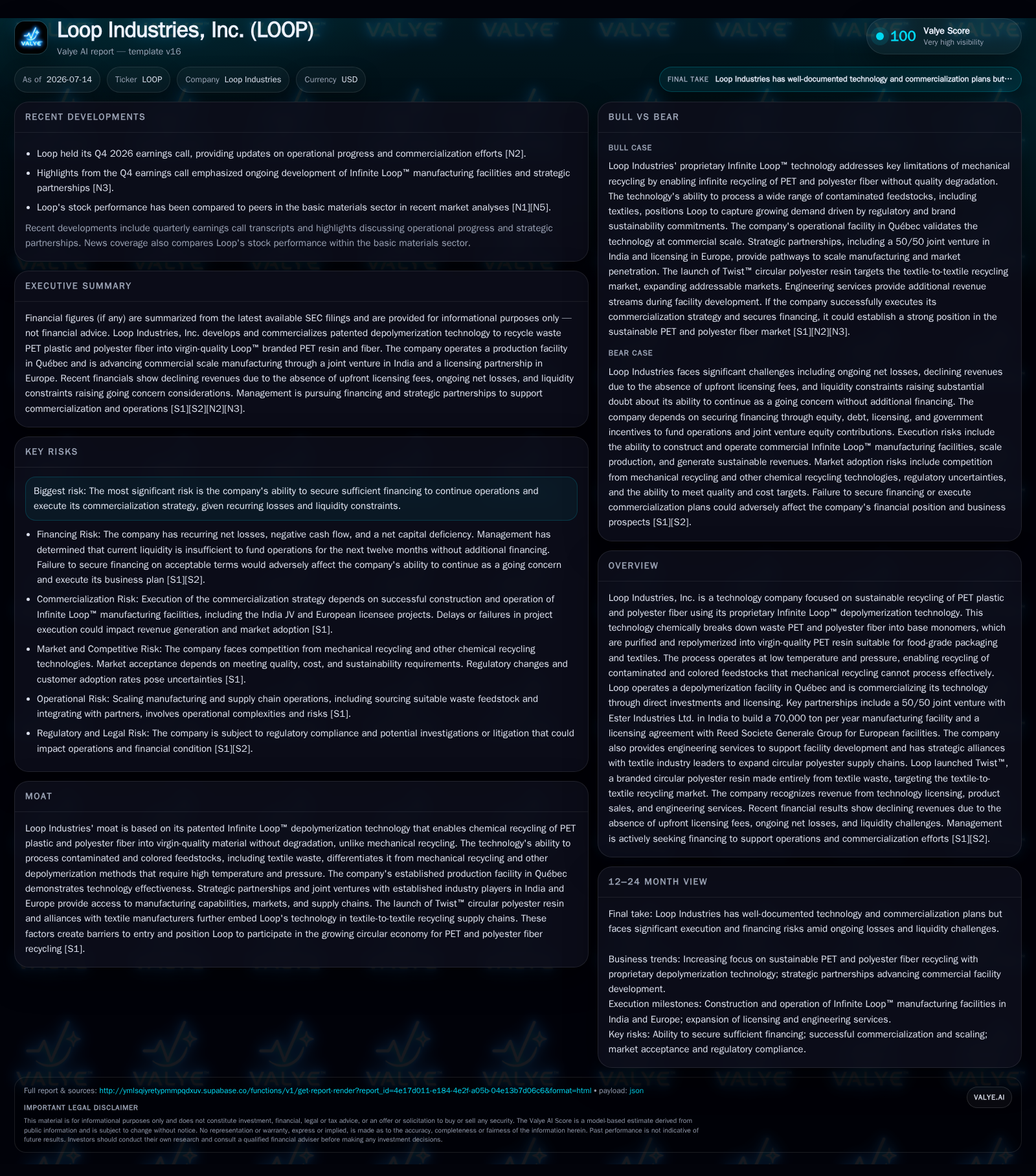
Loop Industries operates in the chemical recycling sector using proprietary Infinite Loop™ depolymerization technology to convert waste PET plastic and polyester fiber into virgin-quality resin. The company reported progress toward commercialization through joint ventures in India and Europe and initial offtake agreements with major apparel brands. However, despite strategic milestones, Loop remains in a pre-commercial stage with no recurring licensing or product revenue and faces substantial doubts about its ability to continue as a going concern without securing additional financing. The firm’s growth hinges on successful plant construction, market adoption driven by regulatory recycled content mandates, and execution against its modular construction approach to scale production competitively.
Recent Operating Update
In its latest quarterly filing ending May 31, 2026, Loop Industries emphasized progress in commercializing its Infinite Loop™ chemical recycling technology designed to break down post-consumer PET plastic and polyester fiber into base monomers that can be repolymerized into virgin-quality resin suitable for food-grade packaging and textiles [S2]. This advancement aligns with growing global sustainability mandates requiring recycled content in packaging and textiles. However, despite these promising trends favoring chemical recycling solutions over traditional mechanical recycling—which struggles with contaminated or colored feedstock—Loop continues experiencing operational challenges typical of early-stage technology companies.
Notably, the company generated modest engineering services revenue ($0.2 million) through supporting plant development for its India joint venture (JV) with Ester Industries Ltd., signaling initial monetization beyond pure R&D activities [S5]. Strategically, Loop is executing on multiple fronts: advancing JV manufacturing facilities in India targeting 70,000 tons per year capacity; establishing Infinite Loop Europe SAS alongside Reed Societe Generale Group holding 90% ownership; launching a branded circular polyester resin "Twist™" made entirely from textile waste; and negotiating multi-year offtake agreements expected to supply up to 15,000 metric tons annually to major global apparel companies [S2][S5].
Nevertheless, the company remains pre-commercial without recurrent licensing or significant product sales revenues. It posted a net loss of approximately $3.4 million during this quarter during ongoing investments in engineering services, research and development (R&D), plant operations, and corporate overheads [S9][F1]. These losses underscore the challenges of scaling complex chemical recycling technologies that require capital-intensive manufacturing facilities coupled with lengthy commercialization cycles.
Business Model Analysis
Loop’s business model centers on leveraging its proprietary Infinite Loop™ depolymerization process capable of chemically degrading PET plastics—including contaminated and colored post-consumer waste—and polyester fibers back into purified monomers. These monomers serve as feedstock for producing high-purity PET resins indistinguishable from virgin materials [N1][S1]. This vat-to-pure chemical recycling bypasses limitations inherent in mechanical recycling where quality degradation restricts reuse applications.
Revenue generation avenues include direct manufacturing/sale of recycled resin products primarily via joint ventures (India JV with Ester; Infinite Loop Europe partnership) along with licensing fees for use of the patented technology by third-party operators [S12][S21]. Engineering services related to plant design, construction oversight, and operation yield incremental income prior to full commercial launch [S5]. Commercial success depends heavily on securing sufficient capital to build scalable manufacturing infrastructure while forging strategic partnerships with brand owners—particularly apparel and consumer packaged goods (CPG) companies—that increasingly demand certified circular materials under regulatory recycled content mandates.
While the core IP-driven technology differentiates sourcing virgin-quality inputs from waste feedstock—including textile-to-textile closed-loop capabilities embodied by Twist™ branded resins—the business faces substantial upfront capital expenditures (capex) and ongoing operational costs before achieving scale economics or positive cash flow [S20]. Integration into apparel supply chains requires meeting stringent polymer purity standards alongside traceability commitments. Offtake agreements structured as multi-year contracts provide visibility on demand but have yet to translate into sizable recurring revenues given scaled production remains nascent [S5].
Industry Structure & Competitive Position
Loop operates within the niche chemical recycling segment of the broader plastics value chain focused on converting post-consumer PET waste into recycled monomers that enable production of virgin-equivalent resins. This midstream segment interfaces upstream with waste collection/sorting operations and downstream with resin converters supplying packaging firms and textile manufacturers.
Competition exists both from mechanical recyclers—largely constrained by feedstock quality—and other chemical recycling ventures deploying alternative molecular depolymerization technologies. Peers such as Eastman Chemical have demonstrated molecular recycling at industrial scale across multiple sites generating substantive licensing revenue alongside product sales. Brightmark pursues advanced plastics recycling projects focusing more broadly on mixed plastics conversion while Indorama Ventures integrates traditional recycling paired with virgin resin production leveraging scale advantages.
Loop’s moat arises from patented Infinite Loop™ chemistry facilitating low-temperature/pressure processing able to handle highly contaminated feedstock including polyester textiles that mechanical approaches cannot recycle effectively. Strategic joint ventures provide access to manufacturing ecosystems in India (Ester) catering to fast-growing regional markets plus European capacity via Reed Societe Generale Group participation [S12][S21]. However, limited current scale production volumes place Loop behind larger peers already demonstrating commercial throughput.
Growth Drivers
Fundamental growth catalysts coincide with escalating regulatory actions worldwide mandating increasing percentages of recycled content in plastic packaging and textiles—policies driven by governments seeking reductions in landfill use, carbon emissions reduction targets, and circular economy promotion. Corporate sustainability commitments from major apparel brands heighten demand for chemically recycled circular polymers like Twist™, recognized for closed-loop textile-to-textile capabilities [S2][S13].
Technological advances improving cost efficiencies or feedstock flexibility could expand accessible supply of otherwise unrecyclable PET waste streams—crucial since pricing pressure remains key when competing against fossil-derived virgin resins [S5]. The modular construction strategy adopted by Loop aims at reducing capex requirements by standardizing plant components built offsite in low-cost regions then assembled rapidly onsite—a potential enabler for faster geographies roll-out while controlling fixed costs
Strategic partnerships securing early multi-year supply commitments build credibility while broadening market reach beyond initial pilot plants; however volume ramp-up timelines remain uncertain given dependency on JV plant commissioning.
Risks & Constraints
Foremost risk resides in persistent liquidity challenges: as of May 31, 2026 cash balance was approximately $1.1 million supplemented by an undrawn $2.5 million credit facility secured by Quebec real estate; management explicitly raised ‘substantial doubt’ regarding going concern status absent new financing within twelve months [S16][F1]. Continuous net losses exceeding operating cash burn since inception epitomize difficulty sustaining R&D investments while transitioning from pilot phase toward industrial scale production.
Capital intensity inherent in constructing large-scale chemical recycling plants constrains rapid capacity expansion absent robust equity/debt raises or government incentives which may fluctuate based on geopolitical/economic factors. Execution risks around JV construction timelines impact near-term output availability affecting revenue ramp profiles [S5]. Moreover, competitive pressures loom from both established petrochemical resin producers optimizing mechanical recycling feedstocks plus emerging alternative chemical recycling suppliers.
Reliance on strategic alliances necessitates managing cross-cultural governance complexities especially within Infinite Loop Europe controlled predominantly by private equity partner Reed Circular Economy (90% ownership). Intellectual property protection remains critical but undisclosed outcomes from SEC investigations introduce reputational uncertainty [S1]. Adoption cycle lengths within brand owners tied to long sales cycles also delay predictable revenue flows.
What To Watch Next
Key upcoming milestones include progress updates on India JV’s facility construction status impacting capacity realization; ramp-up plans for Infinite Loop Europe projects; formalization of binding multi-year supply contracts converting current letters of intent into executable demand; changes in cash runway informed by successful capital raises; scalability validation through operating cost per ton improvements enabled via modular construction; regulatory developments tightening recycled content mandates especially in EU/US markets; patent portfolio expansions reinforcing technological moat; and additional engineering service contracts broadening pre-commercial revenue sources [S5][N1]
Operational KPIs worth monitoring encompass tonnage of plastic waste processed regionally across JVs reflecting throughput growth; purity/quality certifications achieved validating resin acceptance; licensing fees booked if any third-party deals materialize; backlog/order book for Twist™ resin signifying effective market penetration; feedstock contamination tolerance confirming technological superiority over mechanical alternatives.
Financial Profile Discussion
As per the most recent quarterly filing dated July 14, 2026 ending May 31 fiscal period, Loop Industries reports cash reserves at $1.063 million complemented by an undrawn $2.537 million credit facility secured against its Québec property [S2][F1]. Current assets of approximately $2.16 million and current liabilities of approximately $3.17 million result in a current ratio of about 0.68, indicating liquidity constraints that may challenge near-term operational funding needs [F1].
The company’s total debt was approximately $3.115 million as of November 2025, with recent amendments to financing terms that did not substantially modify repayment schedules or terms [S2][F1]. Failure to secure acceptable financing terms could imperil commercialization timelines substantially undermining valuation creation prospects.
Conclusion
Loop Industries exemplifies emerging chemical recycling innovators targeting critical gaps left by traditional mechanical methods through patented Infinite Loop™ depolymerization technology unlocking high-value circular market opportunities across packaging and apparel sectors via JV-led manufacturing strategies and targeted licensing models. While technical differentiation supports potential defensibility anchored in molecular quality equivalence matched against virgin resins as well as expanding legislative recycled content demands enhance addressable market size materially, financial fragility stemming from extended pre-commercial losses combined with capital-intensive scale-up requirements pose formidable near-term challenges beyond currently envisioned resource pools. Monitoring timely execution of facility builds at Indian/EU JVs together with conversion of preliminary customer engagements into contracted revenues will prove pivotal in converting promising sustainable innovation narratives into durable economic franchise value.
This analysis is based solely on publicly available filings dated up through July 14, 2026, including Form 10-Qs, Form 10-Ks, press releases attached thereto, industry data references relevant at publication date but does not constitute investment advice or an offer or solicitation for securities purchase or sale.
Disclaimer: This is research-only, informational analysis and not investment advice. It may include AI-generated interpretation and general industry context. Always verify important details using primary sources.

Comments