
Jewett-Cameron Trading Co Navigates Tariff Pressures and Customer Concentration Amid Strategic Refocus
The company updates on operational challenges and strategic steps amid tariff volatility and inventory adjustments.
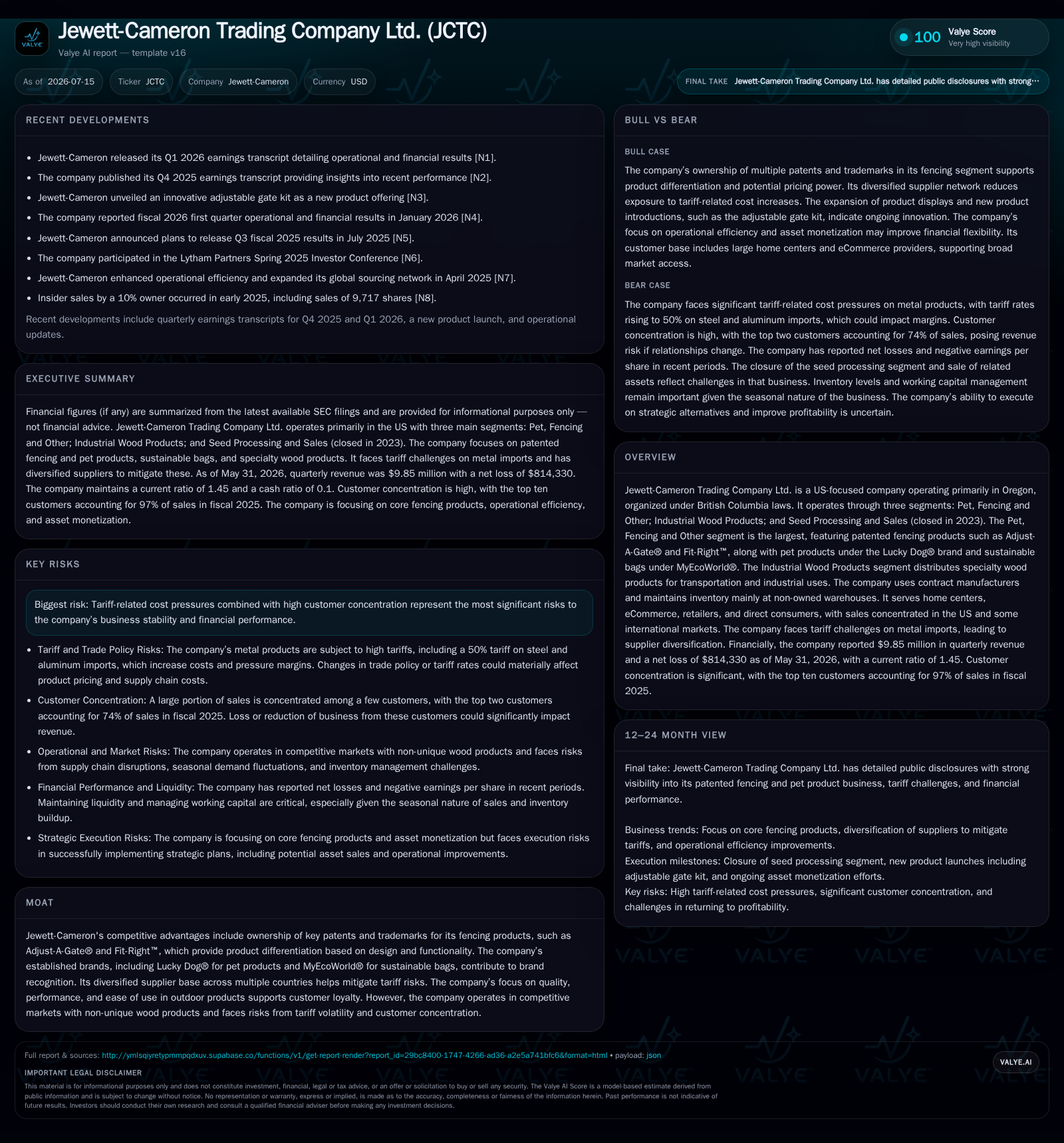
Jewett-Cameron Trading Co Ltd. reported a $814K net loss for Q3 2026 and a $6M loss year-to-date, impacted by tariff volatility and inventory write-downs. The firm is concentrating on its patented fencing products, leveraging Adjust-A-Gate® and Fit-Right™ brands, while managing tariff-driven cost pressures through diversified sourcing. High customer concentration and ongoing supply chain complexities remain critical risks, although recent credit line modifications aim to improve liquidity. The company continues to evaluate strategic alternatives amidst a challenging but targeted growth environment.
Recent Operating Update
The Industrial Wood Products segment continues operations through Greenwood Products based in Oregon, which uses contract manufacturers and relies on just-in-time shipping from non-owned warehouses—a setup that emphasizes lean inventory but can expose the firm to supply chain disruptions [S2]. Meanwhile, Jewett-Cameron’s other major business line is Pet, Fencing and Other products concentrated on patented fencing solutions under trademarks such as Adjust-A-Gate® and Fit-Right™, as well as pet accessories branded Lucky Dog® and eco-friendly bags under MyEcoWorld®. The Seed Processing division was closed in 2023 as part of strategic pruning [S1].
Business Model
Operating primarily in specialized outdoor hardware and industrial wood product markets, Jewett-Cameron derives revenue through wholesale distribution to home improvement centers, e-commerce sellers, other retailers, and some direct consumer sales [S1]. The business model hinges on product differentiation secured by patented fencing technologies that allow pricing premiums relative to commodity fence suppliers. This intellectual property provides defensive moats against generic competitors but does not insulate from raw material price inflation or tariff shocks.
The reliance on contract manufacturing enables flexible capacity without heavy fixed assets; however, it necessitates rigorous supply chain coordination—especially critical given the just-in-time delivery strategy employed by Greenwood’s wood products segment [S2]. Inventory management is a keystone operating metric here as excess stock carries significant risk due to seasonal demand swings in outdoor living and home improvement markets.
Revenue mechanics are affected by sales volume shifts across three segments: the core Pet/Fencing segment representing the majority of sales; Industrial Wood Products serving mainly transportation and industrial sectors; and residual contributions from corporate/administrative services. Pricing power depends largely on branded product strength (e.g., Adjust-A-Gate®) rather than commodity wood products which face pricing pressure from competitors.
Industry Structure and Competitive Position
Jewett-Cameron operates in an industry characterized by moderate fragmentation with competitive elements depending heavily on product innovation (patents), brand recognition, supply chain efficiency, and customer relationships. Patented fencing products grant Jewett-Cameron defensible market positions that peers without intellectual property struggle to replicate.
The company’s ability to source materials across multiple geographies partially offsets tariffs—a critical factor since recent years have seen steel/aluminum tariffs disrupt global supply chains broadly impacting hardware industries [S1]. Nevertheless, these tariffs have compressed gross margins despite partial pass-through pricing efforts facilitated by retailer acceptance over time.
Customer concentration remains elevated: just two customers contributed roughly three-quarters of total sales in FY2025—indicative of dependency risks common among specialty distributors tied closely with large retail chains or e-commerce platforms [S6]. Although relationships with established home centers provide market access advantages versus smaller brands or commodity suppliers, they raise exposure to fluctuations in those partners’ buying behaviors.
Peer reference groups comprise specialty hardware manufacturers with patented systems (e.g., specific outdoor gate/fence innovations), sustainable consumer goods brands with eco-friendly product lines akin to MyEcoWorld®, as well as industrial wood distributors reliant on contract manufacturing models.
Growth Drivers
Growth initiatives revolve around leveraging patented fencing offerings that combine premium design with ease-of-use features sought by contractors and DIY consumers alike. Continued innovation around Adjust-A-Gate® and Fit-Right™ can fortify differentiation amid competitive pressure.
Expansion into direct-to-consumer channels alongside traditional wholesale helps diversify revenue streams while fostering closer end-user engagement—potentially reducing channel conflicts common in multi-tier retail ecosystems.
The growing demand for sustainable consumer goods offers an ancillary growth vector through the MyEcoWorld® brand that taps into broader environmental trends influencing purchasing patterns.
Operational improvements targeting supply chain efficiencies—including multi-country sourcing strategies—aim at moderating the negative gross margin impacts induced by tariffs [S22]. Asset monetization programs targeting non-core properties (such as seed processing facilities) provide opportunities for capital redeployment toward core product lines with better margins [S22].
Strategic partnerships and alliances remain under consideration as part of broader efforts to enhance scale or market reach without significant incremental capex commitments.
Risks and Watchpoints
Tariff-related cost volatility continues as perhaps the most acute near-term risk given its direct impact on input costs for metal components fundamental to fencing hardware production [S1]. Although Jewett-Cameron has successfully obtained some tariff refunds recently totaling over $1 million including interest payments dated June 2026—a backward-looking relief—it cannot fully immunize future results given ongoing uncertainty surrounding trade policies [S24].
Customer concentration risk is structurally high; losing or reducing orders from any top customers could sharply reduce revenues given few large buying accounts dominate sales volumes [S6]. This requires active customer diversification efforts or strengthening value propositions through product innovation.
Inventory management remains another watchpoint considering prior write-downs exceeding $2 million linked primarily to excess fencing stock resulting from inaccurate demand forecasting exacerbated by liquidation activities earlier in fiscal 2026 [S2]. Improving inventory turnover ratios will be essential to restore working capital efficiency.
Supply chain disruptions related to contract manufacturing partners or third-party warehouse operations pose logistical risks which could impact timely deliveries especially during peak selling seasons.
Brand dilution or patent expiry could erode competitive moats if newer entrants develop substitutable designs or if licensing disputes arise—although no current legal proceedings threaten this scenario significantly [S20]. Finally, liquidity constraints driven by working capital needs amid uneven cash flow require vigilant capital management.
What to Watch Next
Investors should monitor quarterly operating income trends particularly gross margin stabilization as tariff-related cost pass-through matures among customers.
Execution progress on inventory reduction initiatives will be evident through subsequent inventory turnover improvements or lower impairment charges.
The outcome of ongoing credit line negotiations post-June 2026 will be key for financial flexibility given modifications in borrowing capacity tied partly to asset dispositions such as real estate sales from former seed processing sites [S13], [S24].
Any announcements regarding strategic partnerships or potential divestitures within the Industrial Wood Products segment could signal directional shifts relevant for growth prospects.
Additionally, tracking customer order volumes especially among top two clients will help gauge concentration risk evolution.
Corporate governance developments including board composition changes are also notable; independent director Ian Wendler’s retirement may impact oversight continuity after July 2026 until successor appointment occurs [S3]
Financial Profile Discussion
As of May 31, 2026, Jewett-Cameron held cash and cash equivalents totaling approximately $1.06 million—up notably from around $226K at August 31, 2025—in part reflecting improved cash management after prior quarters marked by operational losses [F1], [S2]. Current assets stand at roughly $15.3 million. The latest available current liabilities figure is from November 30, 2022, at approximately $10.6 million; however, due to the date mismatch, the current ratio of 1.45 is based on the most recent available data and should be interpreted cautiously [F1].
Interest expense has increased reflecting higher rates embedded in credit terms pegged at prime plus approximately 4.75% with floors near 11%, impacting finance costs materially compared with prior periods [S24].
Overall profitability remains negative driven by elevated cost of goods sold reflecting tariff impacts despite some refunds received mid-year plus significant inventory impairments recognized during fiscal 2026 constraining operating income trends [S2]
Management’s focus on asset monetization combined with ongoing efforts at cost containment—including workforce headcount reductions noted in prior years—and improved supply chain logistics via multi-country sourcing are intended mitigating measures against deteriorating margin profile suspended currently awaiting clearer resolution on raw materials tariffs policy trajectory which underpins capital allocation flexibility going forward [S21], [S22], [S24].
This analysis is based solely on publicly available SEC filings as cited and industry context using sector knowledge relevant through mid-2026. It does not constitute investment advice or a research view but seeks to provide detailed operational insight supporting financial interpretation of Jewett-Cameron Trading Company Ltd.'s business profile amid prevailing market conditions.
Disclaimer: This is research-only, informational analysis and not investment advice. It may include AI-generated interpretation and general industry context. Always verify important details using primary sources.

Comments