
Oyocar Group’s Cash Crunch and Capital Needs Cloud Growth Prospects
Latest 10-Q reveals ongoing zero revenue amid rising costs and liquidity pressures as Oyocar strives to build a cross-border used car sales platform.
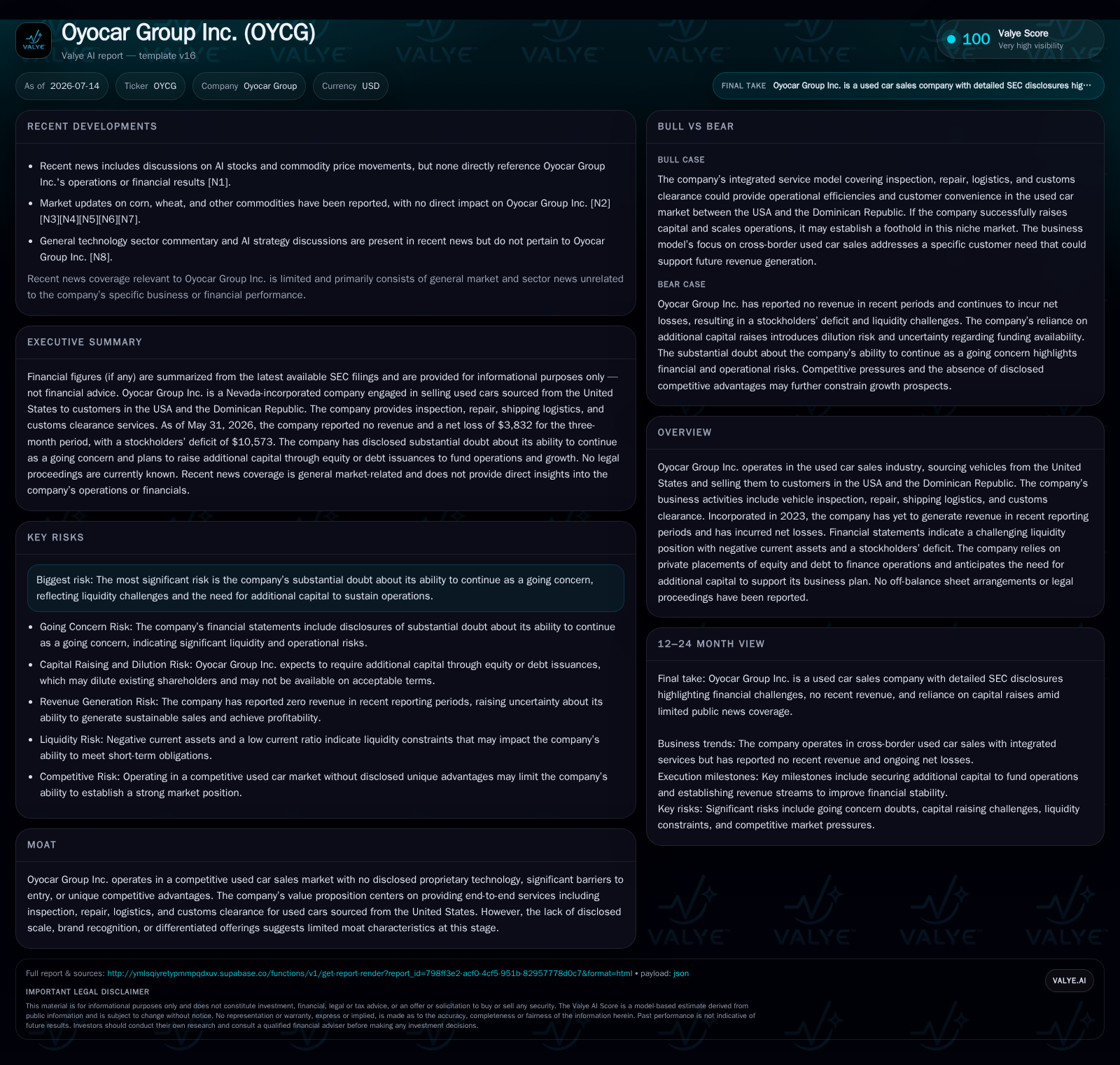
Oyocar Group Inc. continues to face critical challenges in scaling its business, reporting no revenue for the first nine months of fiscal 2026 despite incurring steady operating expenses. The company's comprehensive service offering—from vehicle inspection to cross-border logistics—is typical for the used car resale industry but demands substantial capital investment upfront. With negative working capital and a stockholders’ deficit exceeding $10 million as of May 31, 2026, Oyocar depends heavily on private equity and debt financing, raising going concern questions. Comparatively, established peers leverage scale, integrated financing, and brand recognition to drive inventory turnover and margins—advantages yet unavailable to Oyocar. The company must demonstrate significant capital raises, revenue milestones, and operational efficiencies soon to improve its precarious financial footing.
Q2 2026 Filing Frames Ongoing Liquidity Risks and Cost Burdens Without Revenue Lift-Off
Oyocar Group’s latest quarterly report for Q1 fiscal 2026 underscores a stark operating reality: zero revenue through the first nine months of the year despite incurring substantial operating expenses totaling $26.4 million [S2]. This reverses previously modest revenue figures seen in prior comparable periods where revenues reached $64K in nine months ending May 2025 but have since evaporated entirely. The absence of sales throughput while management signals upcoming spending increases on vehicle inventory acquisition, start-up development activities, and marketing suggests an intensifying cash burn with no immediate earning offset [S2].
Adding urgency to this precarious position are balance sheet indicators revealing negative current assets of -$26 against current liabilities exceeding $12.5 million—a resultant current ratio approximating zero—demonstrating severe short-term liquidity stress just before mid-2026 year-end [F1]. Management recognizes these conditions explicitly by preparing statements "assuming we will continue as a going concern" but warning of the necessity for additional capital infusions to avoid insolvency scenarios that would trigger asset impairment or liability reclassification adjustments [S2]. The company’s lack of bank lines or alternative credit facilities compounds reliance on aggressive equity or convertible debt offerings for survival and expansion funding.
Business Model Reliant on Turnkey Vehicle Inspection and Cross-Border Delivery Without Scale or Revenue Yet
Oyocar operates within the used car sales ecosystem focused on sourcing vehicles primarily from U.S. auction markets or fleet disposals, followed by comprehensive end-to-end services including detailed vehicle inspection, necessary repairs/refurbishment, shipping logistics coordination, and customs clearance when distributing cars both domestically within the U.S. and internationally to the Dominican Republic [S1],[S2]. This full-service model aligns with industry practices aimed at assuring vehicle quality post-acquisition while addressing logistical complexities inherent in cross-border transactions.
However, unlike mature industry players who leverage scale economies to optimize procurement costs and refurbishments alongside established dealer networks or digital platforms, Oyocar has yet to demonstrate any meaningful scale advantages or customer traction throughout its limited operating history since incorporation in mid-2023 [S1]. There is no disclosed evidence of proprietary technology platforms automating inspections or logistics nor differentiated vehicle certification programs that could command pricing premiums or reduce inspection defects impacting gross profits. This leaves Oyocar effectively positioned as an asset-light intermediary at early investment stage reliant on incremental capital to progress toward sustainable operations.
Industry Value Chain Pressures Heightened by Customs Clearance Complexity and Inventory Sourcing Costs
Cross-border used car retail presents several structural challenges impacting margin profiles. Inventory acquisition cost volatility from competitive U.S. auctions influences Cost of Goods Sold (COGS) directly; sudden price spikes can erode expected gross profit margins. Vehicle refurbishment quality variability poses risks—poor repairs can increase return rates or warranty claims deteriorating lifetime value per unit.
Moreover, logistics and shipping coupled with customs clearance introduce delays or cost overruns that stretch cash conversion cycles significantly compared to purely domestic resale models. Regulatory compliance variances across jurisdictions require specialized knowledge lanes adding fixed cost layers absent in single-market operators.
These operational factors collectively temper gross margin expansion potential absent tight cost control measures plus reliable supplier relationships facilitating favorable vehicle purchase prices with corresponding availability routinely managed by more seasoned players.
Peer Benchmarks Highlight Scale Benefits Oyocar Has Yet to Achieve in Refurbishment and Financing Integration
Within the broader used vehicle market landscape, companies like CarMax illustrate how integrated refurbishment workflows combined with captive financing solutions generate higher inventory turnover rates and wider gross profit margins. Such firms multiply customer reach via extensive dealership networks augmented by digital marketing platforms which diminish customer acquisition costs relative to smaller startups.
Scaling certifications schemes enhance customer trust translating into price premiums while internalized repair shops compress third-party vendor expenses driving down refurbishment costs per vehicle. Financial product offerings capture higher wallet share per transaction boosting total revenue beyond mere vehicle resale.
Expansion into these cross-border channels could capitalize on affordability trends plus increase supply availability from U.S.-incorporated lease returns or fleet disposals increasing volume inflows if funded adequately.
Nonetheless, this theoretical demand is poorly matched against ongoing losses reflecting partial spending on early-stage business development activity without substantive inventory build-out translating into sales revenue yet [S2]. Operating expense ratios remain high relative to actual throughput creating widening net loss margins exacerbated by negative working capital metrics weakening financial sustainability prospects absent rapid business model validation.
'Going Concern' Risk Underpins Critical Capital Raises for Next Year Amid Operational Investment Needs
The company disclosed stockholders’ deficit widening past $10 million as of May 31, 2026 compared with positive equity figures in prior periods indicative of steep erosion attributable to sustained losses exceeding funded advances [S2],[F1].
With no conventional credit lines available management confirms intent requiring additional equity/debt placements imminently—not only dilutive but potentially involving senior securities which might subordinate common stock value further creating shareholder risk concentration around funding timing execution shortfalls.
Such protracted reliance on sporadic private placements typical of early-stage automotive ventures adds uncertainty regarding runway sufficiency since volatile market conditions may constrain access or escalate fundraising costs sharply undermining forward expansion plans critical for crossing commercial viability thresholds.
'What Next': Key Milestones in Funding, Revenue Generation, and Operating Leverage to Monitor Ahead of Q3
Near-term evaluation milestones include close scrutiny on Oyocar’s success raising needed working capital consistent with planned escalation in inventory acquisition required to start generating meaningful sales flows [S2]. Without progress here operating expense leverage advantages cannot materialize bringing sustained losses into narrower bands essential for longer-term economic sustainability.
Additionally vital readouts will be initial indications of robust sales pipelines translating into incremental revenues validating underlying cross-border logistical workflows particularly effective customs clearance handling which historically introduces significant friction points delaying final delivery commitments in international automotive distribution contexts.
Improvement signals also encompass reductions in operating expense ratios tied to streamlined inspection/refurbishment processes alongside growing brand recognition attracting repeat buyers or scalable dealer network partnerships pivotal for augmenting customer acquisition efficiency metrics key among industry KPIs.
The forthcoming quarters will hence serve as a make-or-break phase clarifying whether Oyocar transcends corporate start-up burn challenges ushering towards commercially viable cadence—or faces deeper liquidity strains amplifying going concern uncertainties needing fresh strategic responses from management teams.
Financial Profile Discussion
As supported by company filings through May 31, 2026, Oyocar’s fragile financial structure is characterized by minimal liquid assets juxtaposed against sizable short-term obligations totaling approximately $12.5 million yielding a working capital deficit reflected by negative current assets around -$26 [F1],[S2]. Cash equivalents sum modestly expressed at $3,224 as tracked previously though possibly depleted through ongoing operating outflows evidenced by net loss totaling $26.4 million over nine months fiscal YTD reflecting considerable burn rate absent offsetting income generation [F1],[S2].
Careful monitoring of cash flow trajectories aligned with fundraising success will be critical indicators shaping medium-term viability assessments versus risk escalating toward insolvency triggers requiring urgent corrective steps including possible operational pivots reducing spend levels commensurate with fund availability constraints [F1]
This analysis reflects facts as presented through latest SEC filings without speculative projections or investment research views.
Disclaimer: This is research-only, informational analysis and not investment advice. It may include AI-generated interpretation and general industry context. Always verify important details using primary sources.

Comments