
Rocky Mountain Chocolate Factory’s Liquidity Crunch Challenges Growth Prospects
Latest quarterly disclosures reveal liquidity pressures and covenant waivers complicate RMCF’s franchise growth amid supply inflation and seasonality.
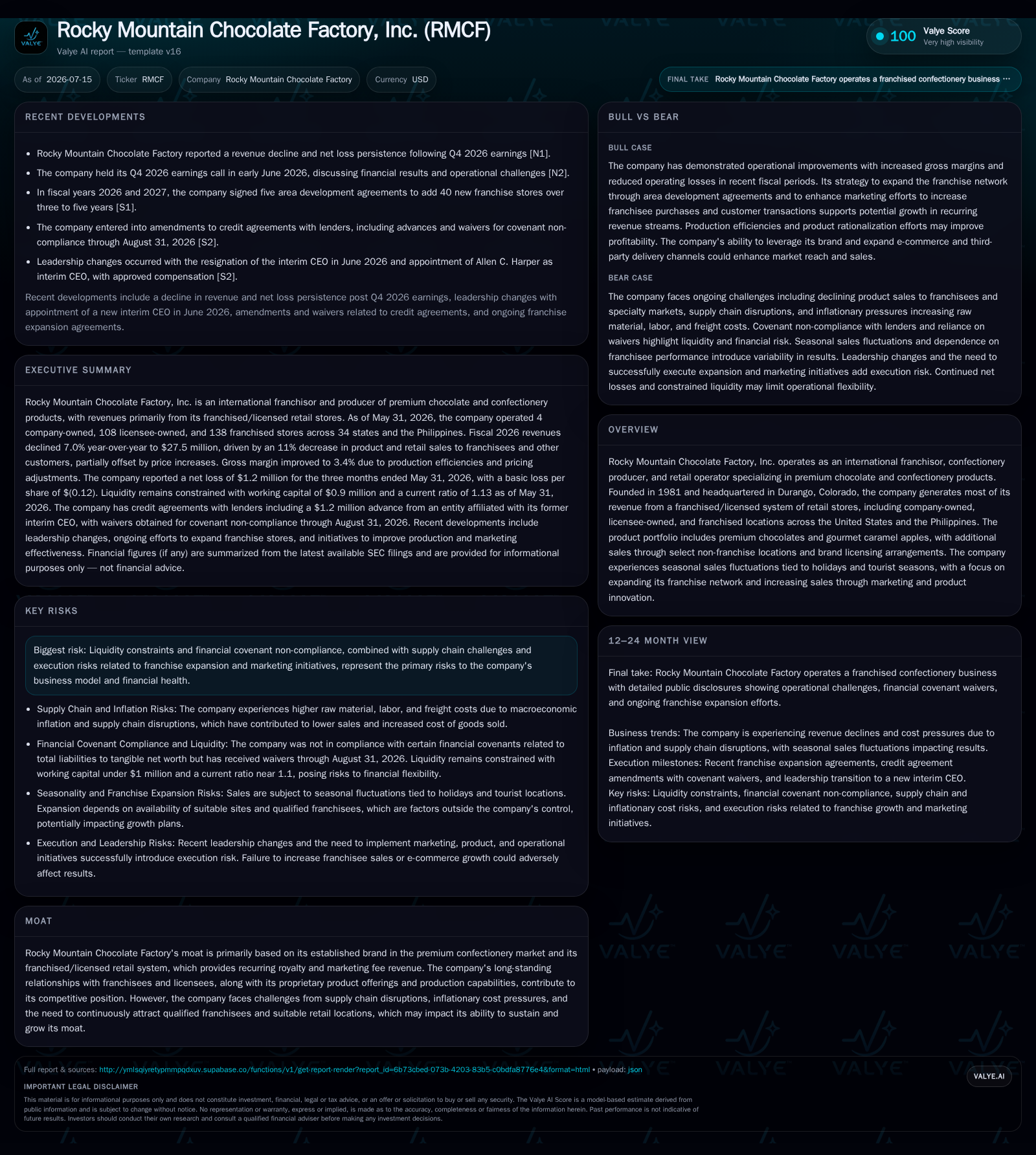
Rocky Mountain Chocolate Factory’s 2026 Q3 filing disclosed ongoing liquidity constraints highlighted by debt covenant non-compliance and reliance on waivers, coinciding with a $2.7 million equity raise to bolster working capital. The company’s business model remains anchored in a franchised/licensed retail network of premium confectionery outlets, generating steady royalty revenue complemented by direct retail sales of proprietary chocolates and gourmet caramel apples. However, supply chain inflation has pressured gross margins, prompting pricing actions and cost realignments ahead of the critical holiday selling season. Fiscal discipline under capital expenditure limits and weakened liquidity pose challenges to accelerating franchise expansion and marketing initiatives. Monitoring near-term seasonal sales results, covenant compliance progress, and franchise store development will be key indicators of recovery.
Rocky Mountain Chocolate Factory Faces Liquidity Challenges Amid Franchise Growth Efforts
Rocky Mountain Chocolate Factory, Inc. (RMCF) disclosed ongoing liquidity pressures in its 2026 Q3 filing, underscoring the company’s reliance on debt covenant waivers and recent equity capital raises to support working capital needs [S2][S5][S11]. The company raised approximately $2.7 million in December 2025 through a common stock offering to ARM-D Rocky Mountain Chocolate Holdings, LLC, net of issuance costs, aiming to bolster liquidity ahead of the critical holiday selling season [S2]. Despite this capital infusion, RMCF remains out of compliance with the debt covenant limiting total liabilities to tangible net worth, with a ratio of 5.3:1.0 as of May 31, 2026, well above the 2.0:1.0 threshold, though lender waivers have been secured through August 31, 2026 [S5]. These financial constraints pose challenges to the company’s ability to accelerate franchise expansion and marketing initiatives.
Franchise-Centric Business Model with Dual Revenue Streams
RMCF operates a hybrid retail system comprising 250 stores as of May 31, 2026, including 4 company-owned, 108 licensee-owned, and 138 franchised locations across 34 U.S. states and the Philippines [S2]. The company’s revenue model is anchored in recurring franchise royalties and license fees paid by franchised and licensed operators who run stores under strict brand standards emphasizing premium confectionery products such as proprietary chocolates and gourmet caramel apples [S1][S2]. These royalties provide a relatively stable, recurring revenue base that supports cash flow predictability.
Complementing franchise royalties, direct retail sales from company-owned stores contribute additional revenue and serve as innovation hubs for new product development and seasonal offerings [S1][S2]. Franchisee recruitment and retention are critical growth drivers, as expanding the franchisee network directly increases royalty revenue and brand footprint. Marketing fees collected from franchisees fund cooperative advertising and promotional campaigns, which are essential for driving retail foot traffic and same-store sales growth. Historically, remodeling and new store openings have been effective levers to boost same-store sales and attract new franchisees, but current capital expenditure restrictions limit these growth tactics
Inflationary Pressures Compress Margins and Drive Pricing Actions
RMCF has faced significant inflationary headwinds across raw materials—including cocoa and packaging—labor, and freight costs, which have compressed gross margins [S1][S2]. To manage these pressures, management relies on adjusted gross margin metrics, which add back depreciation and amortization, to better assess operational cash generation and guide incremental pricing decisions [S2]. While adjusted gross margin excludes certain non-cash expenses, it provides a practical lens for pricing strategy in a cost-inflationary environment.
The company has implemented pricing discipline at both franchised and company-owned retail points, balancing the need to recover costs with sensitivity to consumer price elasticity in a competitive premium confectionery market [S2]. Concurrently, efforts to improve manufacturing efficiencies and streamline supply chain operations aim to mitigate margin erosion over time. Supply chain disruptions remain a risk, particularly in securing inventory ahead of peak seasonal demand periods, which can strain working capital and operational execution
Seasonality and Retail Foot Traffic: Critical Drivers of Revenue Volatility
Seasonal sales fluctuations are pronounced in RMCF’s business, with gift-giving holidays such as Halloween, Christmas, and Valentine’s Day driving substantial spikes in product demand, especially for signature items like gourmet caramel apples [S1][S2]. This seasonality necessitates significant inventory build-up months in advance, creating working capital demands and increasing execution risk.
Many franchised and licensed stores are located in mall environments, where retail foot traffic trends materially impact sales performance [S2]. Shifts in consumer shopping behavior toward e-commerce or alternative snack options could reduce mall traffic, challenging traditional sales channels. RMCF’s ability to innovate marketing approaches and diversify sales channels, including e-commerce, will be important to offset these risks and sustain revenue growth
Competitive Landscape and Brand Positioning
Within the specialty food franchising sector, RMCF competes alongside established premium confectionery franchisors such as See’s Candies, known for strong brand loyalty and extensive franchise networks, and Godiva Chocolatier, which operates a broader international retail footprint. Lindt & Sprüngli exemplifies leadership in product innovation and upscale positioning, setting a benchmark for premium confectionery brands.
RMCF’s competitive differentiation lies in its unique product portfolio, notably gourmet caramel apples, and its longstanding franchisee relationships that generate recurring royalty revenue. However, the company faces ongoing competitive pressures from both artisanal chocolatiers and mass-market confectionery brands, necessitating continuous product innovation and effective franchisee support to maintain market relevance.
Capital Constraints and Covenant Challenges Limit Growth Initiatives
RMCF’s credit agreements impose a capital expenditure cap of $3.5 million annually, restricting investments in new store openings and remodeling projects that historically have driven same-store sales growth and franchise recruitment [S2][S5]. These financial covenants, coupled with liquidity pressures, constrain the company’s ability to fund marketing initiatives critical for attracting qualified franchisees amid intensifying competition for prime retail locations.
The company’s current debt structure includes a $1.2 million promissory note under the RMCF2 Credit Agreement, with a 12% interest rate and maturity in September 2027, collateralized by real estate, inventory, and accounts receivable [S2][S5]. Despite recent equity raises, operating cash flow remains negative, with a net loss of $1.2 million reported for the quarter ended May 31, 2026, and cash reserves declining from $1.2 million to $0.6 million during the period, highlighting tight liquidity headwinds [S2][F1].
Key Near-Term Milestones and Watchpoints
The upcoming holiday season represents a critical revenue inflection point, where effective inventory management and strong consumer demand could materially improve top-line results and adjusted gross margins [S2][N1]. Monitoring same-store sales growth post-holiday will provide insight into the sustainability of consumer engagement beyond seasonal promotions.
Sustained compliance with debt covenants beyond the current waiver period ending August 31, 2026, is essential to avoid defaults or further restrictions on liquidity and capital access [S2]. Progress in franchise network expansion, particularly in key U.S. markets, will be a vital indicator of recovery and growth potential, as will marketing spend efficiency and franchisee recruitment and retention metrics [S2][N2].
Financial Snapshot: Liquidity and Leverage
As of May 31, 2026, RMCF reported cash and cash equivalents of approximately $609,000, with current assets totaling $7.55 million against current liabilities of $6.68 million, yielding a current ratio of 1.13x [F1]. The company’s net debt position, approximated at $910,000, reflects ongoing leverage amid constrained liquidity [F1]. These balance sheet metrics underscore the importance of managing working capital tightly and exploring supplemental liquidity sources, including potential refinancing or additional equity raises, to support operational stability and growth initiatives [S2].
Disclaimer: This analysis is based exclusively on publicly filed documents dated July 14, 2026, or earlier. It is for informational purposes only and does not constitute investment advice or an offer to buy or sell securities.
Disclaimer: This is research-only, informational analysis and not investment advice. It may include AI-generated interpretation and general industry context. Always verify important details using primary sources.

Comments