
America’s Car-Mart Advances Credit Infrastructure Amid Dealership Footprint Optimization
Recent quarterly updates show America’s Car-Mart balancing credit underwriting enhancements and liquidity preservation while consolidating its dealership network.
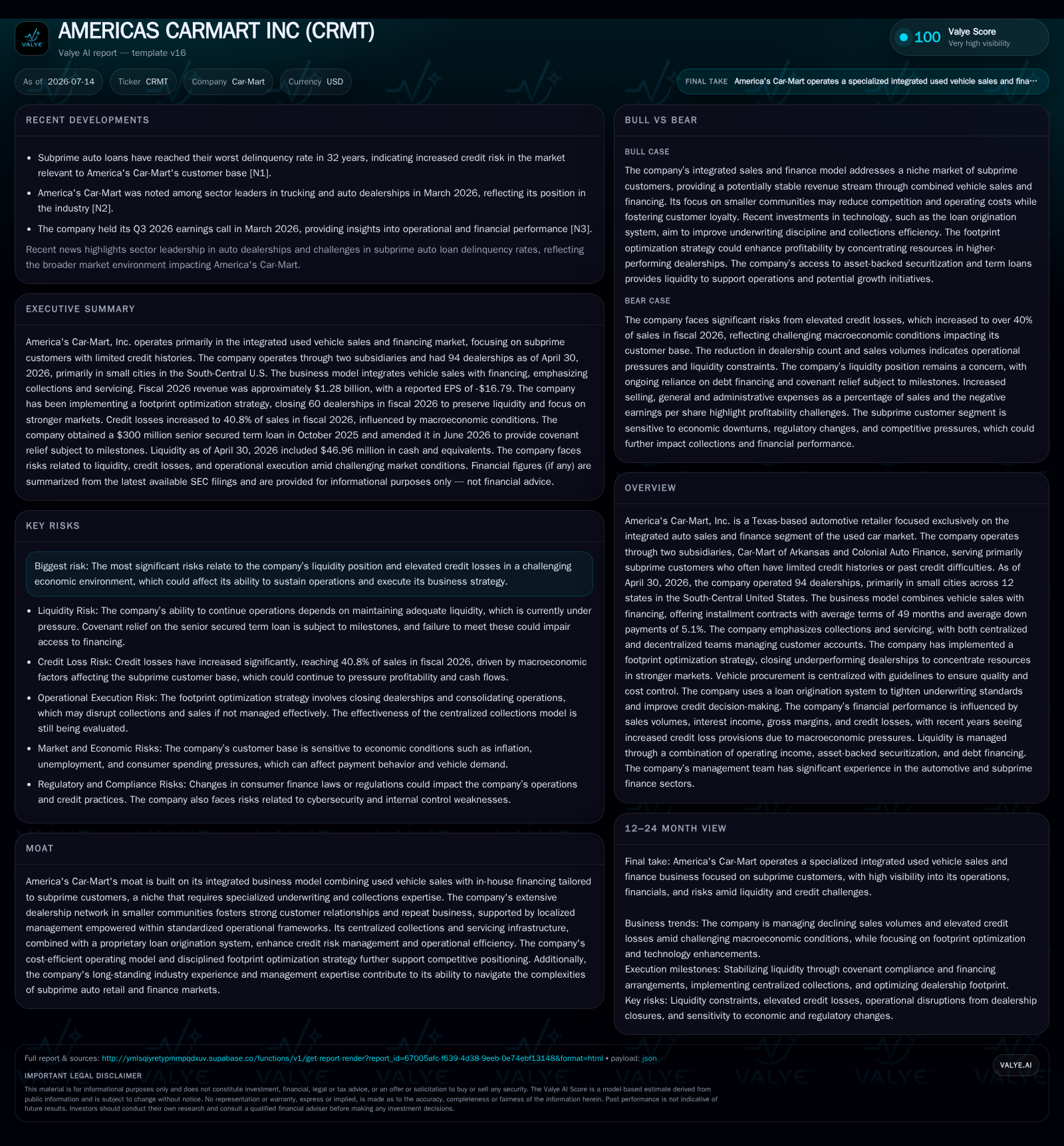
America’s Car-Mart, operating an integrated used car sales and subprime auto finance model, has prioritized stabilizing liquidity and optimizing its dealership footprint in fiscal 2026. The company closed 60 dealerships to concentrate resources and transitioned servicing to centralized collections, although this new model is early-stage and requires paced expansion. Concurrently, it advanced credit underwriting through a new loan origination system with embedded risk-based pricing, shifting originations toward better-quality customers. While vehicle sales volumes declined due to affordability challenges and inventory discipline, average retail pricing and interest income improved. The company’s liquidity remains dependent on financing sources such as securitized borrowings, with recent covenant relief obtained on its $300 million senior secured term loan.
Recent Operating Developments
America’s Car-Mart reported operational updates for the quarter ended January 31, 2026, emphasizing key drivers of profitability: vehicle sales revenue, interest income from finance receivables, gross margins on used vehicles, and credit loss management focused on principal recovery [S2]. The company advanced its credit underwriting capabilities by implementing an upgraded loan origination system (LOS) featuring an enhanced risk scorecard and embedded risk-based pricing. This technology enables more precise alignment of loan pricing with customer credit risk profiles, resulting in an early shift in originations toward higher-ranked borrowers, which is expected to improve portfolio credit quality over time [S2].
Concurrently, America’s Car-Mart pursued a strategic dealership footprint optimization, closing 60 dealerships primarily in smaller South-Central U.S. markets during fiscal 2026 to reduce operating costs and concentrate resources in stronger locations [S1]. Servicing and collections for accounts from closed dealerships were transitioned to nearby stores or a newly established centralized collections department. Given the centralized collections model is in its early stages without full-cycle performance validation, management plans to pace further closures cautiously to avoid impairing recoveries and cash flow [S1].
Vehicle retail unit sales declined 9.4% year-over-year through January 31, 2026, reflecting customer affordability pressures amid inflation and deliberate inventory purchase discipline to preserve liquidity [S18]. Despite lower volumes, average retail sales prices increased modestly, partially offsetting revenue declines, while interest income on finance receivables grew due to higher average receivables balances and elevated interest rates [S18]. Gross margin percentages on vehicle sales remained stable near historical levels, supported by disciplined sourcing amid tight used vehicle supply [S18]. SG&A expenses rose proportionally, driven by reduced operating leverage from lower sales volumes and investments in technology and collections infrastructure [S20].
Business Model Overview
America’s Car-Mart operates an integrated used vehicle retail and subprime auto finance business model targeting consumers with limited or challenged credit histories who typically cannot access traditional financing [S1]. The company sources older-model used vehicles primarily through auctions and wholesale channels, selling them via a network of 94 dealerships located mainly in small cities across twelve states in the South-Central U.S. as of April 30, 2026 [S1].
A majority of customers finance their vehicle purchases through installment contracts offered by the company’s Colonial Auto Finance subsidiary. These contracts average approximately 49 months in term length with down payments near historical averages of about 5%, balancing affordability with credit risk mitigation [S1]. Revenue streams comprise retail vehicle sales, including ancillary products such as accident protection plans, and finance income generated from interest on outstanding installment contracts. Profitability hinges on maintaining disciplined vehicle acquisition costs relative to retail pricing to preserve gross margin per unit while offering contract terms accessible to a subprime customer base.
Credit underwriting rigor and collections effectiveness are critical to managing elevated credit losses inherent in serving subprime borrowers. Each dealership historically managed both sales and collections, but recent investments have introduced centralized collections capabilities and digital payment tools to enhance cash flow consistency and delinquency management amid economic pressures on customers [S2]
Industry Structure and Competitive Position
America’s Car-Mart competes within a fragmented used vehicle retail and subprime auto finance industry that includes franchised automotive groups (e.g., AutoNation’s used car segment), large integrated retailers with broad financing options like CarMax, specialized subprime operators such as DriveTime Automotive Group, and independent dealers without captive financing arms.
The company’s competitive niche is defined by its integrated sales and proprietary subprime lending model, focused regionally on smaller communities rather than national urban markets. This requires specialized underwriting expertise and tailored collections strategies for higher-risk borrowers underserved by traditional lenders. Its competitive advantages include recent technological enhancements enabling nuanced risk-based pricing through the LOS and cost efficiencies from leasing approximately 84% of dealership properties, which reduces fixed overhead and enhances cost flexibility relative to volume fluctuations [S1], [S8].
The ongoing dealership footprint optimization reduces operating expenses but introduces execution risks that must be managed carefully to align with the centralized collections model’s capacity and preserve recoveries [S1]
Growth Drivers
Sustained demand for affordable transportation remains a key growth driver, supported by rising new vehicle prices that push credit-constrained consumers toward used vehicles financed via installment contracts. The upgraded LOS technology is expected to enhance origination quality by selectively targeting higher-credit-score customers, improving long-term portfolio health and risk-adjusted returns amid macroeconomic volatility.
Further development of collections infrastructure—integrating centralized processes with localized dealership support—is anticipated to incrementally improve delinquency recovery rates. Geographic concentration in core markets allows optimized capital deployment across fewer, higher-performing dealerships, enhancing operational efficiency and profitability.
Risks and Watchpoints
Liquidity risk remains elevated due to the capital-intensive nature of funding both used vehicle inventory and finance receivables growth [S2]. The company believes it will maintain adequate liquidity through expected financing sources such as asset-backed securitization borrowings, warehouse loan facilities, and other debt or equity arrangements, but this is not guaranteed [S2].
Credit loss rates are vulnerable to deterioration amid inflationary pressures increasing customers’ essential living costs, which may reduce discretionary payment capacity and elevate delinquency rates [N1]. The early-stage centralized collections model carries execution risk until proven effective across full loan cycles.
Regulatory scrutiny of subprime lending practices continues to pose compliance challenges, requiring ongoing investment in governance and cybersecurity frameworks to protect customer data and maintain operational resilience [S1]. Supply volatility from fluctuations in new vehicle production affects used vehicle acquisition costs, impacting retail margins and contract affordability [S13].
What to Watch Next
Key indicators to monitor include shifts in the credit quality mix of new originations following LOS deployment, alongside trends in delinquency rates and credit loss ratios in upcoming quarters [S2]. The pace and financial impact of additional dealership closures will reveal management’s confidence in the scalability of the centralized collections model without compromising recoveries or customer experience [S1].
Liquidity developments, including renewal or expansion of securitization facilities and adjustments to capital expenditures, will signal the company’s financial flexibility to support growth funding needs. Tracking average retail prices relative to acquisition costs will clarify whether gross margin stability persists amid supply-driven cost pressures [S18]. Regulatory changes affecting subprime auto finance standards warrant close attention given the company’s concentrated exposure in this lending segment [N1].
Financial Profile Discussion
As of April 30, 2026, America’s Car-Mart held approximately $46.96 million in cash and equivalents [F1]. The company’s liquidity is supported by $628 million in asset-backed non-recourse notes payable with maturities extending through 2032 and a $300 million senior secured term loan obtained in October 2025, for which covenant relief was secured in June 2026 to provide temporary financial flexibility [S4], [S1]. Historically, operating cash flow has been primarily deployed to fund finance receivables growth, capital expenditures, and share repurchases [S2].
Deferred tax liabilities increased to $37.0 million as of January 31, 2026, reflecting a $47.0 million non-cash valuation allowance against Colonial’s deferred tax assets, shifting the consolidated balance sheet to a net deferred tax liability position [S2]
SG&A expenses increased proportionally due to lower sales volumes reducing operating leverage and ongoing investments in technology and collections infrastructure aimed at enhancing operational efficiency and credit loss mitigation [S20]
This analysis synthesizes publicly disclosed information from SEC filings and reputable sources within the context of used car retail and subprime auto finance sector dynamics without constituting investment advice.
Disclaimer: This is research-only, informational analysis and not investment advice. It may include AI-generated interpretation and general industry context. Always verify important details using primary sources.

Comments