
Artelo Biosciences Q2 2026: Advancing Lipid-Signaling Therapeutics with Solid Balance Sheet
Artelo Biosciences reported clinical progress in its lipid-signaling drug candidates alongside a liquidity position in Q2 2026.
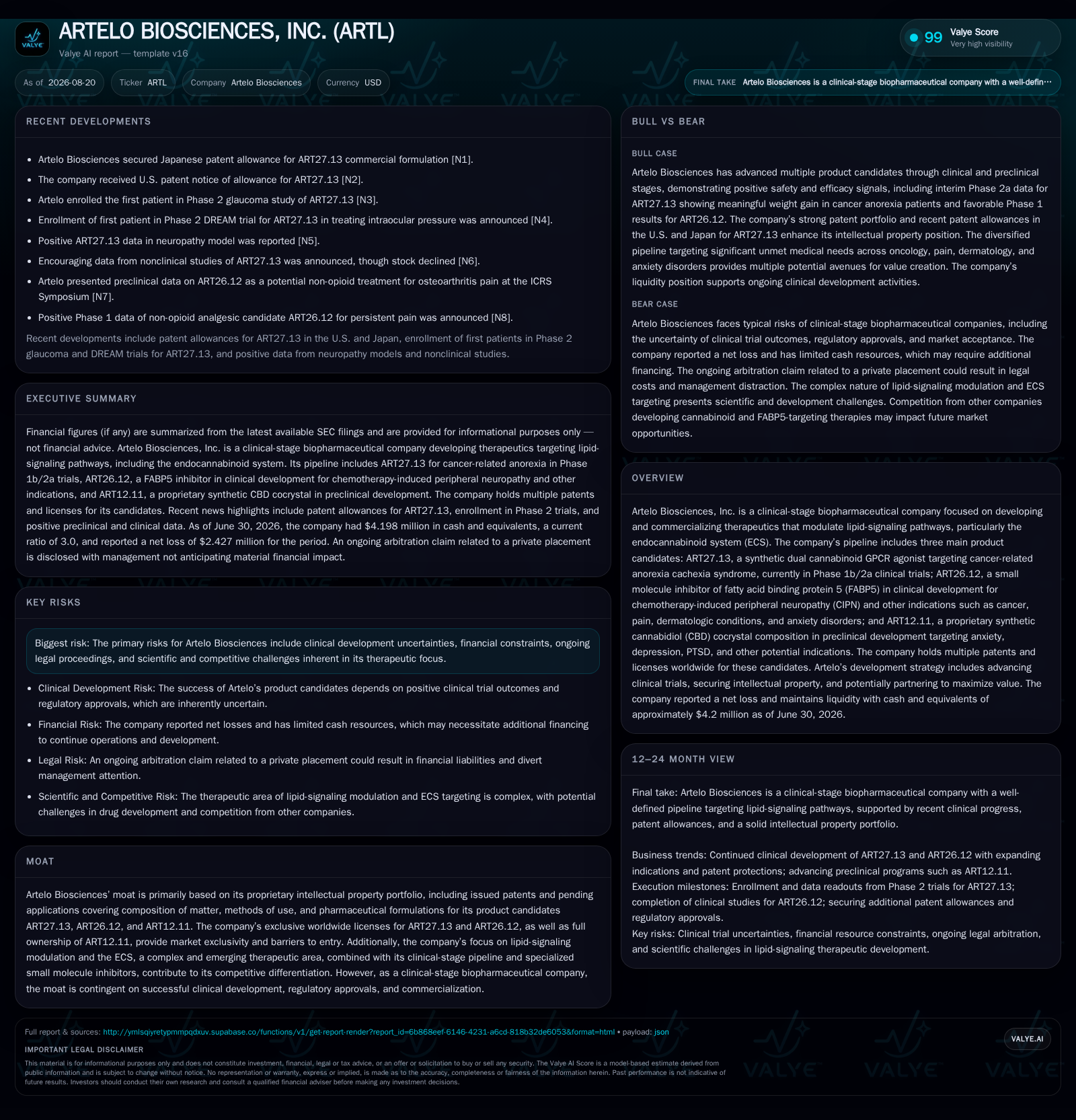
Artelo Biosciences, a clinical-stage biopharmaceutical company, advanced its Phase 1b/2a trial of ART27.13 for cancer anorexia cachexia syndrome and completed Phase 1 trials for ART26.12 targeting chemotherapy-induced peripheral neuropathy in the second quarter of 2026. The company maintained a current ratio of 3 as of June 30, 2026, reflecting a solid liquidity buffer with $4.37 million in current assets against $1.46 million in current liabilities. Recent shareholder approval to increase authorized common stock shares supports potential future capital raises to fund ongoing clinical development.
Q2 2026 Operating and Clinical Update
Artelo Biosciences, Inc. advanced its clinical-stage pipeline targeting lipid-signaling modulation pathways during the second quarter of 2026 [S1][S2]. The company’s lead candidate, ART27.13, a synthetic dual cannabinoid G protein-coupled receptor (GPCR) agonist, is in Phase 1b/2a clinical trials for cancer-related anorexia cachexia syndrome (CACS). This outcome highlights ART27.13’s potential to address a significant unmet medical need, as no FDA-approved therapies currently exist for CACS. The safety profile remained consistent with prior Phase 1b results, even at doses up to twice the previous maximum, supporting further clinical development.
Interim data from the ongoing Phase 2a CAReS trial demonstrated that patients with cancer anorexia receiving ART27.13 experienced a mean weight gain of over 6%, compared to a 5% weight loss in the placebo group [S2]
In parallel, ART26.12, a small molecule inhibitor of Fatty Acid Binding Protein 5 (FABP5), completed Phase 1 clinical trials in healthy volunteers. The study demonstrated favorable safety, tolerability, and pharmacokinetic characteristics, with no drug-related adverse events observed. Dose-dependent, linear absorption was confirmed, and a wide safety margin was established between therapeutic plasma concentrations and observed exposure levels [S1]. These results support further clinical evaluation of ART26.12 for chemotherapy-induced peripheral neuropathy (CIPN) and potentially other indications such as cancer therapeutics, dermatologic conditions, and anxiety-related disorders.
The company remains clinical-stage with no reported commercial revenue, consistent with its focus on drug development rather than product sales [S2]. Operating expenses are dominated by research and development costs associated with advancing its pipeline candidates, reflecting the typical cost structure of early-stage biopharmaceutical companies.
Financial Position and Capital Structure
Artelo Biosciences reported a liquidity position as of June 30, 2026, with a current ratio of 3, reflecting current assets of approximately $4.37 million relative to current liabilities of $1.46 million [F1]. Additionally, cash and cash equivalents stood at approximately $4.2 million as of March 31, 2026 [F1].
In July 2026, shareholders approved an amendment to increase the authorized shares of common stock from approximately 167 million to 500 million [S3]. This change facilitates potential future capital raises through equity issuance, which could provide additional funding to support clinical development and corporate activities. The approval of share issuance aligns with typical early-stage biotech financing strategies, enabling Artelo to access capital markets as needed to advance its pipeline.
Business Model and Intellectual Property
Artelo’s business model centers on the discovery and clinical development of novel therapeutics that modulate lipid-signaling pathways, including the endocannabinoid system (ECS) and fatty acid binding proteins. The company’s pipeline leverages proprietary compounds such as ART27.13, a dual cannabinoid receptor agonist, and ART26.12, a FABP5 inhibitor, targeting indications with significant unmet medical needs like cancer anorexia cachexia syndrome and chemotherapy-induced peripheral neuropathy.
Revenue generation is currently contingent on future regulatory approvals and potential licensing or partnership agreements with pharmaceutical or biopharmaceutical companies [S1][S2]. Until commercialization, Artelo relies primarily on equity financing and research and development tax credits to fund operations. The company’s strategy includes evaluating partnerships with larger pharmaceutical firms to maximize value, although it currently plans to retain development and commercialization rights based on management’s experience and future talent acquisition [S1].
The company holds exclusive licenses and patents on its drug candidates, providing potential market exclusivity and competitive differentiation. These intellectual property rights are critical in protecting the value of its pipeline and enabling future monetization through licensing or direct commercialization [S1]. Maintaining and expanding this patent portfolio is essential to safeguard against competition and to attract potential partners or acquirers.
Risks and Scenario Analysis
Artelo faces typical risks inherent to clinical-stage biopharmaceutical companies, including clinical trial uncertainties, regulatory hurdles, and capital dependency [F1][S2]. The absence of commercial products means the company must continue to secure financing to fund its research and development activities. Failure to obtain additional capital on favorable terms could adversely affect operations or lead to termination of development programs [S1].
Positive interim data for ART27.13 and favorable Phase 1 results for ART26.12 support potential advancement toward later-stage trials, which could enhance valuation and attract strategic partnerships [S1][S2]. Confirmation of this scenario would come from announcements of positive clinical data, new partnership agreements, or regulatory designations such as fast-track status.
Conversely, trial failures, safety concerns, or inability to secure additional capital could materially impair development programs and threaten operational viability. Evidence of such setbacks would include negative trial results, cash depletion without replenishment, or loss of intellectual property rights. These risks are compounded by the inherent uncertainties in clinical development and the competitive landscape.
The base case envisions steady clinical progress with manageable financing needs, maintaining the current development trajectory without near-term commercial revenue. Updates on patent grants or intellectual property developments will also be important to assess the durability of competitive advantages. Additionally, capital raising activities or share issuance updates will provide insight into the company’s financial runway and ability to fund ongoing trials. Finally, regulatory filings and Investigational New Drug (IND) progress for pipeline candidates will be key indicators of development momentum.
Overall, Artelo Biosciences’ Q2 2026 disclosures reflect clinical advancement in its lipid-signaling therapeutic candidates and a financial position that may support continued development amid the inherent risks of clinical-stage biopharmaceutical innovation. The company’s liquidity position and recent shareholder-approved capital structure enhancements could provide a runway to navigate the critical phases of clinical development, while its proprietary intellectual property portfolio may contribute to its differentiation in the lipid-signaling therapeutic space.
Disclaimer: This is research-only, informational analysis and not investment advice. It may include AI-generated interpretation and general industry context. Always verify important details using primary sources.

Comments