
Arxis Consolidates Mission-Critical Components Amid Heavy Debt and Recent Acquisitions
The company's Q1 2026 report highlights operational integration benefits from recent acquisitions but underscores leverage and cyclicality risks.
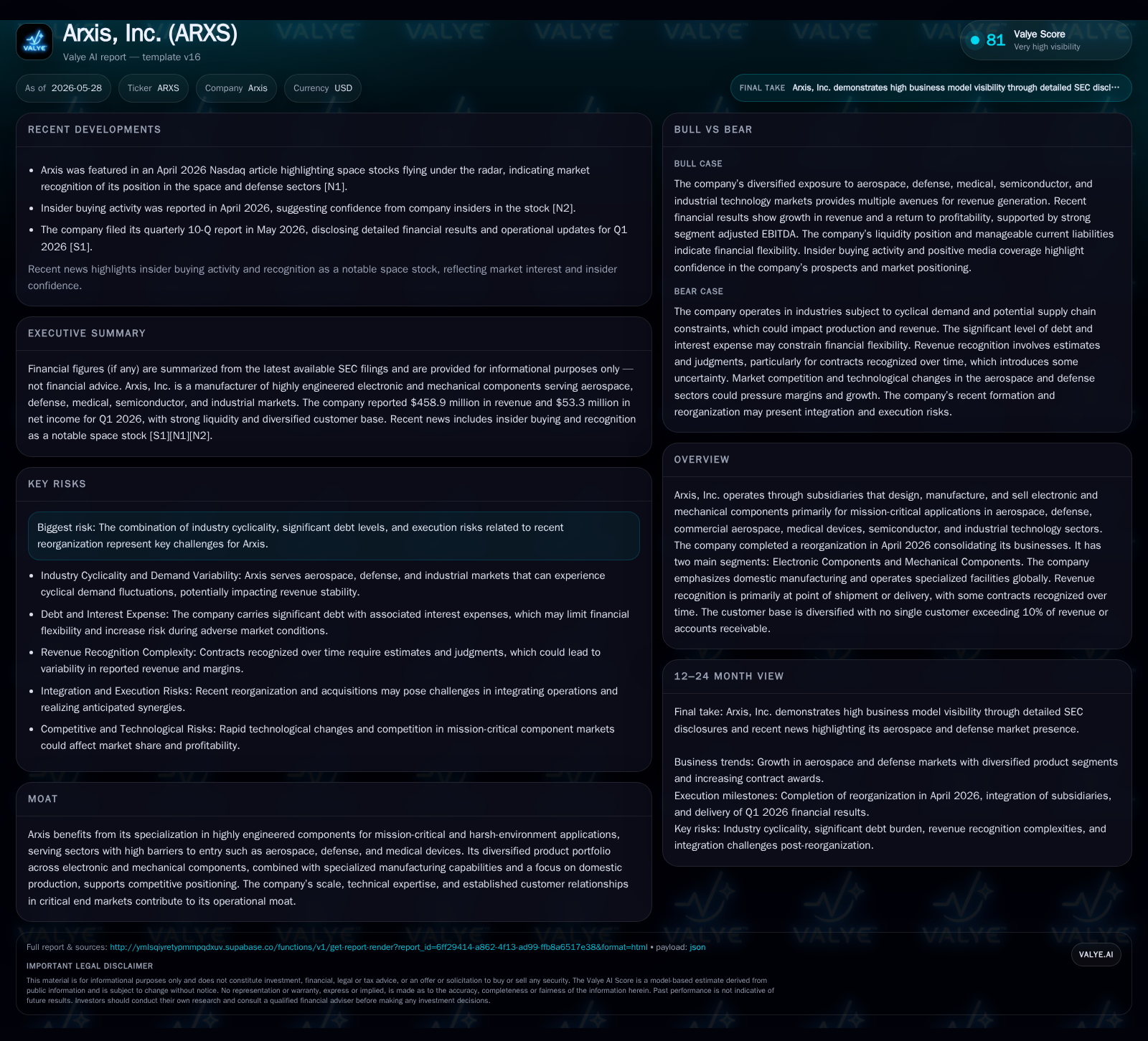
Arxis, Inc. reported solid revenue growth and improved operating income in Q1 2026 driven by the Electronic and Mechanical Components segments following its April 2026 reorganization and prior acquisitions. The company’s business model centers on supplying highly engineered electronic and mechanical parts for aerospace, defense, medical, semiconductor, and industrial sectors with a strong emphasis on domestic manufacturing. Despite diversified end markets and deep technical knowhow underpinning its competitive moat, Arxis faces structural challenges from its elevated debt load and the inherent cyclicality of its core industries. Future growth depends on successful integration of recent acquisitions like Micro-Tronics and Spira Manufacturing, maintaining customer relationships in mission-critical areas, and effective cost management amid fluctuating end-market demand.
Recent Operating Update: Q1 2026 Performance Anchors Current View
Arxis’s latest quarterly filing for the period ended March 31, 2026 [S2] confirms several critical developments reshaping its near-term trajectory. Revenue climbed to approximately $459 million [F1], a notable increase versus prior year levels reflecting stronger demand as well as organic growth boosted by recent acquisitions. Operating income more than doubled to just over $110 million [F1], underpinned by operational improvements following the company’s consolidation reorganization completed in April 2026 [S11]. Net income swung positive to $53.3 million from a prior quarter loss [F1], highlighting effective expense management despite ongoing integration costs.
Noteworthy is Arxis's acquisition strategy materializing through deals such as the purchase of Micro-Tronics in January 2026 [S4]—adding engineered elastomeric seals primarily serving aerospace/defense—and Spira Manufacturing Corporation in January 2025 [S5], specializing in EMI/RFI shielding gaskets. These bolt-on moves broaden Arxis’s differentiated product portfolio within mission-critical applications with high technical barriers.
Liquidity analysis reveals a robust current ratio of approximately 3.7 owing to cash balances nearing $239 million versus current liabilities around $255 million [F1]. However, total debt remains substantial at nearly $2.68 billion [F1], leading to net debt north of $2.44 billion after accounting for cash reserves, sustaining heavy leverage burdens that amplify interest expense pressures ($43.9 million in Q1) [F1].
Business Model: Mission-Critical Components for Demanding Markets
Arxis operates two primary segments: Electronic Components and Mechanical Components [S11]. Through subsidiaries organized under Connector TopCo and Ovation TopCo respectively, the company designs, manufactures, and sells highly engineered components tailored for mission- and safety-critical environments including aerospace (commercial & defense), medical devices, semiconductor equipment, industrial technology, naval shipping, oil & gas sectors.
Customers pay primarily for complex electronic interconnects (e.g., connectors with stringent EMI shielding) or precision mechanical parts such as elastomeric seals adapted for harsh environments subject to strict regulatory standards. Revenue recognition hinges largely on shipment or delivery points [S4], though some contracts utilize over-time recognition reflective of longer production cycles.
The business model leverages specialized manufacturing processes emphasizing domestic U.S.-based production capacity to meet exacting quality requirements while minimizing supply chain disruptions—a recognized competitive advantage given geopolitical sensitivities impacting global aerospace/defense supply chains.
Pricing derives from engineering complexity coupled with contractual terms often favoring multi-year engagements due to the custom nature of products; this generates moderate volume stability with some pricing power rooted in entrenched customer relationships.
Industry Structure and Competitive Position
Arxis competes in a fragmented yet high-barrier landscape where incumbent suppliers hold domain expertise in materials science, precision machining, and qualification/testing protocols that new entrants struggle to match easily. Its focus on aerospace, defense, medical devices, semiconductor manufacturing equipment, plus specialized industrial niches imparts exposure to sectors with long certification cycles supporting higher switching costs.
Peers typically range from large diversified aerospace suppliers to niche specialists focused exclusively on either electronic or mechanical componentry; Arxis’s dual-segment approach enables cross-selling opportunities but also requires managing distinct operational demands.
The ongoing industry cyclicality—driven by government spending patterns, commercial aerospace new build rates tied to economic cycles, and semiconductor capital expenditure cycles—introduces volatility risk. However, Arxis’s scale post-acquisitions (Micro-Tronics addition extending elastomeric capabilities; Spira enhancing EMI shielding) improves its competitive moats via broader product mix scope and scale economies.
Growth Drivers
- Acquisition-Fueled Expansion: Integration of Micro-Tronics’ diaphragm seals and metallic components complements existing offerings while Spira adds electromagnetic shielding products aiding penetration into more diversified end markets.
- Defense & Space Demand: Sustained governmental budgets for defense modernization programs bolster mechanical seal demand for naval/land systems plus ruggedized electronic connectors vital for space applications.
- Commercial Aerospace Recovery: Post-pandemic ramp in commercial aircraft production supports higher volumes for engineered electronic connectors,
- Domestic Manufacturing Push: Heightened U.S. focus on supply chain resilience incentivizes OEMs to source domestically manufactured components benefiting Arxis’s footprint.
- Innovation & Engineering Expertise: Ongoing R&D investment enables product differentiation through enhanced performance (e.g., EMI shielding effectiveness or seal durability) meeting increasingly stringent client specs.
Risks / Watchpoints / Growth Constraints
- High Leverage Load: Total indebtedness exceeding $2.67 billion weighing on cash flow flexibility; interest expense remains a material drag [$43.9M Q1] [F1]. Refinancing or deleveraging options are pivotal watchpoints.
- Cyclicality Impact: Fluctuating end-market spending especially commercial aerospace or oil/gas segments could pressure near-term volumes causing margin compression if fixed costs remain elevated.
- Integration Complexity: Assimilating recently acquired businesses while achieving synergies demands focused execution; failure risks diluting expected uplift or inflating costs.
- Customer Concentration & Contract Dynamics: Although no single customer surpasses 10% revenue [S11], dependence on large OEMs may expose Arxis to order deferrals or renegotiations affecting topline predictability.
- Foreign Exchange Volatility: Global operations introduce FX translation effects recorded within comprehensive income impacting equity though not immediate operating cash flow.
- Regulatory & Certification Requirements: Maintaining compliance across diverse regulated sectors entails ongoing investment; delays or failures can affect product qualification timelines restricting sales ramp-ups.
What to Watch Next
Key milestones include quarterly performance updates monitoring organic revenue growth post-reorganization combined with acquisition synergy delivery measured through margin expansion metrics. Order backlog growth or shrinkage details by segment will provide early indications of demand trajectory supported by disclosed contracts recognized over time versus point-in-time shipments.
Capital deployment is another focal point: capex trends (~$12 million spent in Q1 primarily in Mechanical Components) highlight investment stance toward capacity expansion or modernization. Debt servicing plans including any potential refinancing activity amid evolving interest rate environments could materially alter financial headwinds.
R&D progress announcements signalling pipeline innovations enhancing component reliability or functionality serve as catalysts enhancing differentiation versus competitors.
Finally, working capital trends reflecting inventory turns or receivables collection efficiency influence liquidity standing given elevated leverage.
Financial Profile: Leverage Overshadows Profitability Gains
While Arxis reported meaningful profitability improvement — net income of $53.3 million versus prior losses — the capital structure remains burdened with approximately $2.68 billion total debt offset partially by near $239 million cash reserves as of March-end 2026 implying a net debt position exceeding $2.44 billion [F1]. Interest expense at roughly $44 million weighs significantly on earnings capacity despite optimized operating cost controls evidenced by operating income doubling over one year ago ($110.5M vs ~$60M) [F1]. The firm maintains prudent liquidity coverage reflected by a current ratio near 3.7 driven by substantial short-term assets relative to liabilities [F1]. Investment levels remain steady with capex focused on manufacturing assets upgrades supporting growth trajectories across both segments [S27]. No impairment charges were recorded against long-lived assets validating current asset utilization assumptions [S13].
In summary, while the company shows promising operational momentum aided by strategic acquisitions and sector positioning focused on mission-critical components requiring specialized manufacturing expertise domestically sourced, material leverage remains an overarching constraint requiring vigilant management alongside navigating cyclical demand shifts typical of its end markets.
This analysis is based solely on the company's public financial disclosures and industry context available as of May 28, 2026; it does not constitute investment advice but aims to outline operating fundamentals and structural factors shaping Arxis's current situation.
Disclaimer: This is research-only, informational analysis and not investment advice. It may include AI-generated interpretation and general industry context. Always verify important details using primary sources.

Comments