
Axogen's Growth Constrained by FDA Accelerated Approval Obligations and Operational Challenges
Axogen's peripheral nerve repair technologies face growth and profitability tradeoffs amid regulatory commitments and facility operational hurdles.
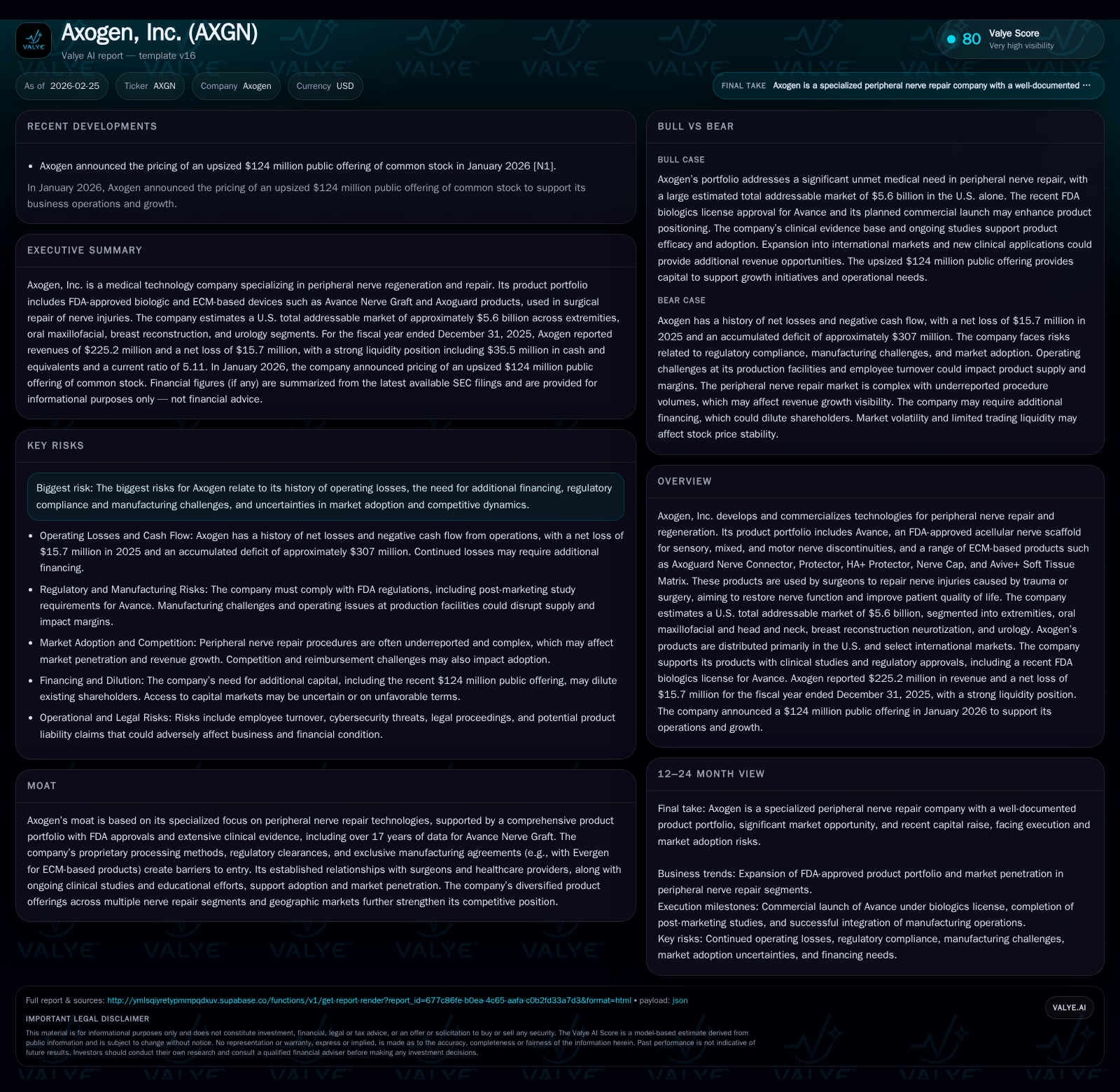
Axogen, Inc. has expanded its market presence with FDA approval of Avance as a licensed biologic in late 2025, marking a key milestone in its peripheral nerve repair product lineup. However, the accelerated approval pathway imposes stringent post-marketing confirmatory study obligations which could constrain commercialization. The company’s revenue has grown steadily at about 20% annually over the past three years, yet it remains unprofitable with challenges arising from manufacturing transitions at its new APC facility affecting margins. Cash flow trends reflect tight liquidity despite positive operating cash flow. Future growth hinges on successful product adoption across multiple surgical segments and execution of regulatory trials, while capital allocation is conservative in the near term to preserve financial flexibility.
Company Overview and Product Portfolio
Axogen, Inc., headquartered in Alachua, Florida, specializes exclusively in peripheral nerve repair and regeneration technologies. Its FDA-approved flagship product, Avance®, is an acellular nerve allograft designed for bridging sensory, mixed, and motor nerve discontinuities in adult and pediatric patients aged one month or older. In December 2025, Avance transitioned from a human tissue product to a licensed biological product under FDA regulation following Biologics License Application (BLA) approval, marking a critical inflection point for the company’s commercial positioning [S1].
Complementing Avance are extracellular matrix (ECM)-based products such as Axoguard Nerve Connector®, Protector®, HA+ Protector™, Nerve Cap®, as well as Avive+ Soft Tissue Matrix™, launched mid-2024. These products support various facets of nerve repair including tensionless coaptation, protection against soft tissue adhesions, neuroma prevention, and healing environment optimization. Axogen estimates the total addressable U.S. market for its technologies at approximately $5.6 billion spanning four key segments: extremities; oral maxillofacial/head & neck; breast reconstruction neurotization; and urology [N1], aligning with secular trends toward surgical restoration of nerve function.
Historical Financial Performance
Axogen’s recent financials reflect consistent top-line growth accompanied by persistent operating losses due to continued investment in R&D, regulatory processes, manufacturing scale-up, and commercial expansion.
Historical performance (annual)
| FY | Rev ($mm) | Net ($mm) | CFO ($mm) | OpInc ($mm) | Rev YoY | Net YoY |
|---|---|---|---|---|---|---|
| 2025 | 225 | -16 | 1 | -8 | +20.2% | -57.6% |
| 2024 | 187 | -10 | 5 | -3 | +17.8% | +54.1% |
| 2023 | 159 | -22 | -6 | -21 | +14.7% | +25.0% |
| 2022 | 139 | -29 | -16 | -30 |
Note: Omitted columns lack sufficient annual XBRL coverage in the provided tags (need ≥2 annual points): Capex, Div, Buybacks. Source: SEC companyfacts cache [F1].
Capital returns and efficiency (annual)
| FY | FCF ($mm) | ROE% |
|---|---|---|
| 2025 | -3 | -12.2 |
| 2024 | 1 | -9.6 |
| 2023 | -20 | -22.7 |
| 2022 | -36 | -28.7 |
Source: SEC companyfacts cache [F1].
Note: Buybacks and dividends omitted due to insufficient current info [F1]
Revenue growth sustained over the last four years shows strong demand pull for Axogen's niche restorative solutions amid rising clinical acceptance of nerve repair technologies across diversified anatomical applications.
Operating losses narrowed sharply in FY2024 but widened again in FY2025 despite revenue gains, underscoring cost pressures partly attributable to the APC facility commissioning challenges that increased operating expenses and disrupted gross margin improvement trajectories [S27], compounded by expenses associated with post-BLA commercialization efforts.
Despite net losses each year since FY2022, Axogen’s operating cash flow turned positive in FY2024 (+$4.5M) but plummeted to near break-even ($0.8M) in FY2025 amid increased working capital needs linked to inventory build for newly approved biologic product lines.
Capital expenditures moderated compared to peak outlays during earlier facility expansions but remain recurrent as the company upgrades its manufacturing capability and quality systems needed under biological product licensing standards.
Recent Earnings Highlights & Operational Updates
In Q4 2025 earnings communications (Feb '26), management indicated initial commercial availability of Avance as a licensed biologic was set for early Q2 2026 following final production qualification steps [N1][S3]. This launch replaces the previously marketed Avance Nerve Graft offering.
The transition aims to strengthen Axogen’s competitive moat through enhanced regulatory status potentially resulting in better reimbursement profiles but introduces complexity around hospital access protocols and payer coverage that differed from prior biologic tissue handling models [S15].
Operationally, ongoing issues at the APC facility—responsible for processing Avance products—have led to delays in achieving targeted processing yields and regulatory inspections have necessitated extended quality assurance initiatives impacting margin profiles negatively [S27][N2]. Employee turnover at the APC facility also weighs on timely production continuity.
Regulatory Environment & Risks
A principal long-term constraint stems from the FDA's accelerated approval program applied to specific indications for Avance involving sensory nerve discontinuities greater than 25mm and mixed/motor nerve repair [S13][S16]. These approvals are contingent on completing confirmatory post-marketing clinical trials by December 2030 with stringent milestone reporting requirements established by February 2026[S13][S16].
Failure to conduct these trials successfully or demonstrate clinical benefit could lead to FDA actions including withdrawal or modification of these accelerated approval indications adversely affecting revenue streams significantly given that Avance Products contribute about 60% of total sales [S13]. This regulatory risk engenders uncertainty over future market potential despite initial uptake.
Additionally, post-BLA approval adjustments may alter hospital supply chain integration processes differing from prior models thus affecting surgeon access patterns—the company expects some pricing pressure from payors adjusting coverage policies under new biologic status frameworks [S15].
The company's regulatory compliance posture demands continuous investment due to complex HCT/P regulations for tissues alongside medical device clearances for ECM products like Axoguard lines requiring vigilant oversight for quality control and adverse event reporting [S6][S12][S23].
Competitive Position & Moat Analysis
Axogen's moat derives primarily from its focused expertise on peripheral nerve repair backed by an extensive clinically validated portfolio including over seventeen years of data supporting Avance effectiveness . Proprietary processing techniques coupled with exclusive supply agreements (notably with Evergen for ECM materials) create high barriers for new entrants particularly given stringent FDA approvals achieved.
Its diversified product set spanning several surgical indications enhances resilience against single-segment demand shocks while surgeon relationships cultivated through training programs further entrench adoption rates.
Nonetheless patent expirations on key formulations used within ECM products may gradually erode exclusivity benefits posing medium-term competitive threats unless offset by innovation or brand strength enhancements[S28].
Capital Structure & Returns Profile
As of year-end FY2025, Axogen maintains $35.5 million cash balances supporting liquidity needs amidst continued operating deficits but demonstrating prudent cash management relative to growing revenues [F1]. The strong current ratio (~5x) signals solvency buffer though free cash flow remains negative (-$2.9 million), indicating investing activities still outweigh operational cash generation.
Return metrics such as ROE remain negative (-12%), reflecting ongoing net losses typical of growth-stage biotech/medtech firms heavily invested in commercialization infrastructure ahead of profitability inflection points.
There are no recent dividend payments or significant share repurchases recorded indicating management’s emphasis on funding growth initiatives rather than shareholder distributions currently[F1][N7][N8].
Forward Outlook & Catalysts to Monitor
Growth prospects depend firstly on successful commercialization ramp following launch of licensed Avance products starting mid-2026 coupled with broader market adoption across extremities, oral maxillofacial/head & neck procedures, breast reconstruction neurotization, and urology segments mapped to an estimated total addressable market north of $5 billion domestically alone[N1]. Strategic initiatives likely focus on surgeon education expansion and reimbursement optimization.
Key milestones include:
- Completion initiation of FDA-mandated confirmatory clinical trials within specified timelines with regular progress reports required starting May 31st, 2026[S13];
- Resolution of APC operational inefficiencies enabling stable supply chains;
- Navigating evolving hospital formulary placements driven by biologic designation impacting purchasing patterns;
- Development pipeline progression on next-generation nerve connectors/protectors enhancing product breadth;
- Potential international regulatory approvals hinging on varying jurisdictional requirements adding complexity yet expanding geographic reach.[S18]
Monitoring upcoming quarterly reports for improvements in gross margin percentage trends will provide insight into operational recovery post-APC ramp-up phases while watchfulness regarding any FDA communications pertaining to accelerated approval enforcement will be critical.
Industry Context Analysis
Peripheral nerve repair remains a niche but medically significant segment straddling biological products regulation and medical device clearance pathways with distinct technical demands unlike orthopedics or cardiovascular devices where scale differs substantially. The industry historically struggles balancing highly specialized manufacturing controls with scalable cost structures impacting margins and cash flows. Successful navigation through FDA accelerated approvals is pivotal as biopharma increasingly faces pressure integrating rigorous evidence generation aligned with streamlined patient access models—Axogen embodies these challenges realistically currently. Worldwide regulatory heterogeneity adds layers of compliance overheads especially impacting companies strongly reliant on human tissue derived products.
Conclusion
Axogen sits at a pivotal juncture marked by historic revenue growth translating benefits from a broadened portfolio yet grappling with profitability hurdles born from recent facility transitions under stringent biological product license guidelines coupled with exacting FDA confirmatory study mandates imposed under accelerated approval pathways. The company's comprehensive product suite across multiple nerve repair segments supported by extensive clinical validation forms a durable competitive moat though persistent operational challenges necessitate focused execution discipline to fully monetize these advantages long-term. Investor attention should center on developments related to confirmatory trial launches/completions along with operational KPIs from APC facility recovery while maintaining cognizance around evolving reimbursement landscapes possibly influencing near-term revenue quality. Financial stewardship indicates measured capital deployment preserving liquidity resources albeit perpetuating negative returns typical until scale efficiencies manifest post-commercial maturity.
This analysis is intended solely for informational purposes without providing investment advice or recommendations regarding the securities discussed herein.
Disclaimer: This is research-only, informational analysis and not investment advice. It may include AI-generated interpretation and general industry context. Always verify important details using primary sources.

Comments