
BayFirst Financial: Community Banking Adjusts to Credit Headwinds and Revenue Refocus
BayFirst Financial’s exit from nationwide SBA 7(a) lending and residential mortgages marks a decisive pivot back to its local roots. The company’s ability to manage credit risk, rebuild profitability, and defend its niche against larger and digital-first competitors will determine whether its specialized lending and relationship-driven model can deliver sustainable returns.
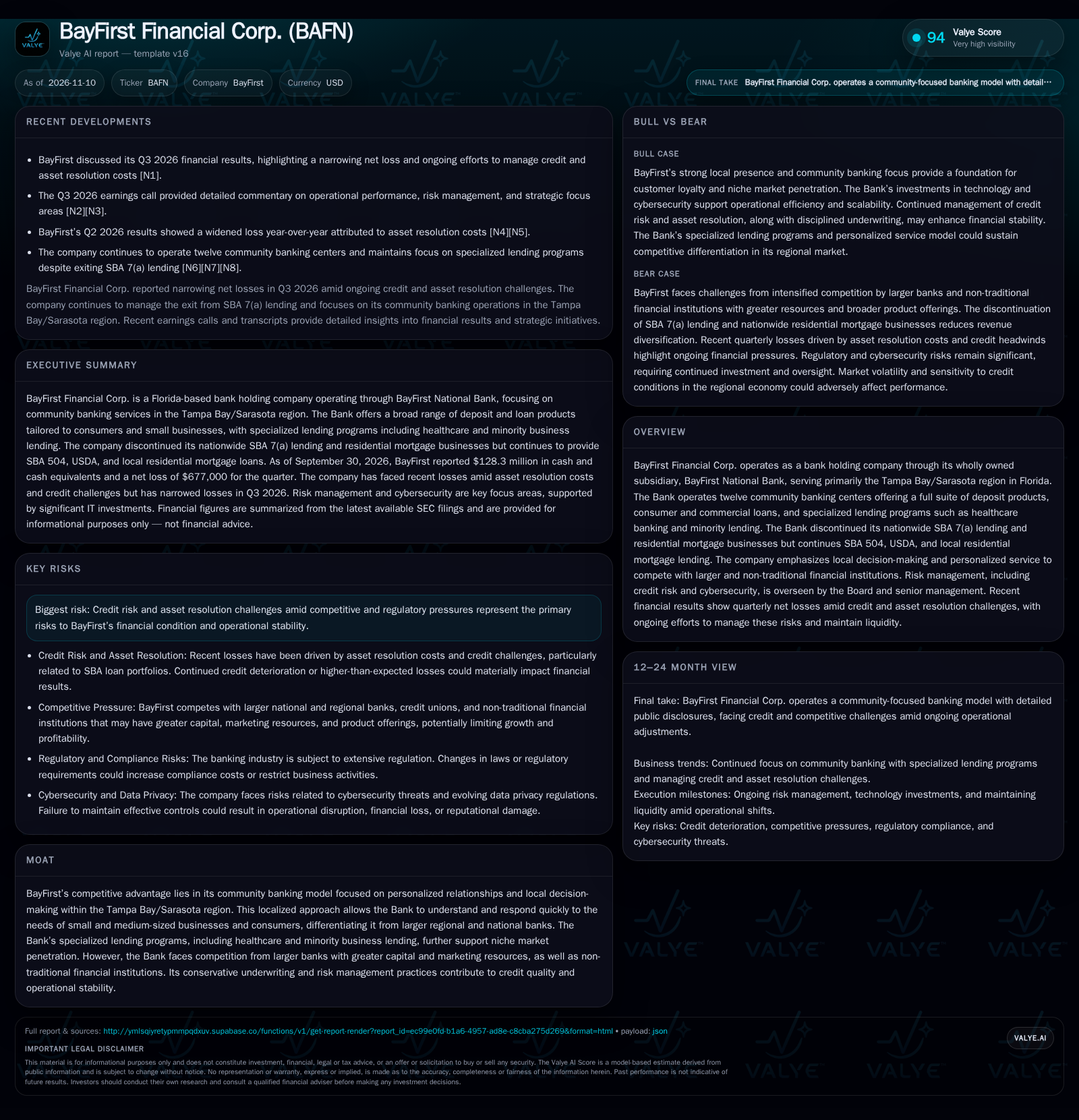
BayFirst Financial Corp. has narrowed quarterly losses after discontinuing its nationwide SBA 7(a) and residential lending businesses, focusing on community banking in the Tampa Bay/Sarasota region. While specialized local lending and technology investments offer some differentiation, ongoing credit and asset resolution costs, alongside heightened competition, continue to pressure profitability. The next phase hinges on credit performance, core loan growth, and the ability to retain clients amid a shifting competitive landscape.[S1] [S2] [N1] [N5] [N8]
BayFirst Financial Corp. is at a strategic crossroads. After years of pursuing national lending opportunities, the company has retreated to its community banking core in Florida, emphasizing local decision-making and specialized lending to regain financial footing. Recent results show progress in narrowing losses, but the business now faces a critical test: can a concentrated regional strategy, supported by niche products and technology upgrades, offset competitive pressures and persistent credit headwinds? The answer will shape BayFirst’s value proposition and sustainability in a rapidly evolving banking landscape.[S1] [S2] [N1] [N5] [N8]
Recent Strategic Retrenchment and Credit Headwinds Frame the Current State
BayFirst Financial’s Q3 2026 net loss narrowed to $677,000, reflecting incremental progress in managing credit and asset resolution costs that have weighed on results since the exit from its nationwide SBA 7(a) lending division in late 2025 and earlier discontinuation of national residential mortgages. [S2] [N1] [N5] [N8] [S2] The business now operates twelve community banking centers in west-central Florida, focusing on local deposits, consumer and commercial loans, and specialized programs such as healthcare and minority lending.[S1] This strategic retrenchment is a pivotal development: it reduces revenue diversification and scale, but may allow the company to focus resources and risk management more effectively on its core market.
How BayFirst’s Community Banking Model Generates Returns—And Its Limitations
BayFirst’s revenue is primarily driven by spread income from loans and deposits, with fee income from specialized lending (e.g., SBA 504, USDA) and ancillary services for local clients.[S1] By exiting the capital-intensive, volatile nationwide SBA 7(a) and residential mortgage segments, BayFirst has reduced exposure to loan sales, secondary-market pricing swings, and the operational complexity of national platforms. The cost base is now more closely tied to local branch operations, IT infrastructure, and credit administration. This could enable tighter cost control and more predictable funding costs, but also caps growth potential and limits scale-driven efficiency.
Fixed costs remain significant: branch networks, compliance, and ongoing IT/cybersecurity investments create operating leverage, but with limited revenue growth, efficiency gains will depend on loan book quality and stable deposit funding. The focus on conservative underwriting and centralized credit approval is intended to reduce future credit losses, but in a competitive market, this can also limit loan growth if standards are not balanced with market realities. Capital needs will be shaped by credit performance—further deterioration in asset quality could require higher loan loss provisions, constraining lending capacity and flexibility.
The interplay between BayFirst’s localized loan portfolio and its funding structure is critical to understanding its return dynamics. Community banks often rely heavily on core deposits, which tend to be more stable and lower-cost than wholesale funding sources. However, the relatively small size of BayFirst’s deposit base limits its bargaining power on deposit pricing, especially in a competitive regional environment. This constraint can compress net interest margins if the bank must raise deposit rates to retain or attract funds. Additionally, the bank’s ability to cross-sell ancillary financial services to its local customers could enhance fee income, but this depends on effective relationship management and product relevance within its niche markets.
Another consideration is the scalability of BayFirst’s operational model in the absence of national lending platforms. While focusing on local branches may reduce complexity, it also limits the potential for economies of scale that larger banks or fintechs exploit. Fixed costs such as compliance and cybersecurity investments do not scale down proportionally with a smaller loan book, potentially increasing the cost-to-income ratio. Therefore, BayFirst’s profitability will be sensitive not only to loan growth but also to its ability to optimize operational efficiency through technology and process improvements, which must be balanced against the risk of underinvestment in critical infrastructure.
Defending a Local Niche Against Larger Banks and Digital Disruptors
BayFirst’s core competitive proposition is its regional focus, with an emphasis on local decision-making, relationship banking, and niche lending programs (notably healthcare and minority business lending).[S1] This model can attract small businesses and consumers underserved by larger, less personalized banks. However, the moat is inherently narrow: regional and national banks offer broader product suites, digital-first fintechs target the same customer segments with improved convenience and lower fees, and credit unions compete on price and community ties.
The company’s ability to maintain differentiation depends on the perceived value of local underwriting, responsiveness, and personal relationships—qualities that are being steadily eroded as digital platforms improve. Technology investments may help BayFirst close some operational and service gaps, but without scale, it is difficult to match the product breadth, marketing reach, or pricing power of larger competitors. The exit from national lending reduces exposure to non-local competitors but also surrenders potential scale advantages and fee income diversity.
If Credit Stabilizes and Local Lending Rebounds, Margin Recovery is Plausible
A favorable scenario would see BayFirst successfully contain credit losses and asset resolution costs, allowing the company to redeploy capital into higher-margin local lending. If the specialized healthcare and minority lending programs can drive core loan growth without a corresponding rise in credit risk, net interest margin could expand and fee income from SBA 504 and USDA programs could partially offset lost 7(a) revenue. Technology upgrades would need to deliver measurable improvements in operational efficiency and customer experience, reducing per-branch overhead and sustaining deposit inflows.
Confirmation of this scenario would include sustained reductions in provision expense, improving net interest income, and evidence of loan growth in targeted segments. A further narrowing or reversal of net losses, alongside stable or growing core deposits, would support the case that BayFirst’s focused model can deliver sustainable profitability.
Regional Focus Delivers Stability but Limits Growth and Earnings Power
The most plausible trajectory is one of modest recovery: BayFirst maintains its community banking franchise, containing (but not fully eradicating) credit and asset resolution costs. Loan growth in core categories offsets some lost revenue, but the absence of national lending scale means profitability remains below pre-exit levels. Technology investments and risk management continue, but operating leverage is constrained by the fixed costs of branch operations and compliance.
Evidence supporting this outcome would be a gradual improvement in net interest margin and fee income, stable nonperforming asset levels, and subdued (but not eliminated) credit provision expense. Conversely, persistent net losses or renewed credit deterioration would challenge even this modest recovery.
Renewed Credit Deterioration or Deposit Outflows Could Force Defensive Measures
A negative scenario would involve further credit deterioration—perhaps due to regional economic weakness or poor performance in the remaining loan book—leading to increased provisions and eroding capital. If deposit competition intensifies, BayFirst could face funding cost pressure or even outflows, constraining its ability to lend and invest. Technology and compliance costs could become a heavier drag on earnings if revenue growth stalls.
Confirmation of this scenario would include rising nonperforming assets, renewed net loss expansion, material deposit outflows, or regulatory actions requiring capital conservation. In this case, BayFirst may need to shrink its balance sheet, raise capital, or consider strategic alternatives.
Milestones and Metrics That Will Define BayFirst’s Community Banking Pivot
Quarterly trend in net charge-offs and loan loss provisions—persistent elevation would signal unresolved credit risk.
Core loan growth in healthcare, minority lending, and other specialized segments—if disclosed, this would indicate whether niche strategies are gaining traction.
Deposit retention and cost of funds—rising funding costs or outflows would challenge branch economics and lending capacity.
Noninterest expense trajectory, particularly IT and compliance—continued efficiency improvements are crucial to offset limited revenue growth.
Nonperforming loan ratio and early-stage delinquency trends—would provide leading indicators of future credit losses.
Net interest margin movements—improving or stable margins would support recovery, while compression would signal competitive or funding pressure.
Effectiveness of technology investments—if disclosed, metrics such as digital adoption rates or operational cost savings would help test the thesis.
Regulatory or supervisory findings—material new requirements or findings could impact capital, compliance, or operational flexibility.
Disclaimer: This is research-only, informational analysis and not investment advice. It may include AI-generated interpretation and general industry context. Always verify important details using primary sources.

Comments