
BlueOne Card’s Strategic Pivot to Payment Hub Platform Amid Financial and Liquidity Challenges
Following the acquisition of Millennium EBS, BlueOne Card, Inc. has transitioned from prepaid card management to delivering fintech payment infrastructure solutions, yet faces ongoing operating losses and constrained liquidity.
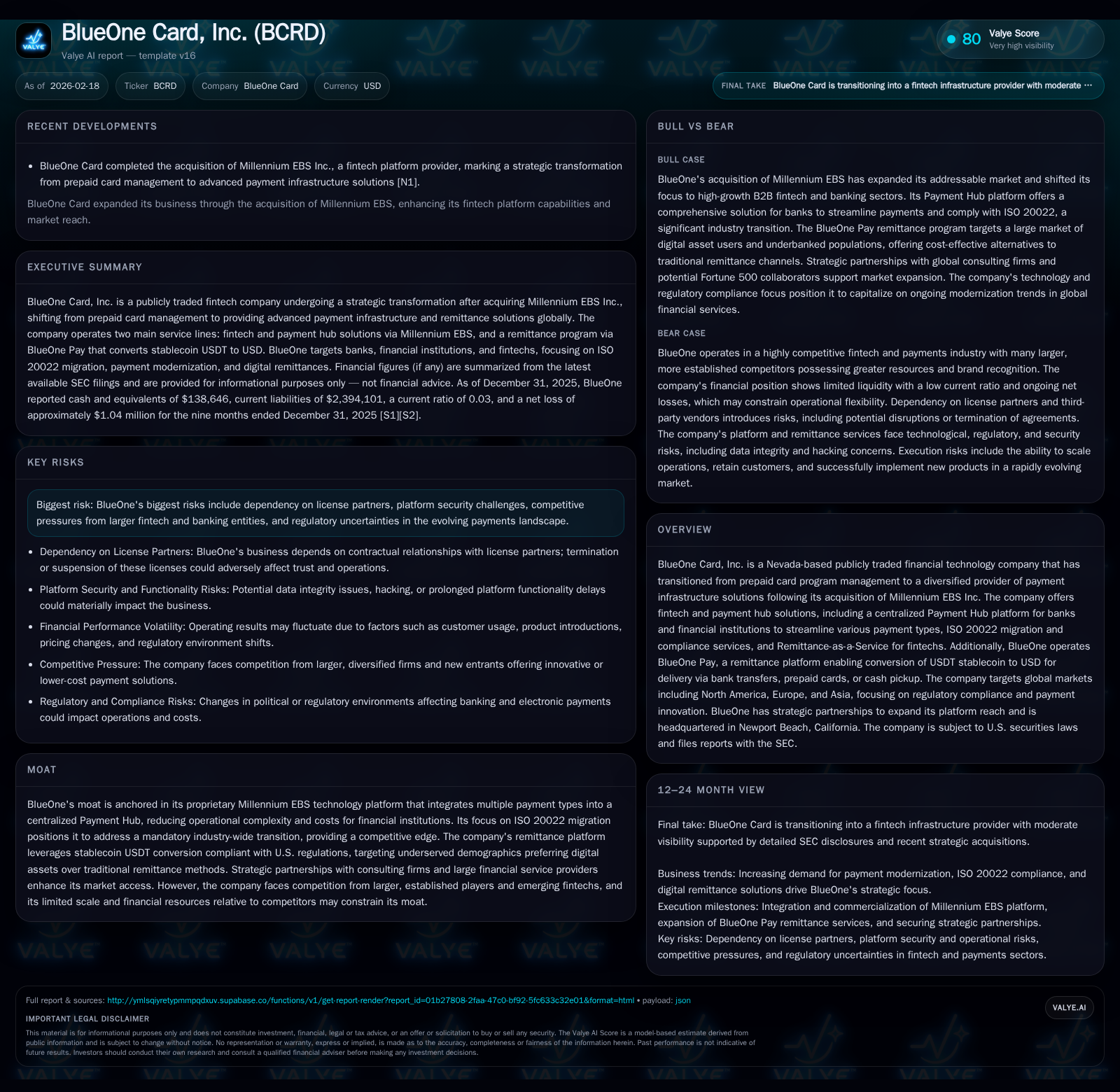
BlueOne Card’s acquisition of Millennium EBS in late 2024 marks a strategic transformation into a fintech payment orchestration and compliance solutions provider targeting banks and fintechs globally. The company’s expanded offering includes a centralized Payment Hub platform, ISO 20022 migration services, and Remittance-as-a-Service. Despite these growth opportunities, BlueOne continues to report significant operating losses and negative cash flows. Critical near-term challenges include successful integration of Millennium’s platform, resolving vendor-bank dependencies, securing additional capital, and expanding client adoption amid competitive pressures.
Company Overview and Historical Context
BlueOne Card, Inc., a Nevada corporation, began as a prepaid card program manager generating modest revenue (~$350K) as of 2011 data [F1]. The company has historically faced challenges scaling this business with sustained operating losses.
Strategic Transformation Following Millennium Acquisition
In December 2024, BlueOne acquired Millennium EBS Inc., a fintech platform provider specializing in payment orchestration technology. This acquisition significantly shifted BlueOne's focus toward B2B payment infrastructure solutions aimed at banks, financial institutions (FIs), processors, and fintech companies globally [N1][S1].
Millennium's proprietary Payment Hub platform centralizes diverse payment types—including ACH, wire transfers, card payments, and real-time payments—into a unified interface that simplifies operations for financial institutions while reducing costs.
A core offering addresses the mandatory global transition to the ISO 20022 messaging standard by accelerating compliance adoption for customers through advanced technology solutions.
Additionally, BlueOne offers Remittance-as-a-Service (RaaS), enabling fintechs to launch cross-border remittance services rapidly. The consumer-facing BlueOne Pay platform supports USDT stablecoin conversions compliant with U.S. regulations facilitating remittances via bank transfer, prepaid cards, or cash pickups.
This portfolio positions BlueOne at the confluence of regulatory-driven demand (ISO 20022 migration) and innovative payment technologies leveraging digital assets.
Financial Performance Overview
Historical performance (annual)
| FY | Net ($) | CFO ($) | OpInc ($) | Capex ($) | Net YoY |
|---|---|---|---|---|---|
| 2025 | -1051243 | -317295 | -1159619 | 333249 | +34.8% |
| 2024 | -1613140 | -1146710 | -1624229 | 333249 | -44.2% |
| 2023 | -1118799 | -331574 | -1113871 | 13500 | -110.8% |
| 2022 | -530827 | -452472 | -528263 | 13500 |
Note: Omitted columns lack sufficient annual XBRL coverage in the provided tags (need ≥2 annual points): Rev, Div, Buybacks. Source: SEC companyfacts cache [F1].
Capital returns and efficiency (annual)
| FY | FCF ($) | ROE% |
|---|---|---|
| 2025 | -650544 | -13.2 |
| 2024 | -1479959 | -659.0 |
| 2023 | -345074 | -241.7 |
| 2022 | -465972 | -579.9 |
Source: SEC companyfacts cache [F1].
*Fiscal years ended March 31.
Revenue beyond early historical data is not available in the provided filings reflecting transitional reporting post-acquisition [F1]. Operating losses remain substantial but show improving trends in FY2025 driven possibly by expense management or initial integration benefits.
Operating cash flows are negative but improved markedly in FY2025 compared to prior years despite steady capital expenditures dedicated mainly to technology investments.
Stockholders' equity increased significantly following capital raises associated with the Millennium acquisition.
Capital Structure and Liquidity Position
As of December 31, 2025 the balance sheet reveals severe liquidity constraints: current liabilities total approximately $2.39 million vastly exceed current assets around $74 thousand yielding a critically low current ratio close to 0.03 [F1]. This indicates potential challenges meeting short-term obligations absent new capital or operational cash flow improvements.
The company has experienced vendor dependency risks; it terminated its primary vendor relationship in late-2023 and engaged a new one in early-2024 but currently awaits banking partner engagement for prepaid card servicing — a key operational dependency [S3][S23].
Loan receivables exceeding $100K have been fully reserved as uncollectible reflecting conservative credit risk assessments [S11][S18].
Competitive Positioning and Moat Analysis
BlueOne’s competitive advantage lies in Millennium EBS’s proprietary centralized Payment Hub technology that integrates multiple payment networks efficiently—a vital capability for financial institutions seeking to modernize fragmented legacy systems.
Expertise in ISO 20022 migration positions BlueOne as a critical partner amid industry-wide regulatory mandates requiring technological upgrades across banks worldwide .
Its Remittance-as-a-Service leverages growing acceptance of stablecoins among underbanked populations seeking cost-effective cross-border remittances.
However, scale limitations relative to major incumbents like FIS or Fiserv and blockchain-native startups constrain competitive positioning.
Dependency on license partners limits market access autonomy while cybersecurity threats inherent in fintech platforms pose ongoing operational risks [S4].
Growth Outlook and Key Catalysts
Potential growth drivers include:
- Scaling adoption of Millennium’s Payment Hub among small- to medium-sized banks consolidating payment processing post-ISO20022 mandates,
- Expansion of RaaS offerings attracting emerging fintech clients,
- Growth in digital asset-based remittance volumes via BlueOne Pay,
- Strategic partnerships enhancing distribution channels,
- Resolution of vendor-bank integrations critical to prepaid card product delivery [N1][S1][S3].
Challenges encompass:
- Persistent capital constraints limiting sales and product development investments,
- Competitive advances from integrated payment platforms,
- Delays or failures in critical vendor-bank technical integrations,
- Regulatory developments potentially restricting stablecoin usage or imposing compliance costs.
Returns and Capital Allocation Summary
BlueOne currently does not pay dividends nor conduct share repurchases reflecting reinvestment focus amid ongoing losses; these metrics are not available from provided tags [F1].
Equity increases stem primarily from capital raises linked to the Millennium acquisition rather than earnings retention given sustained deficits.
Free cash flow remains deeply negative due to ongoing negative operating cash flow combined with steady capex commitments (~$333K annually). Approximate return on equity stands at around -13%, indicating that invested capital has yet to translate into profitability [F1].
Monitoring Points Going Forward
Due to absence of explicit forward guidance,[N#][S#] key indicators will include:
- Customer onboarding milestones for Payment Hub deployments,
- Volume growth metrics for remittance transactions via BlueOne Pay,
- Progress updates on ISO20022 migration projects,
- Status of vendor-bank partnerships enabling prepaid card servicing,
- Announcements regarding capital raises extending financial runway,
- Regulatory developments affecting stablecoin use within remittances,
- Management commentary on pricing strategies or cost controls. These factors will be critical for assessing future operational leverage amidst dynamic industry pressures.
This analysis incorporates publicly available SEC filings through February 18th, 2026 [S#], Nasdaq news coverage [N#], Valye report excerpts provided along with companyfacts XBRL data [F1]. It does not constitute investment advice or endorsement.
Disclaimer: This is research-only, informational analysis and not investment advice. It may include AI-generated interpretation and general industry context. Always verify important details using primary sources.

Comments