
Awaysis Capital Navigates Developmental Losses and Liquidity Challenges Amid Resort Expansion
Focused on branded resort enclave development, Awaysis Capital faces significant near-term debt maturities and ongoing operational cash flow deficits while advancing its flagship projects.
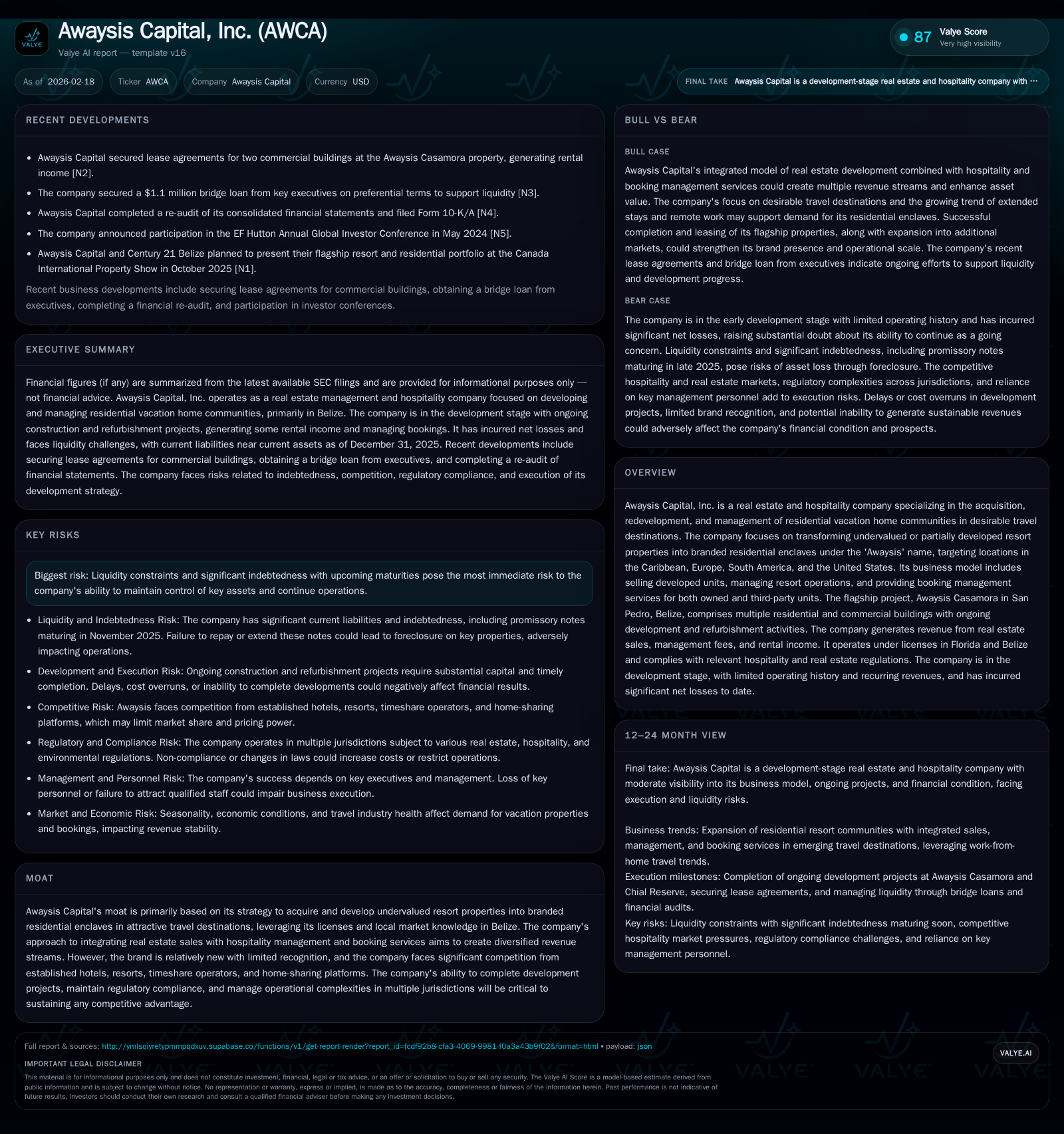
Awaysis Capital, Inc. is a real estate and hospitality company specializing in acquiring and redeveloping undervalued residential vacation communities primarily in Belize, with plans to expand internationally. The company remains in an early developmental stage, reporting persistent operating losses driven by heavy investments in property acquisitions and resort construction, particularly its Awaysis Casamora project. Liquidity constraints are acute with current liabilities near $10 million against $12 million in current assets at the end of 2025, and a significant promissory note of $4.5 million due to an affiliate by November 30, 2025. Operating cash flows remain substantially negative, resulting in large free cash flow deficits after capital expenditures. No dividends or share repurchases are planned as capital allocation prioritizes growth and debt servicing amid financial challenges. Competitive pressures from established hospitality players and regulatory complexities add further risks to the growth outlook.
Company Overview
Awaysis Capital, Inc. operates as a real estate management and hospitality company focusing on acquiring and redeveloping undervalued residential vacation home communities primarily located in Belize with strategic ambitions toward the Caribbean, Europe, South America, and the United States [S1]. Its core concept involves transforming partially developed or underperforming resorts into branded residential enclaves under the "Awaysis" name that cater to extended-stay travelers seeking integrated living, working, and leisure amenities aligned with evolving work-from-anywhere trends.
The flagship property is the Awaysis Casamora resort project situated in San Pedro, Belize. This multi-building development is undergoing phased refurbishment aimed at enhancing unit sales potential alongside growing hospitality operations.
Historical Performance
Since shifting focus to this niche resort acquisition and management model post-2022 following a change in control [S6], Awaysis has incurred consistent operating losses reflecting substantial investments in property acquisition and development phases.
The company reported net losses of approximately $7.1 million for fiscal year 2024 (ending June 30) improving to a $2.7 million loss for fiscal year 2025 (June year-end), indicative of operational scaling challenges typical of early-stage developers engaged in complex projects [F1]. Operating income followed a similar pattern with losses narrowing from about -$7.0 million to nearly -$2.7 million over two years.
Operating cash flow fluctuated markedly: it was positive roughly $0.5 million in FY2024 but reversed sharply to a negative $4.8 million outflow for FY2025 coinciding with increased capital expenditures that surged above $1 million — a significant rise from nominal prior levels—reflecting intensified construction and acquisition activities [F1]. This resulted in an approximate free cash flow deficit exceeding $5.8 million when accounting for capex.
Historical performance (annual)
| FY | Net ($mm) | CFO ($mm) | OpInc ($mm) | Capex ($) | Net YoY |
|---|---|---|---|---|---|
| 2025 | -3 | -5 | -3 | 1042124 | +61.6% |
| 2024 | -7 | 1 | -7 | 2554 | -65.1% |
| 2023 | -4 | 0 | -4 | 54631 | -1690.9% |
| 2022 | 0 | 0 | 0 | 22145 |
Note: Omitted columns lack sufficient annual XBRL coverage in the provided tags (need ≥2 annual points): Rev, Div, Buybacks. Source: SEC companyfacts cache [F1].
Capital returns and efficiency (annual)
| FY | FCF ($mm) | ROE% |
|---|---|---|
| 2025 | -6 | -50.7 |
| 2024 | 1 | -81.1 |
| 2023 | 0 | -73.0 |
| 2022 | 0 | -2.7 |
Source: SEC companyfacts cache [F1].
Note: Revenue data is not available from provided XBRL tags.
The accumulated deficit exceeded $15 million as of mid-2025 despite equity injections primarily from affiliated parties.
Business Model & Revenue Streams
Awaysis generates revenue through multiple avenues:
- Real estate sales: Selling developed units including condominiums and villas within their resorts.
- Management services: Operating resort common areas via their wholly owned management subsidiary on a cost-plus fee basis.
- Booking management: Managing short- and long-term rental bookings for both unsold company-owned units and third-party owners who contract Awaysis for such services.
This diversified approach aims to combine one-time property sales with recurring income streams from management fees and ancillary hospitality services [S16,S13]. Owner financing programs offer buyers mortgage terms typically covering up to half the purchase price while allowing flexible portfolio strategies regarding unit retention or sale [S9].
Development Activity & Operating Leverage
Development requires substantial upfront capital for renovation or completion construction phases which accelerated markedly during FY2025 with capex exceeding $1 million compared to minimal prior spending levels [F1]. Project profitability depends heavily on controlling material and labor costs amid inflationary pressures—a risk acknowledged by management alongside potential delays due to supply chain disruptions or adverse weather conditions that could compress margins or extend timelines [S20].
Liquidity Profile & Debt Structure
Liquidity constraints are prominent as of December 31, 2025: current assets total approximately $12 million versus current liabilities near $10 million resulting in a current ratio of about 1.18 indicating limited short-term cushion [F1].
Key liabilities include promissory notes aggregating roughly $4.5 million maturing November 30, 2025 owed to an affiliate connected to Co-CEO Michael Singh secured by first-priority liens on substantially all assets under management [S4,S22,S27]. Failure to repay or refinance these notes risks loss of critical properties through foreclosure.
Waivers have extended some maturity dates temporarily but no certainty exists regarding long-term refinancing or capital structure stability absent improved operating cash flows or equity raises [S10,S25]. Additional smaller convertible notes held internally add complexity but represent less material sums relative to overall indebtedness [S24].
Competitive Position & Regulatory Environment
Awaysis competes against entrenched hotel chains with loyalty programs; timeshare operators with established sales channels; plus alternative accommodation platforms such as Airbnb fragmenting lodging options [S18]. Brand awareness remains nascent requiring focused marketing efforts.
Regulatory compliance spans multiple jurisdictions involving real estate laws related to title transfers and environmental liabilities alongside hospitality licensing requirements including Belize’s Hotels and Tourist Accommodation Act as well as U.S.-state regulations where applicable—for instance Florida licenses governing real estate services [S8,S19,S21]. Marketing practices must also comply with statutes aimed at preventing unfair trade practices including federal laws such as the USA PATRIOT Act impacting cross-border sales.
Environmental risks include potential contamination liabilities common in redevelopment projects necessitating rigorous due diligence; failure could result in remediation costs despite possible indemnifications embedded within contracts [S17,S19].
Future Growth Prospects & Milestones
Growth prospects depend on:
- Completion of ongoing Casamora build-outs enabling higher unit sales velocity;
- Expansion of hospitality operations driving occupancy gains;
- Strategic acquisitions aligned with geographic expansion targets contingent on capital availability;
- Enhancing global direct marketing supported by owner financing tailored for international buyers;
- Navigating complex regulatory landscapes across multiple countries;
- Maintaining cost discipline amid volatile input prices affecting development schedules.
Near-term upside is limited without liquidity improvements given looming debt maturities; failure may necessitate asset divestitures curtailing organic growth potential [S9,S22]. Potential up-listing events aimed at governance improvements could unlock capital access but remain aspirational currently [S27].
Returns & Capital Allocation Strategy
Return metrics remain negative reflecting ongoing investment phases; approximate return on equity based on trailing net income divided by average equity is about negative 50%, underscoring unprofitability [F1].
The company explicitly does not plan dividends or share repurchases during this developmental phase opting instead to retain earnings—if any—and prioritize reinvestment along with debt servicing obligations amid persistent cash flow deficits [S14,S29].
Key Risks Summary
- Continued net losses pressure liquidity;
- Debt maturities pose risk of asset foreclosure impacting operational continuity;
- Construction delays or cost overruns from supply chain issues could depress profitability;
- Geographic expansion introduces foreign exchange and regulatory compliance risks;
- Limited brand recognition increases marketing costs relative to established competitors;
- Environmental compliance failures carry remediation liabilities affecting financial health.
Analysis / What To Watch Next:
Investors should monitor:
- Developments addressing near-term note maturities including refinancing efforts;
- Progress on Casamora construction milestones;
- Trends in unit sales volumes coupled with booking revenue growth;
- Announcements regarding geographic expansion plans;
- Changes or improvements in capital structure;
- Quarterly operating cash flow indicating movement toward sustainable profitability.
Conclusion
Awaysis Capital represents an early-stage hybrid developer blending real estate acquisition with hospitality management targeting evolving traveler preferences favoring extended-stay lifestyles enabled by remote work trends. While its Belize portfolio anchored by Casamora offers promise alongside diversified revenue streams combining property sales with recurring management fees—the company faces significant near-term liquidity challenges amid large debt maturities that threaten asset control without successful refinancing or operational cash flow improvements.^[F1][S4][S22]
Success depends on timely project execution within budget alongside resolution of refinancing uncertainties that could jeopardize ownership continuity over core assets. Concurrently competitive pressures require continued brand building coupled with navigating multifaceted regulatory regimes—a challenging endeavor given resource constraints inherent at this stage.
Stakeholders should emphasize disciplined capital deployment paired with transparent milestone achievement demonstrating scalability before broader growth can be realized sustainably.
Disclaimer: This analysis is based solely on publicly available SEC filings as of February 18, 2026; it does not constitute investment advice.
Disclaimer: This is research-only, informational analysis and not investment advice. It may include AI-generated interpretation and general industry context. Always verify important details using primary sources.

Comments