
Builders FirstSource Confronts Margin Pressure and Industry Cyclicality After Peak Growth
After several years of robust expansion, Builders FirstSource's latest financials reveal significant earnings compression amid a cooling housing market and aggressive acquisition-driven footprint growth.
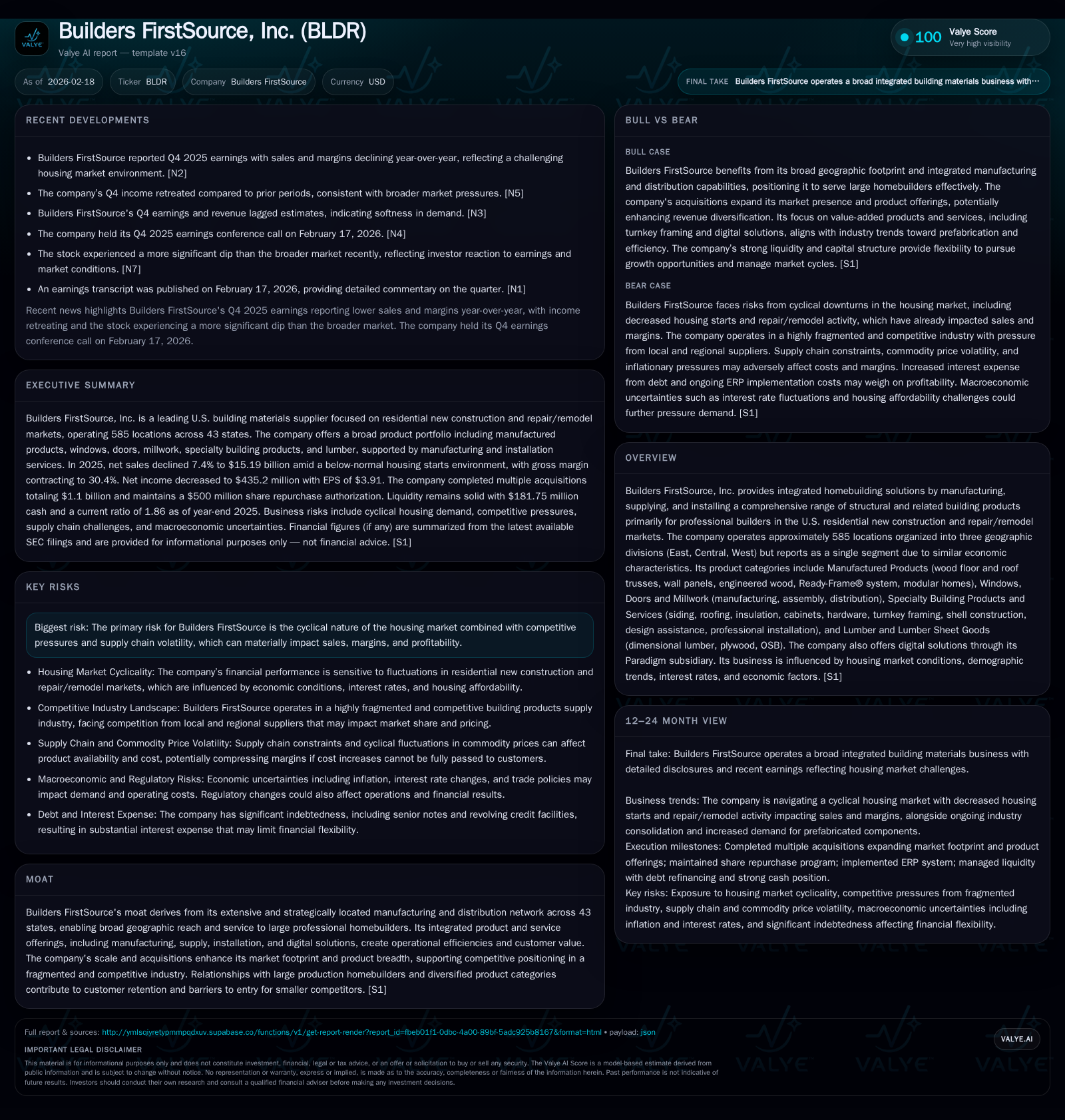
Builders FirstSource (BLDR), a leading integrated homebuilding products supplier and manufacturer in the U.S., has experienced rapid top-line expansion through acquisitions but now faces steep margin headwinds and cyclical pressure as housing demand moderates. Operating income dropped over 50% year-over-year in FY2025, driven by softening volumes and cost inflation from supply chain disruptions. The company continues to invest in capacity and strategic acquisitions, targeting vertical integration and extending its product portfolio beyond single-family homes. Liquidity remains strong with no outstanding revolver debt, though free cash flow declined alongside earnings. Monitoring housing starts trends, margin recovery efforts, and integration success of recent acquisitions will be critical for future performance.
Company Overview and Business Model
Builders FirstSource, Inc. (BLDR) is among the largest integrated providers of structural building products and related services for the U.S. residential new construction and repair/remodel markets. The company manufactures factory-built roof/floor trusses, wall panels, engineered wood products including its proprietary Ready-Frame® system, modular homes components, windows, doors, millwork, siding, roofing materials, insulation, cabinets, hardware and offers turnkey framing and shell construction services.
BLDR operates approximately 585 locations spanning 43 states across three geographic divisions (East, Central, West). Although these divisions facilitate localized management responsive to regional customer needs, financial reporting aggregates all into one segment given largely uniform economics across regions [S1][S4].
Integral to BLDR's model is its extensive network of strategically located manufacturing facilities which produce engineered structural components designed specifically for each customer’s homes. This vertical integration complements distribution of lumber and specialty products sourced externally. On-site professional installation services further deepen BLDR's value proposition by shortening construction cycles — a key priority for builders facing labor shortages.
A notable digital element exists through Paradigm subsidiary software offerings that assist retailers, distributors and builders with estimating, drafting and virtual home design solutions aimed at boosting sales efficiency while reducing costs [S1][S11].
Historical Performance and Growth Drivers
BLDR’s rapid expansion over recent years has been fueled principally by acquisitive growth alongside organic volume gains from core large production homebuilders who dominate market share amid ongoing industry consolidation [S9]. Strategic acquisitions over the past several years have augmented product breadth notably into multi-family wood construction segments and light commercial markets beyond traditional single-family focuses [S9][S21].
Financially the company saw operating income decline from roughly $3.77 billion in FY2022 down to $1.59 billion in FY2024 before plunging sharply by more than half to $786 million in FY2025 — illustrating the pronounced cyclicality underpinning BLDR’s earnings profile amid a more challenging macroeconomic environment marked by higher interest rates and moderated housing demand [F1]. Net income showed an even steeper decline from nearly $2.75 billion in FY2022 to just over $435 million last year (-59.6% YoY) reflecting margin pressures driven by cost inflation and softer volumes coincident with decelerating homebuilding activity [F1].
Historical performance (annual)
| FY | Net ($bn) | CFO ($bn) | OpInc ($bn) | Capex ($mm) | Net YoY |
|---|---|---|---|---|---|
| 2025 | 0.4 | 1.2 | 0.8 | 363 | -59.6% |
| 2024 | 1.1 | 1.9 | 1.6 | 381 | -30.0% |
| 2023 | 1.5 | 2.3 | 2.2 | 476 | -44.0% |
| 2022 | 2.7 | 3.6 | 3.8 | 340 |
Note: Omitted columns lack sufficient annual XBRL coverage in the provided tags (need ≥2 annual points): Rev, Div. Source: SEC companyfacts cache [F1].
Capital returns and efficiency (annual)
| FY | Buybacks ($bn) | FCF ($bn) | ROE% |
|---|---|---|---|
| 2025 | 0.4 | 0.9 | 10.0 |
| 2024 | 1.5 | 1.5 | 25.1 |
| 2023 | 1.8 | 1.8 | 32.6 |
| 2022 | 2.6 | 3.3 | 55.4 |
Source: SEC companyfacts cache [F1].
*Note: Revenue data is not available from provided tags; buybacks reflect payments for share repurchases.
This performance trajectory underscores BLDR’s sensitivity to housing start cycles as well as raw material price fluctuations—particularly lumber commodity swings—which can compress gross margins if cost increases cannot be promptly passed through customers [S8][S24].
Industry Positioning and Competitive Advantages
Builders FirstSource’s competitive moat is anchored by:
- Scale and Integration: An expansive footprint of manufacturing plants close to customers enabling customized engineered products paired with broad distribution capabilities.
- Comprehensive Product Suite: Value-added components including turnkey framing and installation services capture broader wallet share from national/regional builders.
- Digital Tools: Paradigm software solutions enhance operational efficiencies aiding customer loyalty.
- Strong Customer Relationships: Deep ties with large production builders benefit from consistent quality supply chains amid fragmented competition.
These factors limit smaller competitors’ ability to scale both geographically and across product lines while strengthening BLDR's bargaining leverage within supply chains [S1][S9].
Market Risks
Key risks stem from the cyclical nature of U.S residential construction influenced by:
- Mortgage interest rate fluctuations affecting buyer affordability.
- Housing demand variability tied to demographic shifts such as household formation rates.
- Inflationary input cost pressures combined with supply chain uncertainties.
- Intensifying competition despite ongoing industry consolidation.
Prolonged downcycles or mispricing of commodities could materially erode operating margins given timing lags between raw material cost changes and customer pricing adjustments [S8][N2][N3].
Recent Strategic Developments
In calendar year 2025 alone, BLDR completed multiple bolt-on acquisitions totaling approximately $1.1 billion including Alpine Lumber Company and O.C. Cluss Lumber Company that expanded geographic presence primarily in value-added product categories such as trusses and panels commanding higher margins than commodity lumber distribution [S21][N1]. Early January 2026 saw an additional acquisition of Premium Building Components enhancing eastern New York operations [S21].
Financially, no borrowings were outstanding under the $2.2 billion revolving credit facility at year-end with liquidity totaling about $1.7 billion offering operational flexibility despite elevated leverage levels supported by long-term fixed-rate notes issued recently [F1][S13][S17].
Capital return discipline continues with $414 million spent on share repurchases in FY2025 while authorizing further buyback programs totaling $500 million—reflecting confidence in intrinsic value despite short-term earnings softness [F1][S21]. Dividends paid data is not available from provided tags.
Outlook: Growth Opportunities vs Constraints
Near-term headwinds persist as U.S housing starts are forecasted lower amid elevated mortgage rates restricting affordability per industry composites like NAHB and John Burns Research [S9], yet BLDR anticipates sustained long-term demand driven by historically underbuilt housing inventory coupled with natural population growth.
Growth avenues include expanding penetration into multi-family wood construction segments where prefabricated components offset labor shortages alongside growing turnkey framing solutions allowing incremental value capture beyond commodity distribution stabilizing margin floors over time [S9][N6]. Digital tool adoption remains central for tighter supply chain integration improving forecasting accuracy.
Margin recovery hinges on supply chain stabilization permitting smoother passthroughs of commodity inflation without adverse backlog-related cost absorption; competitive pricing pressures require careful account management especially among large production builders maintaining profitability thresholds [N2][N3][N6].
Monitoring key indicators such as housing starts trajectories, lumber pricing trends, acquisition integration progress, margin initiatives effectiveness, and capital deployment toward synergistic M&A will be essential for assessing future outlook.
Capital Structure & Returns
BLDR maintains a multi-billion-dollar revolving credit facility ($2.2B limit extended through May 2030) currently undrawn reflecting robust liquidity while long-term debt includes various fixed-rate senior unsecured notes ranging ~4.25%–6.75% maturing through mid-2030s providing interest cost stability albeit at higher coupon rates typical within cyclically exposed building materials sector balance sheets facing risk premiums [F1].
The balance sheet shows approximately $4.35 billion equity supporting ~$4+ billion liabilities indicating moderate leverage balancing growth ambitions against financial flexibility needs.
Steady execution of sizeable share repurchases since August 2021 totaling nearly half of outstanding shares evidences shareholder return prioritization alongside managed reinvestment into capex (~$360 million annually recently) focused on capacity preservation rather than major expansion during current cautious market conditions [F1][S21]. Dividends paid information is not available from provided tags.
Return metrics include an approximate ROE near 10% for FY2025 based on net income relative to equity; free cash flow (operating cash flow less capex) was about $853 million last year supporting continued investment capacity despite earnings headwinds [F1].
Conclusion
Builders FirstSource stands at an inflection point following several years of vigorous acquisitive scaling bolstered by favorable industry tailwinds now confronting cyclical softness exacerbated by inflationary input costs squeezing margins notably in FY2025 results.
Long-term fundamentals remain supported by demographic drivers and housing undersupply combined with strategic moves into multi-family sectors aligned with labor shortage trends providing pathways toward margin stability with extended revenue streams; however vigilance toward acquisition integration execution risks alongside working capital management amid volatile commodity markets is warranted.
Stakeholders should track evolving macroeconomic indicators influencing builder activity levels along with company initiatives targeting margin remediation leveraging digital/specialty product advantages crucial for sustaining competitive edge within this fragmented yet scale-favoring sector.
Disclaimer: This analysis is provided solely for informational purposes without any investment recommendation or advice regarding Builders FirstSource or any securities mentioned herein.
Disclaimer: This is research-only, informational analysis and not investment advice. It may include AI-generated interpretation and general industry context. Always verify important details using primary sources.

Comments