
First American Financial Posts Strong Rebound With Strategic Expansion in Title Services
FAF's 2025 performance highlights a sharp financial recovery fueled by title insurance strength and technology-driven efficiencies.
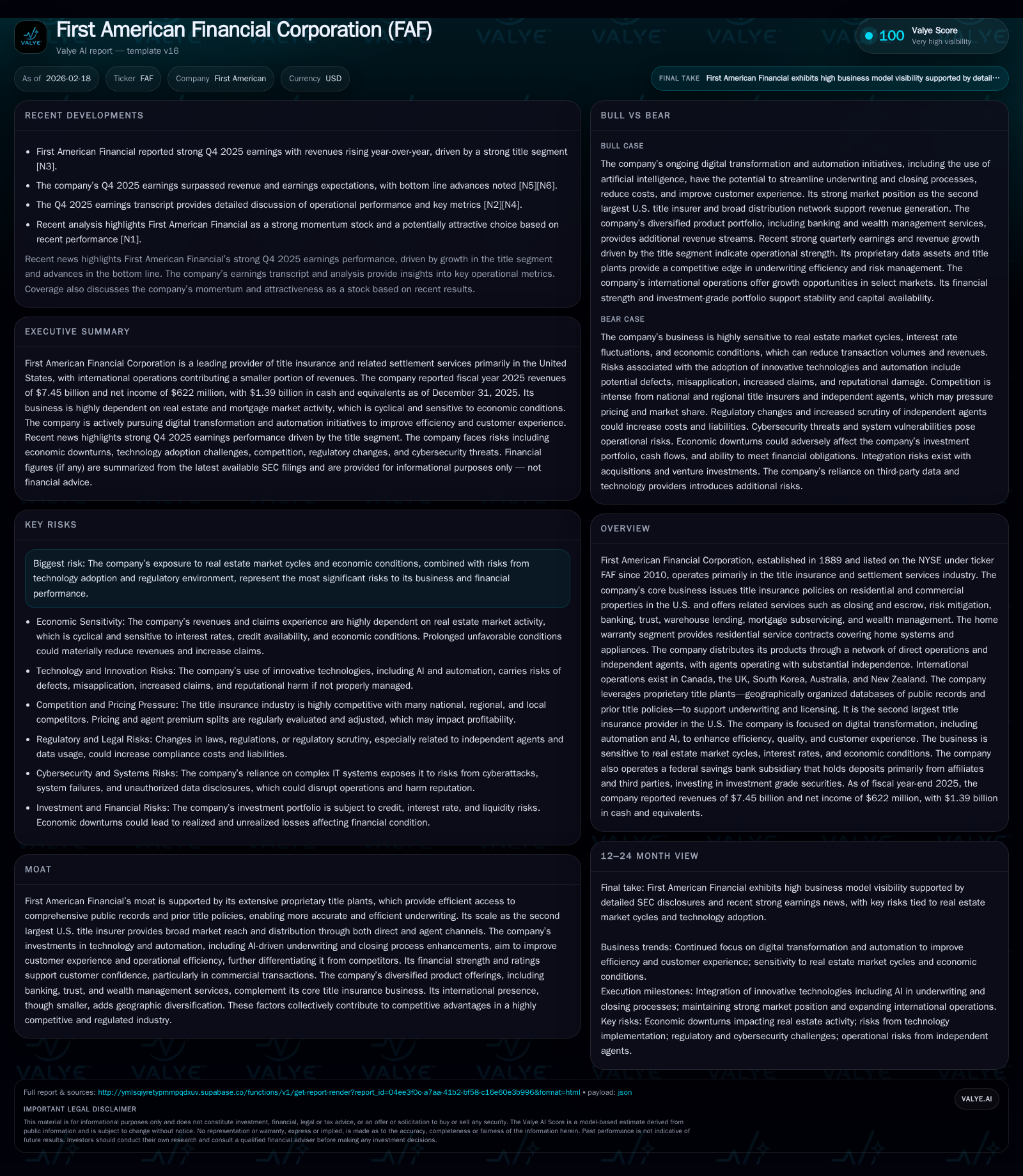
First American Financial Corp recorded a robust rebound in fiscal 2025, with revenue rising 21.6% and net income surging 374% year-over-year, underscoring improved margins and risk management. The firm's moat remains anchored in its proprietary title plants and expanded use of AI to streamline underwriting and closing processes. While the U.S. residential real estate market dynamics will largely dictate near-term growth, FAF's smaller international operations and venture investments offer complementary avenues for expansion. Regulatory complexity and cyclical real estate exposure pose ongoing challenges, balanced by steady cash flow generation and disciplined capital deployment, including dividends and buybacks.
A Resilient Turnaround: Evaluating Historical Financial Performance
First American Financial Corp demonstrated a notable recovery in fiscal year 2025 following a period of muted growth between 2023 and 2024. Revenue increased sharply by 21.6% from $6.13 billion in FY2024 to $7.45 billion in FY2025 [F1]. This rebound was primarily driven by robust performance within its title insurance segment, which accounts for the vast majority of the company's business.
More impressively, net income expanded from $131 million in FY2024 to $622 million in FY2025—a staggering rise of over 370%—reflecting substantial margin improvement likely due to reduced claims exposure as well as operational efficiencies [F1]. Operating cash flow grew moderately by nearly 6% year-over-year to $951 million while capital expenditures declined by nearly 14%, evidencing more disciplined capex spending or optimization of investment outlays [F1]. The free cash flow generated was approximately $763 million.
This financial trajectory underscores how FAF managed to rebound effectively from prior years’ constraining factors such as volatile real estate markets and claims noise.
Historical performance (annual)
| FY | Rev ($bn) | Net ($mm) | CFO ($mm) | Capex ($mm) | Rev YoY | Net YoY |
|---|---|---|---|---|---|---|
| 2025 | 7.5 | 622 | 951 | 188 | +21.6% | +374.3% |
| 2024 | 6.1 | 131 | 898 | 218 | +2.1% | -39.5% |
| 2023 | 6.0 | 217 | 354 | 263 | -21.1% | -17.6% |
| 2022 | 7.6 | 263 | 780 | 260 |
Note: Omitted columns lack sufficient annual XBRL coverage in the provided tags (need ≥2 annual points): OpInc. Source: SEC companyfacts cache [F1].
Capital returns and efficiency (annual)
| FY | Div ($mm) | Buybacks ($mm) | FCF ($mm) |
|---|---|---|---|
| 2025 | 223 | 122 | 763 |
| 2024 | 221 | 69 | 679 |
| 2023 | 217 | 73 | 91 |
| 2022 | 217 | 441 | 520 |
Source: SEC companyfacts cache [F1].
Note: Operating income not available; ROE approximated as net income divided by equity.
Segment Dynamics: Title Insurance at the Core
FAF’s business is heavily concentrated in the title insurance and services segment, which contributed over 93% of consolidated revenues in recent years [S8]. This segment spans issuance of title policies on residential and commercial properties across the U.S., supported by settlement services such as escrow processing, closing services, tax-deferred exchanges facilitation, banking/trust offerings, mortgage subservicing, risk mitigation products, lien release assistance, document custodial services, valuation products including appraisals, warehouse lending solutions, and wealth management services [S8][S12].
The title insurance industry is inherently cyclical given its reliance on real estate transaction volumes influenced by interest rates and economic conditions [S19]. Residential purchase activity shows seasonality with slower winter months while refinancing fluctuates with mortgage rate changes.
While FAF leverages direct sales channels targeting real estate brokers/agents and mortgage originators for residential transactions, it also maintains relationships with commercial principals, REITs, life insurers and law firms for commercial title transactions [S19]. Competition centers on service quality, price competitiveness including agent premium splits, geographic reach with major competitors being Fidelity National Financial among others [S15].
Automation has been increasingly applied within the closing/escrow process to speed transactions without sacrificing compliance or accuracy—a critical differentiator for customer satisfaction [S6][S8].
Leveraging Proprietary Title Plants and AI for Operational Efficiency
A cornerstone of First American's moat lies within its proprietary 'title plants'—geographically organized databases indexing public records alongside prior title insurance policies—which afford significant efficiency advantages over traditional public record searches arranged by party names alone [S18]. These assets enable accelerated accurate underwriting critical for timely closings.
The company has further invested extensively in integrating artificial intelligence tools aimed at automating underwriting workflows such as risk assessment algorithms that can flag issues proactively or reduce manual examination burdens [N1][S6]. Automated closing process enhancements not only shorten cycle times but also improve communication transparency between stakeholders.
FAF manages underwriting authority across multiple levels—from local state underwriters up to regional groups—supported by automated decisioning tools diminishing human error risks while allowing nuanced judgment where necessary [S2]. The integration of these technological enhancements helps maintain competitive pricing flexibility while safeguarding underwriting loss ratios.
Growth Prospects Amid Residential Market Trends and International Footprint
Looking ahead, FAF’s growth trajectory remains closely tied to U.S. residential real estate market activity which drives most title insurance volume as well as home warranty contract sales covering appliance/systems failures—another component sensitive to housing turnover rates [N1][S19]. Rising interest rates introduce headwinds causing potential softness or volatility in purchase/refinance activities.
On the international front, FAF operates notably smaller scale businesses across Canada, United Kingdom, South Korea, Australia, and New Zealand accounting for roughly 7-8% of segment revenues but constituting a strategic foothold for expansion opportunities especially through customized processing offerings tailored toward British Commonwealth markets where it combines title insurance with conveyancing acceleration services [S18].
Supplementing organic expansion are venture investments selectively made into early-stage real estate technology companies focusing on digitization or risk analytics—aimed at capturing structural shifts enabled by technology adoption within the property ecosystem [S6].
However, macroeconomic uncertainties including potential regulatory interventions affecting government-sponsored enterprises like Fannie Mae/Freddie Mac could alter demand dynamics or service requirements impacting FAF’s core market segments [S11][N2].
Navigating Regulatory Complexity and Enterprise Risk Management
First American faces significant regulatory complexity given its operations across multiple jurisdictions under federal,state,and foreign regulatory regimes regulating licensing,status reporting,title insurance rate making,data protection,and consumer financial protection practices [S4][S10][S24]. Increased scrutiny results from heightened oversight by entities such as Consumer Financial Protection Bureau (CFPB), state departments of insurance,and attorneys general enforcing consumer protection statutes among others[S11][S17].
Compliance obligations extend into data privacy/security frameworks given extensive personal data processing inherent in property transaction activities[S24], compelling substantial investments in cybersecurity infrastructure such as firewalls,endpoint protections,and behavior analysis tools[S20].
Enterprise risk management consists of dedicated teams covering disaster recovery,treasury/legal/vendor management,human resources,and model risk management(S2). Localized underwriting autonomy requires robust controls supported by automated underwriting systems mitigating mispricing or excessive risk acceptance [S2][S21].
Ongoing legal exposures include class action lawsuits common within this industry addressing alleged procedural or regulatory violations reflecting operational risks inherent in claims settlement processes[S17][S23]. Regulatory mandates sometimes hamper capital flexibility—potentially constraining dividend payments or share repurchases during downturns[S9][S26].
Capital Deployment: Dividends, Buybacks, and Cash Flow Generation
FAF generated operating cash flow of $951 million during FY2025 while capital expenditures were contained at $188 million resulting in free cash flow near $763 million—a strong liquidity profile enabling steady shareholder returns alongside strategic investments[F1].
Dividend payouts remained consistent around $220-$223 million annually demonstrating commitment to rewarding shareholders even amidst cyclical pressures.FY2025 share repurchases expanded modestly to $122 million versus previous years reflecting calibrated capital deployment balancing buybacks against reinvestment needs[F1].
Equity rose steadily peaking at approximately $5.5 billion end-2025 while estimated return on equity hit around an attractive ~11.3%, signaling solid profitability considering current industry constraints[F1]. Moving forward,this balanced approach supports funding both acquisitions expanding FAF’s market share,and investments enhancing data capabilities/technology platforms[S8].
Innovation as a Growth Lever: Digital Transformation and Venture Investments
Emphasizing innovation,the company prioritizes digital transformation initiatives incorporating AI-driven underwriting engines automating labor-intensive tasks,reducing turnaround times,and improving accuracy[S6]. Closing process improvements leverage bank-related flexible financing solutions streamlining fund transfers enhancing client convenience.[S6]
A thoughtful intellectual property strategy combining patents,trademarks,copyrights,and trade secrets guards these technological advances protecting competitive positioning[S6]. Concurrently,the company's venture investment portfolio targets disruptive startups advancing real-estate software/data analytics functionalities aligned strategically perhaps offering future monetization pathways[S6].
These efforts reflect management's long-term vision to differentiate beyond commoditized insurance products towards integrated technology-enabled service offerings fostering deeper client engagement.
Key Metrics to Monitor: What’s Next For FAF Investors?
Investors tracking FAF should closely watch upcoming quarterly earnings reports focusing on metrics like underwriting loss ratios that directly affect profitability[N3]. Regulatory developments relating to data privacy/compliance or titling regulations especially from key states such as California or Florida may impact pricing power or operational scope[S11][S17]
Real estate market cycles remain critical; any material fluctuations in U.S. home sales/refinances will echo through premium volumes influencing revenue trends[N1][N2]. Additionally,the pace of digital adoption effectiveness reflected through improved turnaround times or enhanced customer satisfaction scores may signal sustainability of technological moats.
Capital allocation decisions including potential shifts in dividend policy or opportunistic acquisitions will reveal confidence levels amid macroeconomic backdrop[N3]. Continued monitoring of technological investments' returns will be vital since these initiatives underpin differentiation thresholds critical for long-term competitive positioning.
All information presented reflects data available as of February 18, 2026. This analysis is intended solely for informational purposes without providing investment advice or recommendations.
Disclaimer: This is research-only, informational analysis and not investment advice. It may include AI-generated interpretation and general industry context. Always verify important details using primary sources.

Comments