
Manitowoc Co: Strategic Shift Toward Aftermarket Fuels Growth but Net Income Challenges Persist
Manitowoc transitions to a customer-centric aftermarket model amid modest profit gains and capital deployment scrutiny.
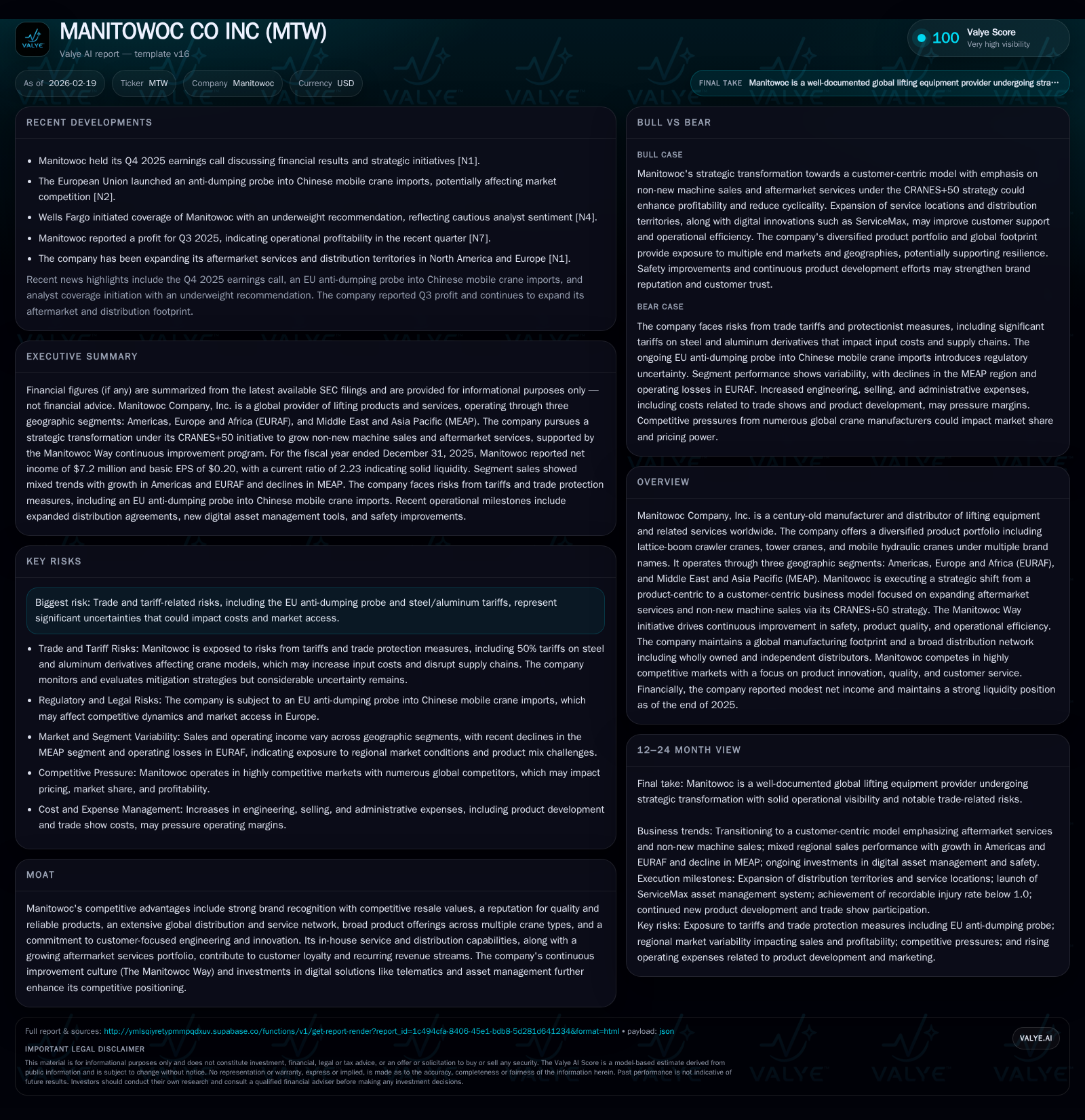
Manitowoc Company, a historic crane manufacturer, is actively reshaping its business with the CRANES+50 strategy aimed at expanding higher-margin aftermarket services. Despite operational improvements and a stabilization of revenues, net income remains constrained by elevated costs and significant capital expenditures. The company’s diversified crane portfolio across geographic segments continues to support order growth, but trade tariffs and supply chain complexities pose margin pressures. Capital allocation reflects disciplined debt management but free cash flow and returns on equity (ROE) stay subdued amid ongoing investments in expansion and service capabilities.
Legacy Growth Trajectory and Recent Financial Performance
Manitowoc's financial history over the past four years illustrates a significant turnaround from substantial losses to restrained profitability amid operational shifts. In FY2022, the company reported an operating loss of $93 million alongside a net loss of $124 million as it navigated volatile market conditions. By FY2023, operating income rebounded sharply to $92.4 million with net income rising to $39.2 million — reflecting recovery driven by restructuring efforts and market stabilization.
Growth moderated in FY2024-25 with operating income increasing marginally by 3.9% to $53.8 million in FY2025 from $51.8 million in FY2024. Net income contracted steeply by 87.1% to $7.2 million in FY2025 due to elevated expenses despite revenue improvements.
Operating cash flow declined from $77 million in FY2022 to $22 million in FY2025 as sustained capital expenditures absorbed free cash resources, resulting in an approximate negative free cash flow of $15 million recently [F1].
Historical performance (annual)
| FY | Net ($mm) | CFO ($mm) | OpInc ($mm) | Capex ($mm) | Net YoY |
|---|---|---|---|---|---|
| 2025 | 7 | 22 | 54 | 38 | -87.1% |
| 2024 | 56 | 49 | 52 | 46 | +42.3% |
| 2023 | 39 | 63 | 92 | 77 | +131.7% |
| 2022 | -124 | 77 | -93 | 62 |
Note: Omitted columns lack sufficient annual XBRL coverage in the provided tags (need ≥2 annual points): Rev, Div. Source: SEC companyfacts cache [F1].
Capital returns and efficiency (annual)
| FY | Buybacks ($mm) | FCF ($mm) | ROE% |
|---|---|---|---|
| 2025 | 0 | -15 | 1.0 |
| 2024 | 6 | 4 | 8.7 |
| 2023 | 6 | -14 | 6.5 |
| 2022 | 3 | 15 | -23.0 |
Source: SEC companyfacts cache [F1].
Note: Revenue data is not available in the provided tags.
The sharp net income decline in FY2025 reflects cost pressures including higher engineering and administrative expenses aligned with ongoing product development and repositioning efforts.
Strategic Pivot: The CRANES+50 Initiative and The Manitowoc Way
Central to Manitowoc’s transformation is its CRANES+50 strategy launched in 2021, shifting focus from traditional new equipment sales toward expanding aftermarket services such as parts sales, maintenance contracts, rentals, remanufacturing (EnCORE®), training, and telematics platforms like Grove CONNECT and Potain CONNECT [S1].
This aims for long-term non-new machine sales exceeding $1 billion annually—a more profitable segment due to lower capital intensity and recurring revenue characteristics.
Simultaneously, The Manitowoc Way embeds continuous improvement practices emphasizing safety excellence (targeting recordable injury rates below industry benchmarks), accelerated product development cycles (reducing tower crane development from typical 18–24 months down to approximately 12–14 months), operational efficiency gains including lead-time compression, and adoption of digital innovations such as ServiceMax inventory management launched late-2025 [S1,S24].
With over 500 certified technicians globally supported by an extensive distribution network including wholly owned MGX Equipment Services in the U.S., Manitowoc targets deeper customer retention through superior total cost of ownership advantages—focusing on reliability, competitive resale values, energy/resource efficiencies, maintenance savings, and responsive technical support.
Geographic Segments and Product Portfolio Dynamics
Operations are divided into three reportable segments:
- Americas (North & South America)
- EURAF (Europe & Africa)
- MEAP (Middle East & Asia Pacific)
The Americas segment drives aftermarket expansion via acquisitions like Aspen Equipment Company and MGX Equipment Services—enhancing distribution reach and field technician depth across key U.S. states along with rental fleet growth [S9]. For nine months ended September 30, 2025, Americas net sales rose ~2.5% year-over-year ($889M vs $867M prior year), mainly due to $32.6M higher non-new machine sales offsetting lower new crane shipments [S17,S26]. Operating income was pressured by lower manufacturing volume absorption but aided by favorable product mix.
EURAF shows mid-cycle growth opportunities emphasizing tower cranes designed for Belt and Road infrastructure projects especially within Middle Eastern markets—a fast-growing region reflected in +28.7% quarterly net sales growth primarily driven by new tower crane deliveries plus sustained non-new machine sales gains [S6,S19,S26]. Product development cadence accelerated via streamlined engineering processes under The Manitowoc Way.
MEAP experienced softer performance with a ~24% decline chiefly due to weak new machine sales linked to unfavorable product mix; however operating profit grew year-over-year through better cost controls despite volume headwinds [S17,S29].
Product lines include:
- Lattice-boom crawler cranes (Manitowoc brand) mainly for heavy construction applications concentrated in North America.
- Tower cranes (Potain brand) featuring top-slewing hammerhead/topless/luffing jib types suited for skyscrapers/nuclear/semiconductor plants produced primarily across France/Portugal/China/India.
- Mobile hydraulic cranes (Grove/National Crane/Shuttlelift brands) offering versatile all-terrain capabilities increasingly integrated with telematics for uptime monitoring [S16,S25].
Trade Tariffs and Supply Chain Challenges Impacting Margins
Trade protection measures continue posing headwinds including U.S.-imposed tariffs up to 50% on steel/aluminum derivatives affecting critical crane component inputs [S2]. The UK benefits from reduced tariff rates (~25%) but overall tariff-induced cost inflation pressures margins especially for imported materials containing steel/aluminum/copper.
Supply chain disruptions persist due to reclassification of products under derivative tariff codes requiring sourcing adjustments; "supply chain diversification" initiatives aim to mitigate reliance on high-cost suppliers [S14]. Pricing elasticity concerns arise as customers seek cost-effective alternatives or delay purchases amid competitive bidding dynamics.
Management actively pursues dynamic pricing adjustments while balancing market share preservation against margin erosion risks.
Capital Structure, Liquidity Position, and Returns Analysis
As of September 30, 2025:
- Total debt approximated $500 million comprising $177 million revolver borrowings (+123% vs prior year), $300 million senior secured second lien notes due in 2031 plus other debts totaling ~$28 million.
- Cash balances stood near $40 million with total liquidity around $213 million indicating sufficient buffers for near-term obligations [S4,S5].
No share repurchases occurred in FY2025 versus modest buybacks ($5.7 million) in prior year; dividend payments remain minimal or discontinued post-FY2014 reflecting conservative cash deployment amid pressure on free cash flow [F1].
Adjusted Return on Invested Capital (ROIC) stands at about 4.8%, significantly below targeted long-term aspirations (~15%), evidencing constrained capital efficiency primarily due to low net income margins combined with substantial invested capital including manufacturing assets [F1,S27].
Capital expenditures remain elevated though declining year-over-year ($37M FY25 vs $45M FY24), supporting rental fleet expansions and product development pipelines but contributing to negative free cash flow challenging shareholder returns or reinvestment tradeoffs.
Market Outlook Signals & Backlog Trends
While explicit guidance is not publicly disclosed, management highlighted a +15.7% increase in Q3-2025 orders compared with prior year driven mainly by Americas segment growth alongside robust tower crane demand within EURAF regions reinforcing positive near-term revenue outlook [N1,S26]. Backlog increased modestly by ~2.5%, providing visibility into upcoming revenues albeit tempered by softer MEAP volumes.
Monitoring backlog evolution alongside incremental aftermarket revenue share gains is critical as these signal potential medium-term margin resilience given aftermarket services’ higher profitability relative to cyclical new equipment sales.
Aftermarket Services Expansion as Stability Driver
Aftermarket services underpin CRANES+50 strategy aiming to smooth cyclicality typical of heavy machinery sectors.
Services include parts/accessories distribution optimized via global parts centers enhancing fulfillment velocity reducing downtime; certified technical teams provide remote diagnostics/troubleshooting plus onsite repair/maintenance ensuring equipment meets original specifications [S16,S24].
Digital telematics solutions like Potain CONNECT/Grove CONNECT aggregate real-time data enabling predictive maintenance scheduling which supports uptime assurance while enabling monetization through subscription models locking recurring revenues beyond one-off equipment sales.
Expanding rental fleets across Americas/EURAF enhance flexible access models preferred by customers wary of ownership costs elevating recurring service revenues less reliant on direct capex investments translating into steadier cash flows over time.
Competitive & Regulatory Risks With Mitigations
Manitowoc operates amid intense competition from global peers such as Liebherr, XCMG, Tadano among others underscoring the need for maintaining strong brand equity supported by quality engineering innovation fostering differentiation yet requiring continuous investment vigilance [S7].
Tariff volatility remains a material regulatory risk given evolving geopolitical trade negotiations affecting raw material imports; mitigation includes geographic supplier diversification enhancing supply chain resilience against prolonged disruptions or cost shocks [S14].
Success depends on agile execution embracing The Manitowoc Way continuous improvement ethos aligning safety/productivity gains with timely regional product introductions reinforcing differentiated value propositions backed by robust aftermarket ecosystems.
This analysis relies exclusively on Manitowoc Company Inc.'s publicly filed documents including recent earnings calls transcripts and SEC filings through February 19th, 2026,[F1],[N1],[S#], without extrapolation or investment advice.
Disclaimer: This is research-only, informational analysis and not investment advice. It may include AI-generated interpretation and general industry context. Always verify important details using primary sources.

Comments